The Road to Authoritarianism in Turkey — and What it Can (and Can’t) Tell us about Trump
If you’re anything like me, you have probably given some thought in the past year or two to the question of authoritarianism. Donald Trump has long barely hidden his strongman ambitions. Unlike in his first term, however, Trump has used his second term to make good on his authoritarian aspirations. As a result, a veritable cottage industry has emerged seeking to understand Trumpism in comparison to other authoritarian projects. We have probably all encountered breathless comparisons of Trumpism to twentieth century fascism. Portraying Trump as Hitler-adjacent probably has some political utility in galvanizing opposition to meet the direness of the moment. But I largely agree with critics of the Trump-as-fascist critique that fascism was a historical phenomenon unique to the mid-twentieth century with limited use as an analytical category.
Comparisons have also been drawn between Trump and more contemporary examples of democratic backsliding and authoritarian consolidation in Russia, Hungary, and Turkey. But how instructive are these examples in making sense of what we are currently witnessing in the United States? I don’t know much about the history of authoritarian consolidation in Russia and Hungary. But I do know a fair amount about Turkey. In this two-part piece, I examine the authoritarian rise of Turkey’s current president and erstwhile prime minister, Recep Tayyip Erdoğan.
I think Turkey is an especially instructive example for a number of reasons. Having spent a great deal of time in both Turkey and the United States, I have always felt that the two societies share certain affinities that are often overlooked. Both are, by the standards of Western-oriented democracies, relatively socially conservative. Both societies are capable of remarkable warmth and openness while also being prone to chauvinistic—and at times violent—expressions of national pride. And, at least until recently, Turkey’s democratic institutions—while brittle and imperfect—more closely resembled those of the United States than those of Russia, or even Hungary. Competitive elections mattered, claims to legitimacy were made using democratic language, and civil society was generally strong and independent.
At the same time, its political system is far more centralized than the US. Americans rightfully recoil at the idea of Washington controlling elections and running police forces everywhere from the biggest cities to the smallest villages. Both are the reality in Turkey. Plenty of obstacles existed to an authoritarian takeover in Turkey, but these were much weaker than those that exist in the United States.
Yet Erdoğan’s road to autocratic power was a winding one, requiring a great deal of patience, the ability to handle setbacks, and a disciplined approach to managing and maintaining popular support. If Erdoğan provides a roadmap to consolidating power, it is not one that Trump has bothered to follow, I think to the detriment of his ambitions. Turkey is an instructive reminder that there is no instant “dictator” button. Transforming a democracy—even an imperfect one—into a dictatorship requires coalition building, a willingness to tolerate strange bedfellows, and, most importantly, good poll numbers. The difficulties Erdoğan faced in transforming Turkey into a dictatorship are a major reason I am skeptical that Trump can succeed in doing the same in the United States.
In Part I, I explore the early years of Erdoğan’s rule, when Erdoğan was widely perceived, both at home and abroad, as a democratic Islamist. Part II will examine Erdoğan’s rule from 2011 to the present, an era marked by crisis and accelerated democratic backsliding.
I. Rise to Power
Erdoğan rose to power in a fractured and fractious political environment. He was elected mayor of Istanbul in 1994 as a member of the conservative Islamist Welfare Party. His political mentor, Necmettin Erbakan, became Prime Minister as part of a coalition government. Erdoğan’s rise to the Istanbul mayoralty and Erbakan’s premiership represented a major challenge to the entrenched secular elite that claimed to represent the legacy of the Republic of Turkey’s founder, Mustafa Kemal Atatürk, and tied itself closely to the Turkish military. In 1997, Erbakan was forced to resign in a military-led “post-modern coup,” with no tanks rumbling through the streets. Erdoğan was forced to resign the mayoralty the following year and later would spend time in prison following his conviction for “inciting violence and religious hatred” after reciting a poem at a rally denouncing Erbakan’s removal.
Erdoğan’s hands, however, were firmly on the pulse of Turkish politics. The 1990s and early-2000s were defined by high inflation and a sputtering economy ruled over by a feckless political elite. The environment was perfectly suited for an outsider promising change. Erdoğan had rebranded himself following his brief imprisonment. He was no longer the second banana in a political party led by his mentor. Instead, in 2001, he and a couple of other castoffs from the Welfare Party started a new political organization, the Justice and Development Party (AKP). The AKP was less outwardly Islamist than Welfare and openly embraced the politics of Washington Consensus market liberalism.
To an American audience, AKP’s politics might have resembled that of the Texas Republican Party, whose most prominent figure, George W. Bush, had just assumed the presidency in the United States. And in the parliamentary elections of 2002, the AKP, with Erdoğan as its leader, found some of its greatest support in the so-called “Anatolian Tigers”, boom towns in the Turkish interior dominated by conservative businessmen who resented the Kemalist elite of Istanbul and Ankara. The AKP won a decisive majority in that year’s parliamentary election and, after some legal wrangling, Erdoğan assumed the premiership in the spring of the following year.
II. The Tightrope Walker
Turkey possesses a very different political structure than the United States. Power is highly centralized. Power over elections and policing are tightly controlled by Ankara. Turkey’s provinces and municipalities have nothing resembling the power that states and cities enjoy in the United States. The US’s byzantine federal structure is a well-recognized if underappreciated obstacle to authoritarian consolidation. No comparable formal obstacle exists in Turkey.
Nevertheless, even in such conditions, Erdoğan came to power in a system riddled with landmines on the path to dictatorial rule, especially that of an outsider populist and Islamist. This was a fact Erdoğan knew all too well. He had witnessed the fall of his mentor, Necmettin Erbakan, not long after he had assumed the premiership. And, perhaps more concerningly, his political touchstone, a conservative populist named Adnan Menderes, had come to power in 1950 in the fledgling republic’s first free elections. Menderes used his popularity to try to sideline Turkey’s secularist elite, only to be removed by the army in a coup and ending up on the wrong side of a hangman’s noose. For Erdoğan, at least in the early days, survival meant balancing the demands of competing interest groups, and taking care not to anger too many.
In his early years as prime minister, Erdoğan was a master tightrope walker. His domestic policy was laser-focused on keeping his public approval north of fifty percent. His market reforms and privatizations of state industries benefitted both Istanbul-based capitalists and the provincial businessmen who had flocked to the AKP in 2002. He showered subsidies on the urban working class, helping to secure support among a rapidly burgeoning portion of Turkey’s population.
Perhaps most important, however, were his efforts to tamp down inflation. Over the two decades preceding Erdoğan’s premiership, the Turkish Lira’s value had plummeted. When Erdoğan took office, one US Dollar was worth well more than one-million Turkish lira. A street simit—that classic on-the-go breakfast staple—would set you back five hundred thousand lira. By 2005, inflation had stabilized enough that the government was able to issue a new version of the lira. Gone were banknotes denominated in the millions, replaced with notes that read 1, 5, 10, 20, 50, and 100, and were worth nearly that much in US dollars. That street simit now cost less than a lira. As Turkey’s economy stabilized, foreign investment poured in while Turkish exports grew rapidly, flooding markets in the greater Middle East and Africa. The visual trappings of prosperity—or, at least reduced economic precarity—became a key feature of Erdoğan’s success in these early years.
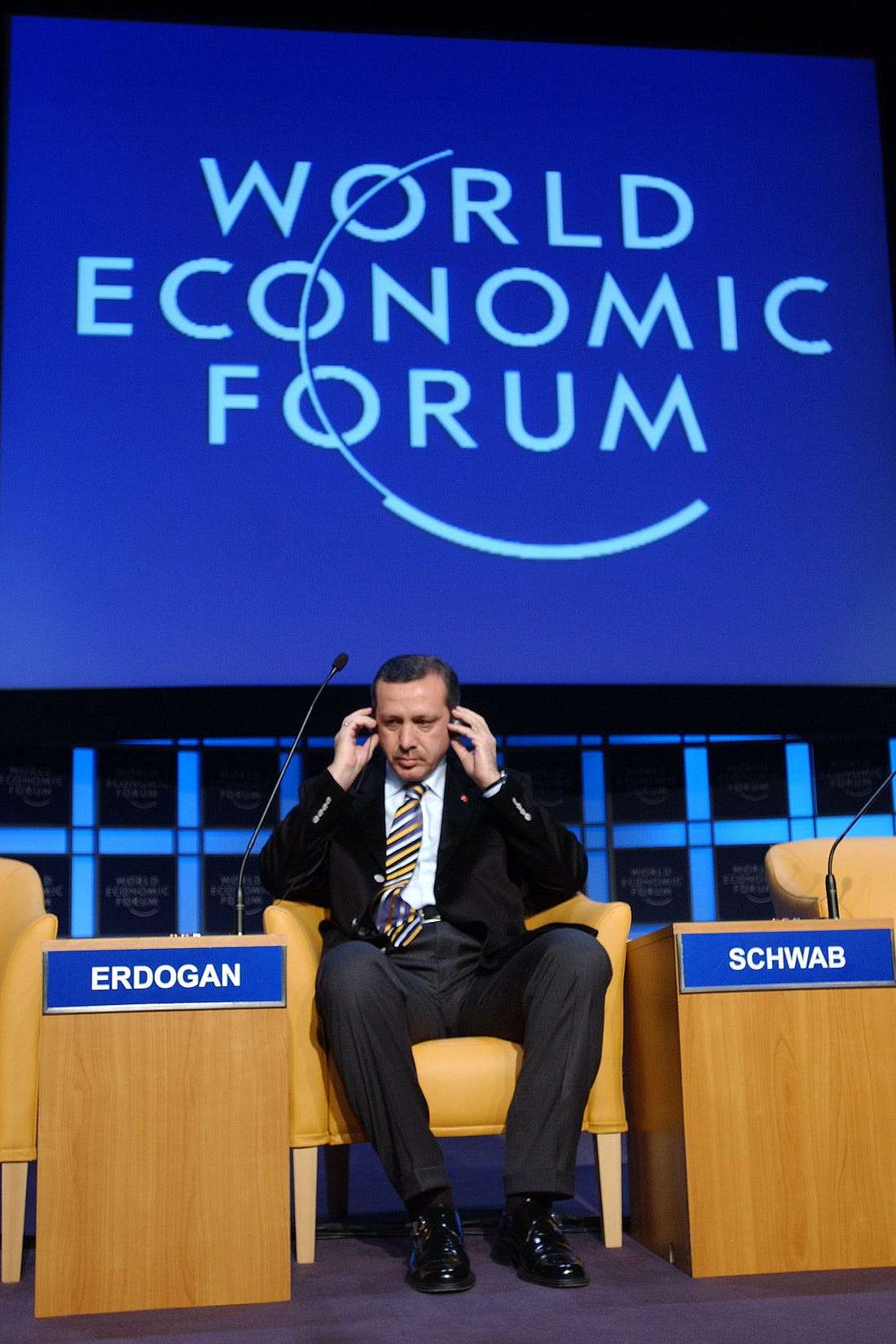
Internationally, Erdoğan revelled in plaudits from the Davos elite. He promoted Turkey’s EU candidacy hard, even as it became clearer that Turkey would never be able to satisfy the opposition posed by France and others. Erdoğan used their opposition to his advantage, making the EU’s foot-dragging look more like truculence on their part rather than justifiable concerns to Turkey’s membership. He also successfully navigated the threat posed by the United States’ invasion of Iraq in 2003. The parliament refused to allow the US to use Turkish bases to stage their invasion—reflecting the war’s deep unpopularity in Turkey.
But as prime minister, Erdoğan took care not to scupper Turkey’s close relationship with its NATO ally. Importantly, in a political moment when Islamist politics had become associated in the minds of many in the West with the terrorist violence of 9/11, Erdoğan’s politics seemed to offer an alternative: an Islamist politics that was amenable to democracy and free trade. By the end of the decade, Erdoğan’s admirers at home and abroad stretched across the political spectrum, from Davos-style neoliberals to members of the Nakşibendi Sufi order living in Çarşamba—arguably Istanbul’s most religiously conservative neighborhood—who saw Erdoğan as an acceptable substitute to a true Islamic revolution.
III. A Confident Man
Erdoğan and the AKP were rewarded in 2007 with a massive electoral victory in parliamentary elections. The election revealed Erdoğan’s deep support across a wide swath of Turkish society outside of a few redoubts of support for the secular nationalists along the Aegean coast and the border with Bulgaria. These elections provided Erdoğan with an opening and the confidence to begin remaking Turkish politics in a more profound way. The waning years of the aughts were shaped by two separate but interrelated phenomena: the so-called Democratic Opening, and the Ergenekon trials.
The 2007 elections revealed deep divides within the opposition, a running theme throughout Erdoğan’s road to authoritarian consolidation. Two opposition parties exceeded the 10 percent threshold needed to win seats in parliament: the secular nationalist Republican People’s Party (CHP), and the hard-right National Movement Party (MHP). These two parties were far too ideologically dissimilar to form a united anti-Erdoğan front. Kurdish voters—another well of potential opposition to Erdoğan—would be hard pressed to vote for either party given their long respective histories of hostility to Kurdish interests. Kurds were themselves divided.
The law that placed the threshold for winning seats in parliament at ten percent had been engineered to ensure Kurdish parties were shut out of parliament. A left-wing Kurdish party, Democratic Society Party (DTP), elected not to put forward a slate of candidates in 2007. Instead, several DTP-aligned candidates ran as independents in order to skirt the threshold requirement. The AKP, hoping to undercut support for DTP-aligned candidates, campaigned hard in many Kurdish-majority provinces. As a result, AKP won significant support among Kurdish voters looking for a more conservative option.
Erdoğan initiated the Democratic Opening in 2009 with an eye toward strengthening support for the AKP among Turkey’s Kurds. Since 1994, Turkey had engaged in a counterinsurgency against the Kurdistan Workers Party (PKK), a conflict that had, to that point, killed thousands and displaced millions. The government’s official position since the founding of the Republic of Turkey was that Kurds did not constitute an ethnic community distinct from the dominant Turkish population. Use of the Kurdish language was banned in almost all public places, Kurdish-language education was outlawed, and expressions of Kurdish ethnic identity were deemed as inherently separatist. Additionally, the predominantly Kurdish regions of Turkey were systematically denied government aid and economic development, leaving them poorer than the rest of the country.
The Democratic Opening was, in its essence, a neoliberal project. Erdoğan proposed lifting many of the draconian limits on the use of the Kurdish language and ethnic expression without significantly transforming the semi-colonial economic relationship between Ankara and its Kurdish periphery. The opening also brought about a fleeting liberalization in other areas as well. Turkey flirted with normalizing relations with Armenia and signaled a willingness to tolerate more open discussion about the Armenian genocide. The effects of the opening were visible even in the Ottoman archives. When I came into the Ottoman archives in 2009, I encountered none of the challenges that other scholars working on “sensitive” topics had long described. Whatever Erdoğan’s motivations for the opening may have been, many in Ottoman history took it as a signal that they could challenge the taboos that had long shaped—and held back—the field.
Backlash was fierce. The ultra right-wing MHP openly denounced the opening as treasonous. And many Kurds viewed the opening as a limited and reversible attempt at placation. As we will see in Part II, Erdoğan would learn the hard way that Kurds weren’t interested in being instrumentalized for his own political ends. But on the surface, at least, one could be forgiven for thinking that the prime minister was ushering in a more liberal era, despite his conservative and Islamist political leanings. Many other observers were more skeptical, but they seemed to be in the minority.
Whatever its flaws and limitations, the Democratic Opening was a straightforward electoral, not dictatorial, power play—Erdoğan simply wanted to out-politic his already divided opposition. The Ergenekon trials were something altogether different. But they had the effect of weakening the single institution in Turkey that had claimed the premierships of Erbakan and Menderes: the army.
The Ergenekon trials are too sprawling and sordid to describe in full here, but some detail is critical. The architects of the trial were judges affiliated with an Islamic movement associated with a cleric named Fethullah Gülen. Gülen’s movement had a significant following in Turkey and, by the early-2000s, ran a number of schools and other organizations that, among other things, emphasized the virtues of both community and government service, particularly within the police, bureaucracy, and judiciary. Although the relationship between the Gülen movement and Welfare/AKP was not always strong, by the late aughts, they had developed a functional alliance.
Beginning in 2008, prosecutors and judges brought charges against several prominent military and government officials accusing them of being part of a conspiratorial organization called Ergenekon, that allegedly worked hand-in-hand with organized criminal networks to assassinate political figures and undermine Turkish democracy. Allegations that a “deep state” (derin devlet in Turkish) was running parallel to the elected government and undermining the democratic will have long existed in Turkish politics.[1] The Ergenekon trials marked the first concerted effort to actually prosecute this deep state.
The Ergenekon trials further weakened the secular elite that had long viewed the republic as their patrimony and the army as their enforcer. Whether or not the charges leveled against them had any merit, the Ergenekon trials unfolded against the backdrop of a society that no longer looked to this elite as exemplars of the nation. It couldn’t have worked out any better for Erdoğan. The single greatest threat to his government appeared increasingly neutered—and he didn’t even have to get his hands dirty.
Erdoğan was entering the 2010s with an extra skip in his step.
This is the first of a two-part essay.
[1] Yes, we can think Turkey for gifting US politics the deep state concept.