Trump, do not let Azerbaijan occupy parts of Armenia
Baku is getting away with expansionist aggression
By Arman Tatoyan
The Washington Times
American diplomacy has always faced a simple but unforgiving test: Does it seek justice? When conflicts are allowed to linger under the banner of “process,” time has a way of favoring the stronger party unless Washington maintains focus. The South Caucasus has reached such a moment. President Trump is proud of his peace efforts between Armenia and Azerbaijan, but so far, he is letting Baku get away with expansionist aggression.
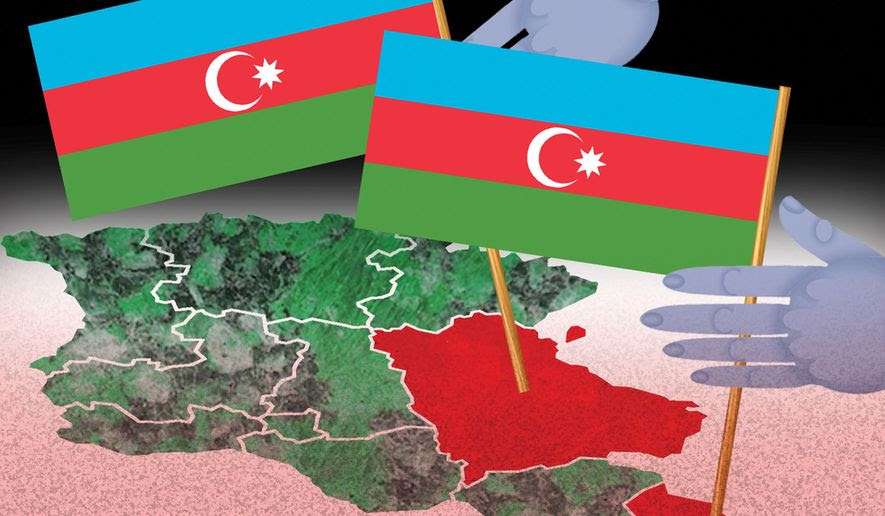
When most people think of the conflict, they focus on the disputed region of Nagorno-Karabakh, an Armenian-populated enclave within Azerbaijan’s post-Soviet border, which Baku has regained and ethnically cleansed. There is another matter: Beginning in 2021, Azerbaijani armed forces crossed Armenia’s internationally recognized border and took up positions inside its sovereign territory. These incursions deepened during the September 2022 large-scale attacks and subsequent escalations. Today, Azerbaijani forces remain deployed on more than 125 square miles of Armenian land, primarily in the border regions of Syunik and Gegharkunik.
This territory is not disputed under any international framework. It is Armenia proper, recognized as such by every state engaged in mediation. Yet after years of talks, that occupation remains unchanged.
After numerous rounds of talks, not a single inch of Armenian territory has been returned, not a single occupying unit has withdrawn. The military reality created by force has been left intact while diplomacy proceeds as if that fact were incidental. This sends the message to Azerbaijani leadership and bad actors everywhere that territorial gains achieved through coercion can be held indefinitely — provided negotiations continue. Over time, the abnormal becomes routine and routine becomes accepted.
This dynamic is reinforced by the rhetoric emanating from Baku. After an Aug. 8 meeting, President Ilham Aliyev publicly described “Armenian society” as “sick.” Azerbaijan continues to promote the state-sponsored narrative that entire Armenia itself constitutes “ancient Azerbaijani land.”
Such language is incompatible with reconciliation. It is the language of hierarchy, not coexistence; of pressure and racism, not compromise. When paired with an ongoing military presence inside Armenia’s borders, it forces us to ask, what is meant by “peace”?
Even without this, the Azerbaijani incursions into Armenia in the Syunik, Vayots Dzor and Gegharkunik provinces have forced people to live in constant anxiety. Civilian populations have been deprived of their livestock breeding, agriculture and opportunities to earn a living. Children attend school under the target of the Azerbaijani armed forces. Homes, roads and strategically important Armenian security facilities are also under target.
Recent diplomatic efforts, including the August framework associated with the understandings under the Trump Route for International Peace and Prosperity, have emphasized normalization, connectivity and future-oriented cooperation. The agreement seems to have put off (maybe even scuttled) Baku’s plans to seize all of Syunik Province. In return, Baku will have access to a U.S.-run road through Armenian territory. That’s a decent solution, but it leaves the preexisting occupations in place.
No framework, however well-intentioned, can succeed if it treats occupation as a background condition rather than an obstacle. Agreements that speak of transport corridors, regional integration or confidence building cannot coexist with the continued forced seizure of territory.
As an Armenian opposition leader and someone who believes American mediation must be judged by outcomes, not symbolism and pageantry, I am concerned about this trajectory. U.S. authority will be strengthened only when principles are consistently enforced.
International law is unambiguous on this point. Use of force to seize territory across a recognized international border is unlawful. Negotiations about border demarcation cannot retroactively legitimize such actions or substitute for withdrawal. A peace process that tolerates occupation while discussing normalization asks the weaker party to negotiate under duress and allows the stronger to wait out accountability.
History offers ample warning about where this leads. Ambiguity does not calm disputes; it entrenches them. When violations of sovereignty are met with procedural patience rather than consequences, they are more likely to be repeated, not resolved.
This is why clarity now matters. American and European mediators should state openly what is already known: Azerbaijani forces are occupying sovereign Armenian territory, and it’s incompatible with any credible peace settlement. Until withdrawal begins, negotiations cannot be treated as an end unto themselves. Process must be tied to compliance, or it becomes a shield behind which the status quo hardens.
None of this precludes peace. On the contrary, it’s the only path toward peace that lasts. A settlement built on unresolved coercion is not stability; it is postponement. Eventually, the imbalance resurfaces.
The U.S. retains leverage in this process, but unused leverage erodes quickly. If sovereignty is treated as negotiable, the rules governing mediation begin to fray.
Peace in the South Caucasus will not come from careful language that avoids naming realities but from negotiations grounded in the simple principle that borders cannot be changed by force and occupation won’t be rewarded with time.
Talks can help end conflict. They cannot be allowed to disguise it.
Arman Tatoyan is a prominent Armenian opposition figure, head of the Wings of Unity political movement, lawyer and former human rights ombudsman of Armenia.