USC Hosts ‘Future Directions for Western Armenian’ Language Conference
BY SEVAN BOGHOS-DEIRBADROSSIAN
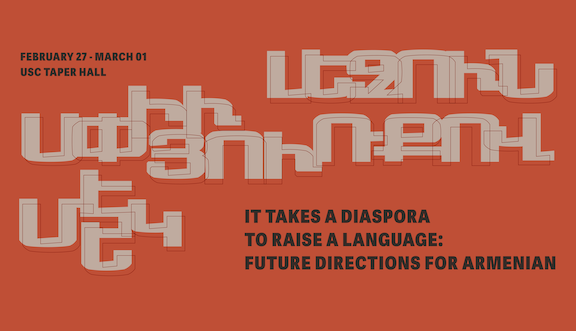
The conference “It Takes a Diaspora to Raise a Language: Future Directions for Western Armenian,” organized by the USC Dornsife Institute of Armenian Studies with the support of the Calouste Gulbenkian Foundation, brought together scholars, educators, researchers, and community leaders to explore practical strategies for strengthening and revitalizing Western Armenian in diaspora communities. At its core, the conference addressed an urgent question: how can an endangered language be sustained and transmitted across generations when its speakers live primarily outside a nation-state where it functions as the dominant language?
Opening Remarks and Strategic Vision
The conference opened with welcoming remarks by USC Armenian Institute director Shushan Karapetian, who emphasized the importance of collaboration among scholars, educators, and community organizations in sustaining Armenian language and culture throughout the diaspora.
The keynote address was delivered by Razmig Panossian, Chair of the Armenian Communities Department at the Calouste Gulbenkian Foundation. Dr. Panossian introduced the broad range of initiatives the Foundation currently sponsors, develops, and mentors in support of Armenian language education and cultural sustainability. These include online Armenian teaching tools, publications for youth and emerging writers, professional development programs for educators, children’s hands-on cultural creativity programs that promote language acquisition, Armenian digital tools such as spell-check systems and dictionaries, digitization of historical Armenian documents and publications, and scholarships and educational support.
Dr. Panossian also introduced an important strategic shift in thinking about Armenian cultural sustainability. He argued that revitalization efforts must prioritize the Armenian language itself rather than focusing first on a broader concept of Armenian identity. His central point was that language acquisition should come first, as language naturally becomes the gateway through which cultural identity develops. He summarized this principle with the expression: “Հայերէնը, ոչ թէ Հայեցին” (Hayeren, not Hayetsi).
A major theme that followed from his remarks was the urgent need for improved pedagogy and teacher preparation in Western Armenian instruction. Dr. Panossian stressed the importance of linking academic research with practical classroom strategies and ensuring that adequate resources and institutional support are directed toward language education. Participants highlighted the lack of teacher-training institutions for Western Armenian in many diaspora communities, the shortage of qualified teachers, and the need for sustained investment in teacher training and professional development. Language teaching, they emphasized, must prioritize communication and acquisition rather than linguistic perfection, especially in the case of heritage learners.
Historical Lessons for Language Expansion
A panel moderated by Manuk Avedikian examined historical precedents for the expansion of literacy in Western Armenian between the eighteenth and twentieth centuries.
Daniel Ohanian presented research on the role of Armenian Catholic missionaries in expanding Armenian literacy in the Ottoman Empire. He explained that Armenian communities of that period faced conditions similar to those of diaspora communities today: few schools, limited financial access to formal education, and multilingual social environments. Literacy existed along a spectrum, often including semi-literacy, where learners could recognize letters and sounds, read words, or even read texts without fully understanding them, relying instead on memorization and interpretation.
Missionaries responded with flexible teaching methods centered on speech and memorization, especially through devotional texts. One pioneer associated with this approach was Madtevos Yevtogiatsi. To make literacy more accessible, educators simplified texts and teaching methods. During the nineteenth century, printing expanded, glossaries were added to books, and schools increased their use of Armenian-language materials. In some cases, Eastern and Western Armenian were blended in educational texts, and teachers minimized strict grammar and spelling requirements in order to encourage broader participation. Dr. Ohanian suggested that this historical experience offers a valuable lesson today: language acquisition should not be hindered by excessive criticism from highly proficient speakers; the priority should be enabling learners to engage actively with the language.
Astghik Soghoyan then presented “Early Western Armenian Children’s Periodicals: Language, Education, and Literary Identity”. Her research examined some of the earliest Armenian publications created specifically for young readers, including “Pourasdan”, “Yergrakound”, and “Yerkaser”. These often included both Eastern and Western Armenian features, reflecting tension but also experimentation between linguistic traditions. This experimentation helped shape modern vernacular Armenian and moved the language away from older classical forms.
Soghoyan also discussed the entrance of Armenian Protestant missionaries into children’s publishing beginning in 1872, including periodicals such as “Avedaper Dghayots Hamar”, which continued until 1915. During this era, Armenian education was closely linked to religious institutions: teachers were often clergy, schools were church-based, instruction centered on Biblical texts, and both students and editors were predominantly male. Other children’s publications included “Avedaper Mangants” and “Paregam Mangants”. In 1876, Hagop Baronian humorously criticized some of these publications as “Aghedpaer Mangants,” while producing his own children’s periodical, “Meghu”, in which he published works such as “Garmir Vartoug”, an Armenian adaptation of “Little Red Riding Hood”. His aim was to help young Armenians develop language skills while also understanding their place within the Armenian community.
The panel concluded with a video presentation by Liza Mardoyan, titled “Print Culture: Armenian Language Publishing and Cultural Resilience in Lebanon’s Armenian Community (1915–2015)”. Her presentation underscored the vital role of Armenian publishing in sustaining the language in Lebanon after the Armenian Genocide. Mardoyan argued that print culture played a decisive role in saving the language and making Armenian teachable. Armenian language vitality, she suggested, thrived through innovation, creativity, practical educational tools, and technological adaptation.
Independent Armenian publishers did more than print books; they created an entire educational ecosystem. One important example was Sevan Printing in Lebanon, which played a central role in producing and coordinating textbooks for Armenian schools and supporting the broader project of Azkashen—the strengthening of Armenian nationhood in diaspora through education and culture. A key figure in this effort was the publisher and editor Simon Simonian, whose technical expertise and collaboration with educators, writers, and editors helped produce materials tailored to the needs of students and teachers. Mardoyan concluded that the Armenian experience shows how a diaspora can successfully build institutions to sustain a language outside its homeland, and that this success depended on a strong print ecosystem connected closely to Armenian schools.
Measuring Language Competency
Another important panel, moderated by Gegham Mughnrtsyan, addressed language competency assessment and the development of standardized proficiency frameworks for Armenian.
Via video, Siranush Dvoyan, Chairperson of the Language Committee of the Ministry of Education, Science, Culture and Sport of the Republic of Armenia and lecturer at the American University of Armenia, explained that the Republic of Armenia is currently developing policy and technological frameworks for national Armenian language proficiency standards. This includes building the necessary assessment infrastructure, evaluation criteria, and technological tools for a structured and standardized language assessment system.
Aldo Rodriguez, Director of Language Policies for the National Administration of Public Education of Uruguay, emphasized the need for a universal Armenian assessment infrastructure that could be used internationally. He presented Uruguay’s national certification model, where learners can receive A1-level certification based mainly on speaking and listening skills. His approach favors user-friendly grammar explanations, transliteration when needed, and communicative teaching based on lexical chunks rather than strict grammar. This model is already in use at the AGBU Uruguay Armenian School, where students receive certificates after completing each level.
Javier Poladian, Director of International Affairs at AGBU Uruguay, stressed that a universal Armenian assessment framework must be developed in collaboration with the Republic of Armenia, which should play the leading role in setting standards. Irshad Madyarov, Associate Professor at the American University of Armenia, discussed the importance of measuring receptive written vocabulary and grammar in Eastern Armenian and the urgent need for a validated and technologically supported Armenian language assessment framework. Together, the speakers highlighted the need for a shared global Armenian assessment infrastructure.
Language, Identity, and Diaspora Experience
The conference program also included a live podcast recording, “Language Therapy with Dr. K”, featuring Vahe Berberian. His conversation offered a lighter but deeply insightful reflection on multilingualism, identity, and diaspora life. Berberian spoke about growing up in Lebanon, traveling through Europe, and eventually settling in the United States. Although Lebanon is an Arabic-speaking country, he explained that Arabic was not his strongest second language; French and English played a stronger role in his development. Blending humor, subtle commentary, and anecdote, the session showed how multilingual diaspora Armenians navigate complex linguistic worlds and how language preservation remains a deeply personal and cultural experience.
Immersion and New Learners
A panel on Immersion Models for Language Vitality, moderated by Razmig Panossian, featured Nancy Hong and Michael Hornsby. Hong, Director of Dual Language Immersion Programs and English Learner Services at the Glendale Unified School District, described Glendale’s Eastern Armenian dual immersion program and announced that Western Armenian will be introduced into the district’s dual immersion program in the 2026–2027 academic year. Hornsby, Associate Professor at Adam Mickiewicz University, discussed minority language communities’ responses to modernization and globalization and emphasized the power of immersion programs to sustain linguistic continuity. The discussion also touched on identity, guilt, and the phenomenon of third-generation diaspora Armenians returning to the language in an effort to reconnect with their roots.
The roundtable Non-Standard Adult Learners Beyond Traditional Community Ties, moderated by Talar Chahinian, explored Armenian language learning outside traditional heritage-school or family frameworks. Jennifer Manoukian described teaching Western Armenian to adults using translation as a key pedagogical tool, particularly for learners working on research projects. Anahit Ghazaryan spoke on the relationship between Eastern and Western Armenian through memory and dialogue, emphasizing mutual respect rather than division. Anatolii Tokmantcev examined language use among Russian-Armenian repatriates, discussing how social pressures, identity, and monolingualism affect heritage language use and intergenerational transmission.
Keynote on Family and Multilingualism
A keynote lecture by Ruth Kircher, titled “Parental Language Attitudes and Heritage Language Transmission Across Generations and Geographies”, examined how family language attitudes shape the survival of heritage languages. Drawing on research in Canada, the United States, and Germany, Kircher showed that parental beliefs about status, economic opportunity, emotional connection, and identity strongly affect language transmission. At the same time, she emphasized the benefits of childhood multilingualism, including cognitive development, stronger family bonds, and deeper ties to cultural communities. She encouraged Armenian-speaking parents in the diaspora to view multilingualism positively and to support Armenian alongside dominant languages.
The first day concluded with a stand-up comedy performance by members of the DEMQ Show, whose humor and satire offered a lively close to the day while still engaging with themes of language, identity, and community.
Second Day: Practice, Play, and Ecosystems
The second day opened with remarks from both organizing institutions, followed by a panel chaired by Lilit Keshishian on language learning, pedagogy, and classroom practice.
Lilit Ghazaryan presented “Language as a Toy: Play, Peer Socialization, and Teacher–Child Interaction in an Armenian-English Bilingual Daycare in Los Angeles”, showing how young children acquire language organically through play and interaction. Natalie Karimian addressed the challenge of bridging pedagogy and practice in Armenian-language materials. Nora Sarafian-Tachjian and Sarin Akbas presented their experience using the digital visual program “The Sun, Moon, and Ribbon” in bilingual classrooms in France. Their session ended with a live demonstration, “Handful of Games from the Wheat Sack”, showing how movement, repetition, play, and memory can support language acquisition.
The conference also featured showcases such as Krots Prots, a university-centered literature and literacy initiative; Word-Bite Play Slay Meet, presented by Hrayr Varaz, Isabelle Kouyoumjian, Jenny Kouyoumjian, Hayk Makhmuryan, and Hovig Artinian; and Before Language Was the Body: Theatre in Armenian by Vache Hoveyan. Together, these showcases reflected the conference’s emphasis on diverse and innovative modes of language engagement.
A roundtable titled “The Gulbenkian Approach: Building a Sustainable Language Ecosystem in the Diaspora” brought together Tamar Tufenkjian, Haiganoush Minasian, Nora Sarafian-Tachjian, Meline Barseghin, Sarin Akbas, and Ani Garmiryan. Their testimonies highlighted the importance of immersive preschool environments, play-based learning, hands-on cultural activities, out-of-classroom language experiences, and digital tools such as Zendoog, Zartis, Yertik, Zartsants, Oos Hartag, Gadag Madag, Agul Dugul, and Alnis Balnis. A recurring message was that the Armenian language must live naturally and joyfully, not imposed through anxiety or negativity.
A panel on Armenian Language in the Era of Artificial Intelligence, chaired by Maral Tavitian, explored the role of technology in language preservation. Artur Ishkhanyan addressed ethical questions in “Beyond Extractive AI”. Vicken Assadourian introduced Arshalouys, a digital platform for Armenian language revitalization. Victoria Khurshudyan discussed annotation models for multivariational Armenian, and Chahan Vidale-Gorene examined how AI can support Armenian language transmission. The panel showed that although technology cannot replace community transmission, it can significantly expand access and resources.
Final Day: Creative Spaces, Universities, Media, and Teachers
The final day opened with a panel chaired by Margarita Baghdasaryan, “Living Language through Creative Spaces and Artistic Practices”. Nairi Khachadourian explored how contemporary art can support language vitality beyond school systems. Nelly Achken Sarkissian presented her short film “Beyond Fear: Western Armenian as a Living, Evolving Language in the Digital Diaspora”. Garine Boghossian demonstrated how map-making and geography can be used to teach Armenian vocabulary through Armenian Atlas (Աշխարհացոյց). Hovig Artinian examined how comedy and social media activate diasporic Armenian linguistic repertoires across generations.
The panel University-Level Armenian Language Programs: Paris and Los Angeles, chaired by Artineh Samkian, focused on higher education. Anaïd Donabédian presented “Revitalizing Western Armenian from Above: IMAS – Content, Vision, and Milestones”, describing INALCO’s unique BA and MA programs in Western Armenian and their wide-ranging curriculum. Hagop Gulludjian spoke on “Policies and Politics of Language as the Post-Yeghern Diaspora Enters its Second Century”, emphasizing creativity, literary production, and meaningful engagement for contemporary diasporic students.
Additional showcases included Building the Language Activist’s Toolkit: Insights from Ejanish, presented by Lia Soorenian and Alexia Hatum, and Beyond Basics: Cultivating the Joy of Discovery in Literacy, presented by Sarin Akbas and Nora Sarafian-Tachjian.
A keynote by Maria Polinsky, “From Periphery to Parity: The Value of Armenian Varieties in the Pluricentric World”, reframed Armenian as a quintessential pluricentric language. She argued that Eastern and Western Armenian are equally valid outcomes of linguistic change and that the ideology of correction often acts as a barrier to language vitality. Instead of emphasizing purity, she urged communities to prioritize vitality, intelligibility, and inclusivity, documenting local norms and supporting heritage learners while treating multiple varieties as resources rather than problems.
The panel Reach and Resilience of Independent and Local Community Journalism, moderated by Myrna Douzjian, focused on Armenian-language media. Jirair Jolakian discussed the history and challenges of “Nor Haratch” in Paris, while Rupen Janbazian described how “Torontohye” adapted through surveys, local community reporting, accessible language, visual appeal, and bilingual publication in Armenian and English to better serve younger generations and families.
The panel What About Teachers? Institutions, Narratives, and Insights, moderated by Hrag Papazian, brought attention to the voices of teachers. Arus Movsesyan presented “Western Armenian Teachers’ Narratives: Between Myth and Mission”, arguing that teachers are too rarely treated as knowledge-holders capable of theorizing their own work. She explored how teachers’ metaphors shape professional identity and noted the recurring image of the teacher as a “soldier” defending an endangered language. Myrna Douzjian and Talar Chahinian then presented “In Tandem: Teaching Eastern and Western Armenian Standards for Diasporic Fluency”, describing classroom approaches that allow students to speak in their preferred dialect while reading texts from both standards.
Closing Session
The conference concluded with a closing session that combined scholarly reflection and broader assessment.
In “License to Spell: When Vanity Plates Speak Armenian in Los Angeles”, Shushan Karapetian examined Armenian vanity license plates as diasporic inscriptions—forms of public belonging, linguistic negotiation, and mobile biography. Drawing on cultural geography, sociology, communication studies, sociolinguistics, popular culture studies, and semiotics, she showed how Armenian vanity plates make minority-language identity visible in a regulated public space, turning vehicles into platforms of self-expression and diaspora presence.
Closing reflections were offered by Ani Garmiryan of the Calouste Gulbenkian Foundation. Looking back at the decade since the 2015 conference “Innovation in Education: Teaching Western Armenian in the 21st Century”, she noted a clear shift away from narratives of language loss and toward approaches centered on language vitality in multilingual diasporic realities. She pointed to the development of pedagogical tools, digital platforms, teacher training, Zarmanazan, audiovisual resources, and the International MA in Armenian Studies as examples of sustained collaborative work. Her remarks emphasized that revitalization requires long-term vision, local and diasporic networks, patience, and collaboration.
Ten years after that first gathering, participants met again—this time at the University of Southern California—from eleven countries to reflect on the theme “It Takes a Diaspora to Raise a Language: Future Directions for Armenian”. The conference made clear that Armenian in the diaspora should not be understood simply as a language at risk, but as a diasporic language capable of evolving and thriving through collective effort, creativity, and institutional collaboration.