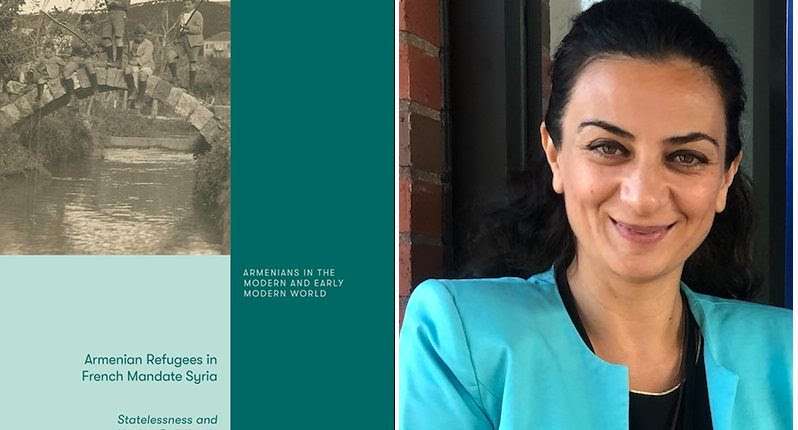
Victoria Abrahamyan’s “Armenian Refugees In French Mandate Syria: Statelessness And Nation-Building In The Middle East” Published · February 26, 2026 LONDON/NEW YORK—I. B. Tauris, an imprint of Bloomsbury Publishing, announced the publication of Dr. Victoria Abrahamyan’s Armenian Refugees in French Mandate Syria: Statelessness and Nation-Building in the Middle East. The book is part of the series Armenians in the Modern and Early Modern World edited by Bedross Der Matossian (University of Nebraska, Lincoln). In the aftermath of the First World War, the Armenian Genocide, and the Turkish War of Independence, Syria became home to tens of thousands of Armenian refugees. In this comprehensive history covering 1920 to 1948, Victoria Abrahamyan foregrounds the experience of Armenian refugees in the Syrian Jazira as they navigated competing state-building efforts led by the French mandatory power, Syrian nationalists, and Soviet Armenia. The book reveals the refugees’ agency amid internal conflicts and diverse loyalties. It sheds light on the intricate power struggles over their status and belonging, particularly through competing French and Soviet post-war refugee settlement schemes, in a critical frontier between Western imperialist powers, the Soviet bloc, and Turkey. Drawing on Armenian, Arabic, Russian, and French sources, the book explores how the Armenian refugee community responded to the rise of Arab nationalism in Syria, complicating simplistic sectarian interpretations of their place and reception in interwar Syria. By situating this history within the broader context of Armenian experiences in the Eastern Mediterranean and the role of refugees and displaced populations in state-building in the post-war Middle East, this study offers essential reading for students and scholars of Armenian and Middle Eastern history alike. Abrahamyan commented on the book, saying, “Armenian Refugees in French Mandate Syria seeks to provide a nuanced understanding of the Armenian refugee experience in interwar Syria, challenging conventional Western narratives that portray Armenian refugees as voiceless, as well as dominant Arab nationalist accounts. The book explores the formative post-Genocide years, showing how Armenian refugees played a crucial role in shaping state- and nation-building processes in interwar Syria. Positioned at the intersection of competing state-building projects led by the French mandate, Syrian nationalists, and Soviet authorities in Yerevan and Moscow, Armenian refugees and their leaders exercised remarkable agency—navigating, negotiating, and at times resisting these pressures. In this sense, the book represents a History from Below.” According to her, the book, for the first time, situates the Armenian refugees within broader geopolitical struggles. It examines how the French authorities, the League of Nations, Turkey, Soviet Armenia, the USSR, and local Syrian actors sought to influence the settlement and political trajectory of Armenian refugees. Specifically, it traces the entangled history of Armenian refugee settlements under the French mandate and their intricate connections to repatriation efforts initiated by Soviet authorities. By connecting the Armenian refugees’ experience to global power dynamics, the book illuminates the interplay between refugees, state-building, and the longstanding involvement of foreign actors in Syria to control populations, resources, and trade routes. Reflecting on the early decades of the twentieth century, when various powers vied for control over Armenian refugees, offers a lens not only for understanding Syria’s past but also for grasping the enduring relevance of displacement, agency, and geopolitics today. “Victoria Abrahamyan’s ‘Armenian Refugees in French Mandate Syria’ is a pioneering analysis of displacement, agency, and state formation after genocide and imperial rule. Focusing on the Syrian Jazira from 1920 to 1948, the book portrays Armenian refugees as active agents rather than mere victims, engaging with the ambitions of the French Mandate, Syrian nationalists, Turkey, and Soviet Armenia,” said Der Matossian, editor of the series. “Using multilingual archival materials, Abrahamyan demonstrates how refugees influenced—and were influenced by—conflicts over settlement, repatriation, identity, and sovereignty along a complex geopolitical border. By placing the Armenian experience within broader Middle Eastern and global power contexts, this work presents a vivid “history from below” that challenges traditional narratives about refugees’ contributions to the development of modern Syria and the post-war Eastern Mediterranean,” he concluded. Review “Victoria Abrahamyan has succeeded in providing a distinctive and original contribution to scholarship. Her impressive book, drawing meticulously and sensitively upon primary sources in a wide array of languages, deserves close attention from anyone interested in armed conflict, refugees and state formation, and the entangled relationships between multiple actors, whether in the Middle East or beyond.” ―Peter Gatrell, Professor, The University of Manchester, UK “Armenian Refugees in French Mandate Syria is a fascinating account of a displaced community’s resettlement into a fluid and uncertain emerging regional and global order, and in particular of refugees’ efforts to manage their own movements and direct their own political lives. It will be essential reading for anyone seeking to understand the history of migration and refugeehood in the interwar Eastern Mediterranean.” ―Laura Robson, Professor, Yale University, USA “In this important new work, Abrahamyan tells the compelling story of post-genocide Armenian survival in the Modern Middle East. Drawing from a wealth of sources, she weaves together the building of an Armenian diaspora national community with interwar French colonialism, rising Arab nationalism, and the politics of Soviet Armenia. In her account Armenians are active agents in creating a new community, not just beneficiaries of international humanitarianism or tools of European colonialism. Armenians come alive as complex actors in the social and ideological tumult of that period in a way no other historian of the interwar era has been able to accomplish.” ―Keith David Watenpaugh, Professor, University of California Davis, USA “Abrahamyan’s study is a powerful exploration of how Armenian genocide survivors forged provisional new lives in Mandate Syria. It highlights their agency, resilience, and ability to collaborate amid competing pressures from the mandatory authorities, Ankara, Syrian nationalists, and the Soviets. This is historical scholarship at its finest: deeply researched, innovative, fine-grained, and eye-opening even for seasoned experts.” ―Hans-Lukas Kieser, Professor, The University of Newcastle, Australia Dr. Victoria Abrahamyan is a postdoctoral research fellow at the University of Geneva. She has held visiting fellowships at the London School of Economics (January–June 2025) and Aix-Marseille University (October–December 2025). She received her PhD in Contemporary History, summa cum laude, from the University of Neuchâtel in 2023, and her BA and MA from Yerevan State University. Her doctoral dissertation received the Society for Armenian Studies (SAS) Outstanding Dissertation Award (2020–2023). Dr. Abrahamyan has published widely in leading academic journals and was recently awarded the Syrian Studies Association Article/Chapter Prize (2025) for her article, “Loyalty at Stake: Armenian Refugees and the Syrian Great Revolt,” published in Microhistories in Armenian Studies, edited by Barlow Der Mugrdechian, Ümit Kurt, and Ara Sarafian (Fresno: The Press at California State University, 2025). Copies of Armenian Refugees in French Mandate Syria: Statelessness and Nation-Building in the Middle East are available for purchase from the Bloomsbury Press website. Enter code ARMENIA at checkout on bloomsbury.com for 25% off.
0 Romania, Hungary, Georgia, Azerbaijan Launch Venture To Lay Black Sea Power Line September 5, 2024 by Gohar Grigoryan · Published September 5, 2024
0 27.8% of Armenians favor relations with Russia March 13, 2025 by Gohar Grigoryan · Published March 13, 2025
0 ANCA Welcomes Launch of Swiss Peace Initiative for Nagorno Karabakh May 22, 2025 by Gohar Grigoryan · Published May 22, 2025