Who are the Bishops of the Mother See and what is the Synod of Bishops
Dr. Hrach Chilingirian
In recent months, due to the tension and competition in church-state relations developing in Armenia, Armenian society has heard more about the “Synod of Bishops” than ever before. For many, this was the first time they had become aware of the existence of such a body in the life of the church.
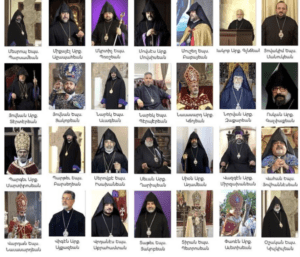
This small study provides a brief introduction to what the Synod of Bishops is, as well as a quantitative picture and collective profile of the bishops of the Mother See of Holy Etchmiadzin. (1)
The Synod of Bishops
The Synod of Bishops of the Armenian Apostolic Church is not only an administrative assembly, but also a body of spiritual consensus, doctrinal supervision and church discipline.
The Synod of Bishops is called to preserve the orthodoxy of the Church’s faith, Holy Tradition and centuries-old canonical balance. It functions not as a center of authority, but as a platform for joint responsibility. (2) The Synod discusses doctrinal and moral issues, contributes to the formation of a unified position and acts as a consultative body of the Catholicos of All Armenians, until the final discussion and decision of the National Ecumenical Synod.
The role of bishops in the life of the Church has its historical and canonical roots. The canons of the Council of Shahabivan (5th century) (3) testify that from early times the Church perceived the episcopate not as a title of honor, but as a most serious and heavy responsibility. The canons of the Church, drawn up during the century, established severe penalties for the conduct of bishops, such as bribery, simony (the buying and selling of church office or grace), and abuse of power. Bishops could be deprived of their see, power, and priestly ministry, be subject to financial fines, and be excommunicated. Even silence in the face of injustice was considered complicity, and the concealment of sin by bribery was a grave canonical offense.
The canons reveal an important principle: episcopal authority in the Armenian Church has never been conceived as a personal authority, but as a service to the Church, which is the body of Christ. The bishop is called not only to be a shepherd and leader, but also a responsible guardian of faith, morals, and justice. (4)
In this sense, the Episcopal Conference, headed by the Catholicos, is the guarantor of the unity of the Church; it unites the dioceses, prevents autocratic practices, and preserves the Church as one living body, not a sum of separate authorities. It does not replace the canonical authority of the Catholicos, the Supreme Spiritual Council, or the diocesan leaders, but acts in conjunction with them, in spiritual balance. (5)
Statistics
Age distribution of the episcopal class
The data on the age distribution of the episcopal class clearly show that experienced and elderly bishops predominate. The largest group, 30% of the total, is made up of bishops in their 60s. This indicates that almost a third of the composition is approaching retirement age.
The middle generation is in their 40s and 50s, representing equal shares, 23% each, and together they make up 46% of the entire class, that is, almost half of the bishops are in the prime of their activity.
On the other hand, those over 70 make up a significant portion, 25% of the total, of which 16% belong to those in their 70s and 9% to those in their 80s, which shows the important presence of the older generation and the important role of their accumulated experience.
The general statistics show that the majority of bishops, 55%, are over 60 years old, meaning that the class is largely composed of bishops with many years of experience and long service.
The Birthplaces of the Episcopal Order
The geographical origin statistics show that almost half of the Bishops, 49%, were born in Armenia, where the Motherland plays a central role as the main source of clergy. At the same time, bishops born in the countries of the Middle East make up a very large proportion, 40%, confirming the once vital role of the traditional Armenian communities of the Middle East in the important task of training clergy.
Considering the thinning of the Armenian communities of the Middle East in recent decades, one of the great questions facing the Armenian Church is which communities in the Diaspora will provide clergy in the coming decades.
Educational level of the episcopal class
According to the data, 30 out of 57 bishops have higher education degrees (Master’s or Doctorate) beyond seminary studies. The largest group is made up of bishops with a Master’s degree, representing 32% of the total. Those with a Doctorate degree make up 14%. They are followed by those with a PhD degree – 7%, who complete the overall scientific picture. This distribution reveals that 53% of the Episcopal class have higher academic degrees (master’s, doctorate or candidate), which emphasizes the serious scientific potential of the staff. The overwhelming majority of those with the highest degree received their education at European and American universities.
Distribution of episcopal positions
The distribution of bishops’ positions in the patriarchal structure of the Church shows that the majority of bishops – 58% – hold the position of diocesan primate. And 39% of the class is involved in administrative or other church responsibilities. There are two (4%) patriarchs in the episcopal hierarchy: Jerusalem and Constantinople.
Of particular note is the manner in which diocesan leaders are appointed, which reveals a certain format of governance. Statistics show that 64% of leaders are appointed directly by the Catholicos, while only 36% are elected at the diocesan level. The overall picture revealed shows that the structure of the church is characterized by strong centralization.
Period of Episcopal Service
These data represent the level of experience of bishops, based on the years since their ordination, and reveal the image of a stable, long-serving patriarchal structure. The largest group is made up of bishops with 10+ years of service, representing 32% of the total, meaning almost a third already have more than a decade of experience in this highest rank. They are followed by those with 20+ years of service, 26%, representing an older and more experienced generation with more than two decades of service. Newly ordained bishops, who have only 1-2 years of experience, make up 18%. This picture is completed by the most experienced senior ministers, 16% of whom have a long record of service, with 11% having 30+ years and 5% having 40+ years of episcopal service.
Chronology of Episcopal Ordination
These data reveal the decades in which the ordinations of currently serving bishops took place. The 2010s are key, when 39% of serving bishops were ordained, which indicates that in the last 10–15 years, the church leadership has been significantly refreshed with the arrival of a new generation. This is followed by the 2000s, when 23% of the class was ordained, that is, those bishops who today have above-average experience, having completed approximately 15–25 years of service. Also, a significant portion, 21%, was ordained in the 1990s, the first decade of Armenia’s independence, which was a historically important turning point for the restructuring of the church.
This picture is completed by the older generation, which represents the bishops ordained in the 1980s and earlier periods. 17% of the total belong to the “Soviet period” composition, where 12% were ordained in the 1980s and 5% in the 1970s, and they embody the spiritual tradition, memory and historical experience of the preceding decades.
* Dr. Hrach Chilingirian, sociologist, diaspora scholar and university lecturer (wwwhratch.info).
____
Sources used: Liturgical Calendar of the Mother See of Holy Etchmiadzin 2025; Biographies of the bishops on the Mother See’s website.
In the case of the Catholicos, the Catholicos is ordained by 12 (or at least 3) bishops, while the Catholicos ordains individual bishops.
The canons of the Shahabivan Synod consist of 20 articles. For the canons related to the bishop, see, for example, articles A, Z, and I. Cf. H. N. Akinyan, “The Canons of the Shahabivan Synod.” Handes Amsoray, No. 4-12, 1949, pp. 79-170.
Armenian Canon. A. Volume I (1964), Volume II (1971). Edited by Vazgen Hakobyan. Publishing House of the Academy of Sciences of the Armenian SSR, Yerevan.
Hagop Nersoyian, Observations: On the Draft “Statute of the Armenian Church”. Jerusalem, 2001. In a broader context, Nersoyian explains (p. 37):
“The Catholicos or Patriarch is simply the first among equals. On the basis of unquestionable Scripture, the Patriarch is the executive head of the episcopal assembly. He is given or receives powers as such. These rights belong to the episcopal order, in a sense lent to the Catholicos, to be exercised in the absence of the episcopal assembly, according to the will and dispositions of that assembly. The Catholicos has his rights as the representative of the entire episcopal order, and as such his decisions have force over any other individual bishop or any faithful, with the understanding that the whole is greater than the sum of its parts. The root of the erroneous belief that he is one degree above the bishops must be sought in the feudal status.”