ANCA-WR, Armenian-American Advocates Press U.S. Religious Freedom Commission on Azerbaijan’s Erasure of Armenian Christian Heritage and Hostages
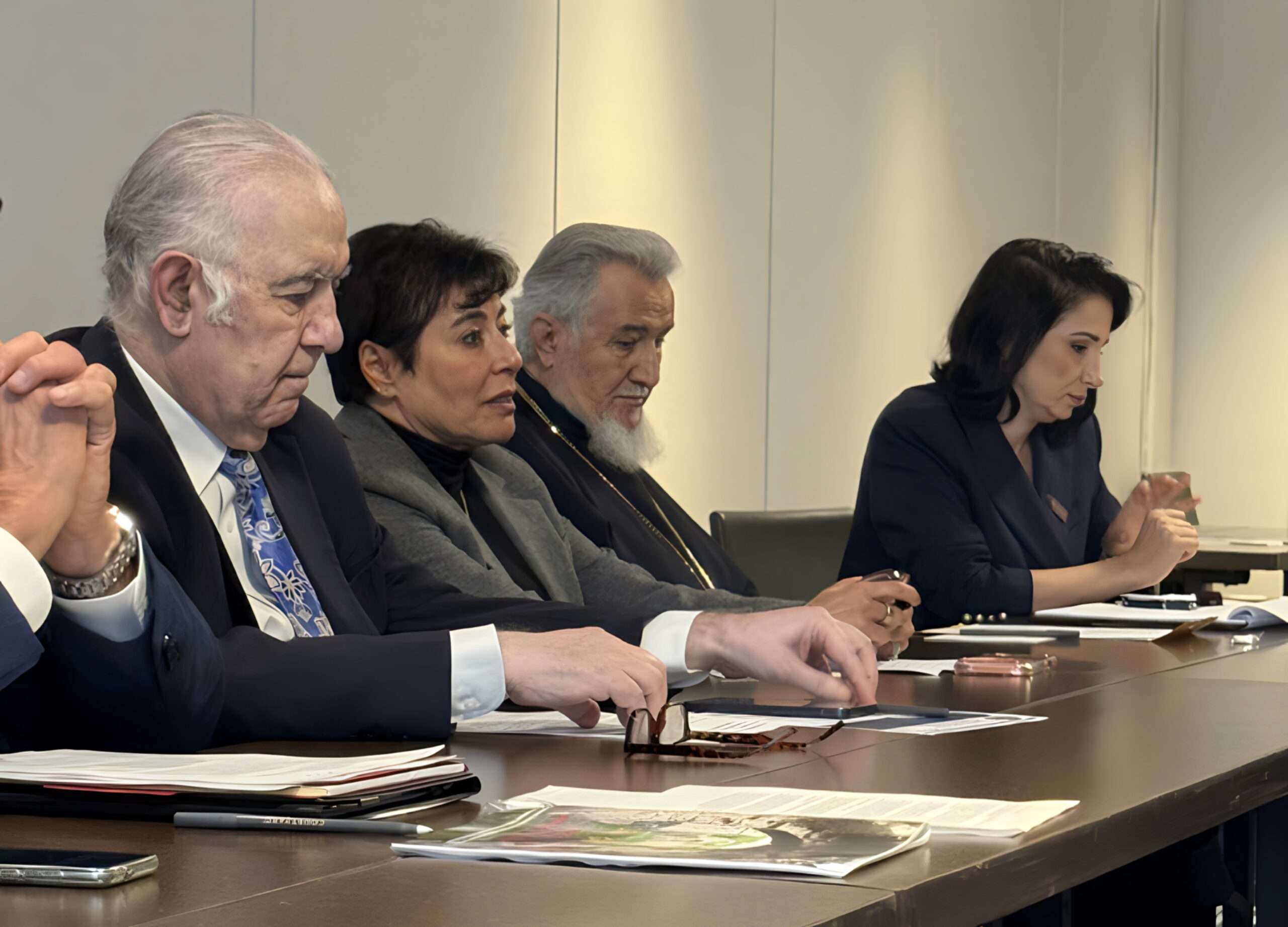
LOS ANGELES, CA – The ANCA-WR and a delegation of Armenian legal experts, clergy, elected officials, and human rights advocates presented documented evidence of Azerbaijan’s systematic destruction of Armenian Christian heritage sites before members of the U.S. Commission on International Religious Freedom (USCIRF), calling for the release of Armenian hostages held in Baku and raising alarms on the Armenian government’s attacks on the Armenian Apostolic Church and on escalating threats to Jerusalem’s Armenian Quarter.
The delegation included Aida Dimejian, ANCA National Board Member, Rev. Fr. Hrant Yeretsian Armenian Apostolic Church, Western Prelacy, Rev. Fr. Serop Azarian, Hon. Ardy Kassakhian, Councilmember of the City of Glendale; Steve Dadaian, Esq., Vice Chair of of the Armenian Bar Association and Founding Member of the Armenian Legal Center for Justice and Human Rights; Harut Sassounian, Publisher of the California Courier and former UN human rights delegate; Garen Jinbachian, ANCA-WR Community Coordinator, Ani Nazaryan, attorney and board member of the Armenian Legal Defense Front; Harutiun Kassakhian, former district attorney; and U.S. Army veteran; Alex Manoukian, longtime ANCA staff member and civic educator.
Steve Dadaian directly addressed claims made by Azerbaijani officials regarding cultural destruction, stating: “The efforts to destroy our faith have been going on for over 100 years now. And it has continued from the Ottoman Empire, to the Russian Tsar, to the Turkish Republic, then to the Soviet Union with Stalin’s purges and the murder of the Catholicos as well as the boarding up of our churches and the execution of Armenian clerics by the Russians.” Dadaian continued, “And now, in the period of Independent Armenia, with the destruction of Armenian churches in Artsakh and the erasure of Armenian identity by Azerbaijan and the repression now being dictated by Baku on to the a compliant Armenian government in persecuting the hierarchy of the Armenian Church in Armenia.”
Dadaian also raised the sham trials in Baku of Armenian civilian authorities being tried in military courts with no due process or transparency. In fact they are prevented from having Armenian clergy visits as well as family. Dadaian expressed outrage that this charade continued under the nose of a visiting US Vice President only last week. Finally he called for international protections to ensure the safe and dignified return of Artsakh’s Armenian Christian population.
Rev. Azarian, who personally served Divine Liturgy in Shushi prior to Azerbaijan’s takeover, described the contrast between preservation and destruction: “If you go to Shushi today, there is only one church which is half destroyed… The other one has been completely destroyed. Basically, it’s erased from existence.” Then, referring to the documented cemetery destruction, he added “There are videos of Azerbaijani soldiers kicking the Armenian cemeteries, destroying the standing stones, spitting on crosses, shooting at them, destroying the khachkars.”
Harut Sassounian underscored the broader human rights dimension of the crisis, noting his decade of experience at the United Nations and stated “Azerbaijan’s claims are often fantastical – we recently heard an Azeri parliamentarian claim that there are 790 million Muslim graves in Armenia. These exaggerations are not accidental.” Sassounian then addresses the azerbaijani expansionist agenda by saying “At the same time, President Aliyev speaks of a ‘non-Republic of Armenia’ and refers to Armenia as ‘Western Azerbaijan.’ That rhetoric is dangerous. It signals a refusal to recognize Armenia’s sovereignty and lays the groundwork for further aggression.”
Sassounian added, “Furthermore, the Armenian Government’s interference on internal church matters of the Armenian Apostolic Church is not only a violation of Armenia’s Constitution, but also the European Convention on Human Rights.”
Hon. Ardy Kassakhian raised concerns about religious parity and accountability, posing a direct challenge: “Ask our U.S. Ambassador in Baku to try and attend an Armenian Holy Mass in any of the [Armenian] churches in Baku… What happened to all the Armenians there? What were these churches before the ethnic cleansing, and what are they being used for now?” Kassakhian continued to address the imprisonment of Armenian detainees, “I’m here to advocate for the release of the Armenian civilian leaders of [Artsakh] Nagorno-Karabakh who have been unjustly held and have been unjustly prosecuted.”
The discussion also examined recent actions by the Armenian government against clergy of the Armenian Apostolic Church. Dadaian explained the constitutional dimension: “In Armenia, in the Armenian Constitution, the church and state are divided… For the political branch to be involved in meddling in the church is a violation of the Constitution.”
Father Serop warned of unprecedented interference: “Pashinyan is getting involved in liturgy… saying you should remove the word Catholicos from the liturgy. This is unacceptable. This liturgy does not belong to the state.”
Rev. Fr. Yeretsian spoke firmly about the separation of Church and State, by mentioning: “The Armenian Church does not belong to the State. It belongs to the faithful and to God. When political authority attempts to control spiritual authority, it endangers not only religious freedom but the very foundation of our nation.”
Ani Nazaryan expanded the religious freedom conversation beyond the South Caucasus, describing the escalating threats to Jerusalem’s Armenian Quarter: “The Armenian community in Jerusalem is under systemic threat… nearly half of all hate crimes in Jerusalem have targeted Armenians.” She detailed armed intimidation and land seizure attempts that threatened one of Christianity’s oldest continuous communities.
Aida Dimejian emphasized the importance of sustained U.S. engagement and accountability, submitting documentation on the destruction of Armenian holy sites and the need for continued monitoring. “My grandmother was born in Adana. She spoke Turkish like everyone around her, but she always prayed in Armenian,” said Aida. “Our faith has preserved our identity when everything else was stripped away. When religion is targeted, when churches are erased, it is not just an attack on buildings — it is an attempt to erase a people. And that is something we must call out clearly.”
Alex Manoukian highlighted the intergenerational impact of these developments, stressing the role of faith and heritage in preserving Armenian identity in the diaspora.
Garen Jinbachian underscored the urgency and the vitality of the issues at hand, stating “It pains every single one of us to talk in this sense – it pains us, most of us physically. The Armenian Church has, for centuries, kept Armenians in the diaspora alive. It has given us a place of worship, apostolic christian values, a sense of community, and protected us from everything a minority community faces. It is the reason we have maintained our identity, and have not been erased from the face of the earth. And that institution continues to be targeted.” Jinbachian continued to state, “And so we urge the USCIRF to publicly condemn the imprisonment of bishops and the targeting of spiritual leaders by the Armenian Government as a first step.”
The delegation urged USCIRF to designate Azerbaijan a “Country of Particular Concern” for their severe violations of religious freedom, as well as, to closely monitor conditions affecting religious freedoms of Armenians, advocate for the release of Armenian prisoners, publicly address documented destruction of Christian heritage, and to engage directly with church leaders and impacted communities.
The meeting reflects ANCA-WR’s continued commitment to ensuring that violations of religious freedom, cultural heritage destruction, and political repression impacting Armenians remain firmly on the U.S. policy agenda.
The ANCA strongly believes that these concerns must be followed by concrete Congressional action, and is actively urging Member of Congress to sponsor the following legislations:
H.R.6840 – the ARMENIA Security Protection Act, to restrict U.S. assistance to Azerbaijan until Armenian POWs and hostages are unconditionally released, Armenian cultural heritage is protected, and Azerbaijani forces withdrawn from Armenian sovereign territory.
H.R.5369 – the Azerbaijan Sanction Review Act, requiring a review of Global Magnitsky sanctions against Azerbaijani officials responsible for grave human rights abuses, including torture of detainees and destruction of Armenian religious heritage.
As instability intensifies across the South Caucasus region, ANCA-WR made clear that silence and delay only embolden further persecution. Religious freedom violations, hostage-taking, and cultural erasure demand immediate and sustained U.S. leadership.