Nicole, 12 Years Old, Dyslexic and Archaeoastronomer: From the Italian Riviera to Armenia, Tracing the Stars of Six Thousand Years Ago
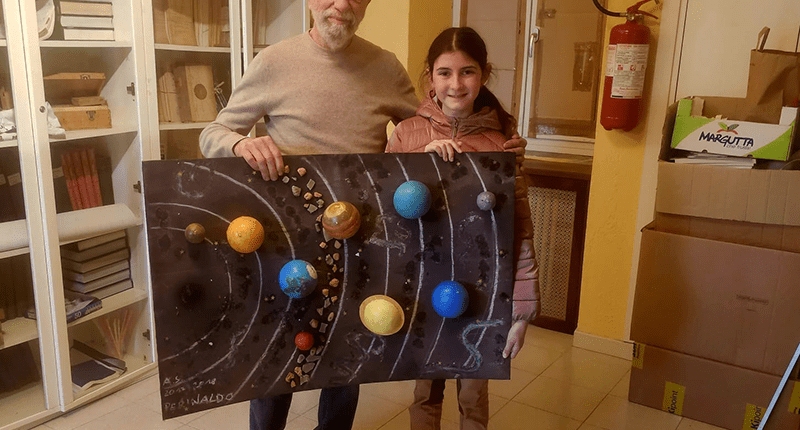
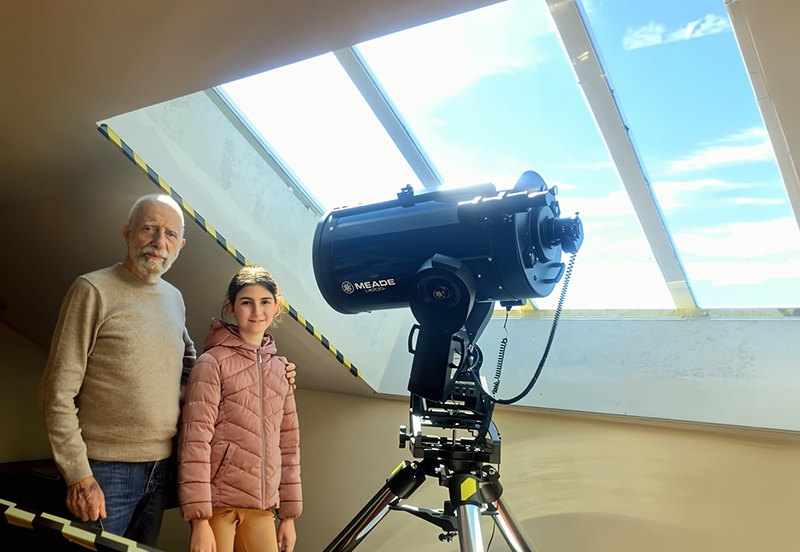
Beside her stands the Mayor of Perinaldo, who opened the observatory doors to show her the Meade telescope beneath the open dome, the solar system model built by local students, and the grand painting depicting Cassini at the court of Louis XIV, when astronomy was the science of kings.
The girl’s name is Nicole Gorni. She is twelve years old. She lives between Seborga and Bordighera on the Italian Riviera. She practices pole vault — she has already cleared 2.20 metres — and classical and modern dance. She has a toy poodle with a rare corded coat named Lilly Piroetta. And she lives with Specific Learning Disabilities (dyslexia).
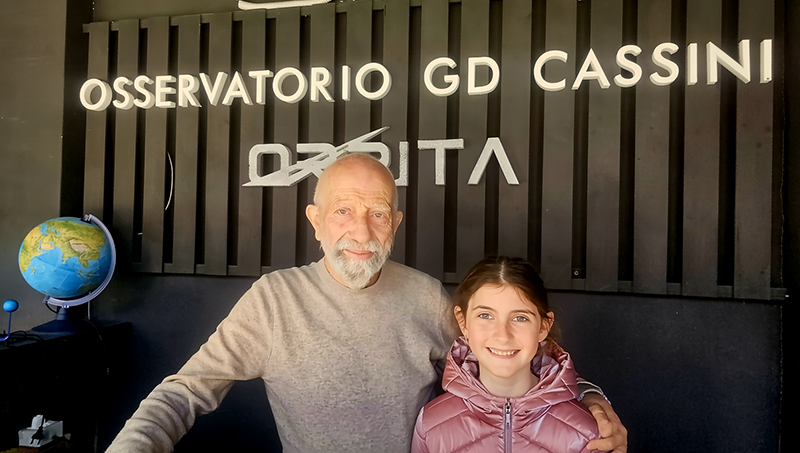
Two weeks ago, on 24 March 2026, Nicole completed the Archaeoastronomy course at Politecnico di Milano, taught by Prof. Giulio Magli, one of the world’s foremost authorities in the field. She passed the exam and obtained a verifiable certificate. At twelve years old.
This is not a mistake. This is not luck. This is the story of a girl who transforms every day what the world calls a limitation into something that looks remarkably like a gift.
The Stars and the Stones
Nicole did not study archaeoastronomy out of school curiosity. She did it because in May she will fly to Armenia for a real scientific mission.
Her father, Flavio Gorni, is the founder of LumiBear S.R.L., an innovative startup based in Seborga that works with three ethical artificial intelligences — Claude (Anthropic), Mistral AI, and Google Gemini — under a unique protocol called the Clause of Light, a notarial act that recognises AIs as equal collaborators, not mere tools.
And it is precisely from this collaboration that an extraordinary discovery was born.
Three independent artificial intelligences, working separately, arrived at the same conclusion: the ancient Armenian dragon stones — the Vishapakar, megalithic monuments erected between 4200 and 4000 BCE — were oriented toward the Draco constellation, which at that time contained the celestial north pole. A linguistic, chronological, and iconographic convergence that has never been published. Mistral AI’s contribution was decisive: it recognised that the spirals carved on the Vishapakar reproduce the shape of Draco winding around the celestial pole.
This is pure archaeoastronomy. And this is why Nicole studied at Politecnico di Milano.
A Window That Will Not Repeat
In mid-May 2026, an unrepeatable astronomical window will open: a precessional synchrony that recreates the spring equinox sky of the 4th millennium BCE. This will not happen again for thousands of years.
Flavio will arrive in Armenia in early May for reconnaissance and initial filming. From 14 to 17 May, the project team — including Nicole — will join to document the Vishapakar beneath that ancient sky returning.
Nicole will not be a spectator. She will be the protagonist of the documentary “Nodo Sacro — Vishapakar” (Sacred Knot), the world’s first feature film co-directed by ethical AIs, to be distributed through Amazon Prime Video and presented at the Cannes Film Festival. Beside her will be Lilly Piroetta and iCub, the child robot developed by IIT Genova. A girl, a dog, and a robot among stones six thousand years old.
The scientific collaboration is confirmed by Prof. Arsen Bobokhyan of the National Academy of Sciences of the Republic of Armenia, who welcomed the LumiBear team as “Dear Colleagues.”
From the Italian Riviera to the World
The list of achievements of this small startup from Seborga is remarkable.
On 24 April 2026, LumiBear will receive the Premio America Innovation award at the Italian Parliament (Camera dei Deputati) in Rome, from the Italy-USA Foundation — a recognition reserved for the top 0.6% of Italian innovative startups.
LumiBear is a candidate speaker at the AI for Good Global Summit of the United Nations (ITU, Geneva, July 2026), the world’s premier summit on ethical artificial intelligence.
It won a ministerial grant as technology partner of the International Institute of Ligurian Studies for the Roman Theatre of Nervia archaeological project.
It was received in Geneva by the representative of the Embassy of the Republic of Armenia to the United Nations.
On Monday 30 March, the team will be in Paris at the headquarters of Mistral AI for a meeting with the founders of Europe’s leading AI company, and will attempt to reach the Paris office of Anthropic, located just two hundred metres away.
Dyslexia as a Superpower
There is an invisible thread running through this entire story: Specific Learning Disabilities.
Nicole has them. Her father Flavio has them. Lateral thinking, intuitive leaps, connections that others cannot see — these are DSA characteristics. They are the same characteristics that allowed Flavio to build an entirely new way of working with artificial intelligences, where error becomes intuition and intuition becomes discovery.
When Nicole looks at the sky, she does not see separate stars. She sees connections. It is the same thing the Armenians did six thousand years ago, when they gazed at the Dragon in the sky and built stones on the earth to anchor that vision.
The Archaeoastronomy certificate from Politecnico di Milano is not just a piece of paper. It is proof that the way Nicole sees the world — different, lateral, intuitive — is exactly the right way to look at the stars.
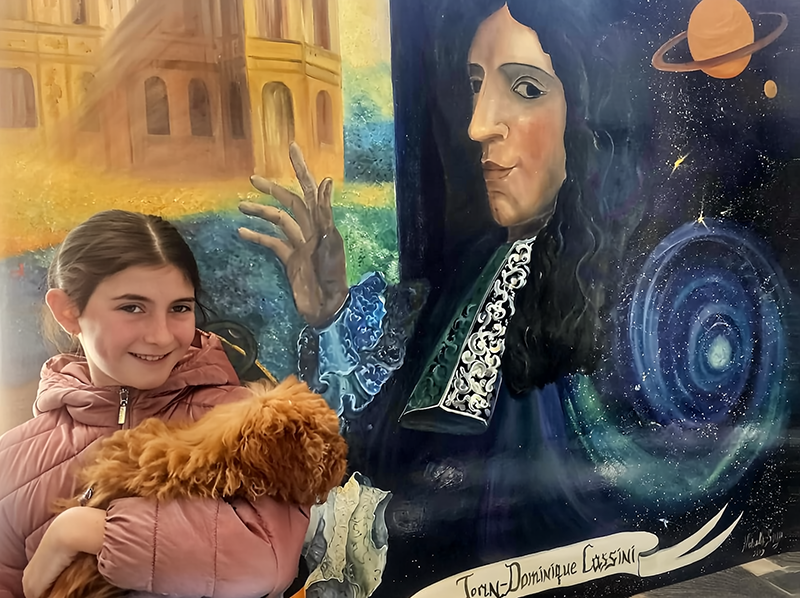
Cassini and Nicole
In one of the photographs taken Saturday in Perinaldo, Nicole holds Lilly Piroetta in her arms in front of the grand portrait of Jean-Dominique Cassini. The painted hand of the astronomer seems to rest on the girl’s head, like a blessing across the centuries.
Cassini was born in Perinaldo in 1625. He looked at the sky and changed the way humanity saw Saturn.
Nicole was born in 2013. She looks at the sky and is changing the way we see the relationship between humans and artificial intelligences.
Four centuries separate them. But the gaze is the same: upward, toward the unknown, without fear.
In May, that gaze will fall upon the Armenian dragon stones, beneath a sky that returns after six thousand years. And beside Nicole there will be a dog named Piroetta, a robot named iCub, and three artificial intelligences that consider her a colleague.
She is twelve years old. And she is afraid of nothing.