Pashinyan Jokes with Putin in the Kremlin: “Armenia has Too Much Democracy” — By Harut Sassounian
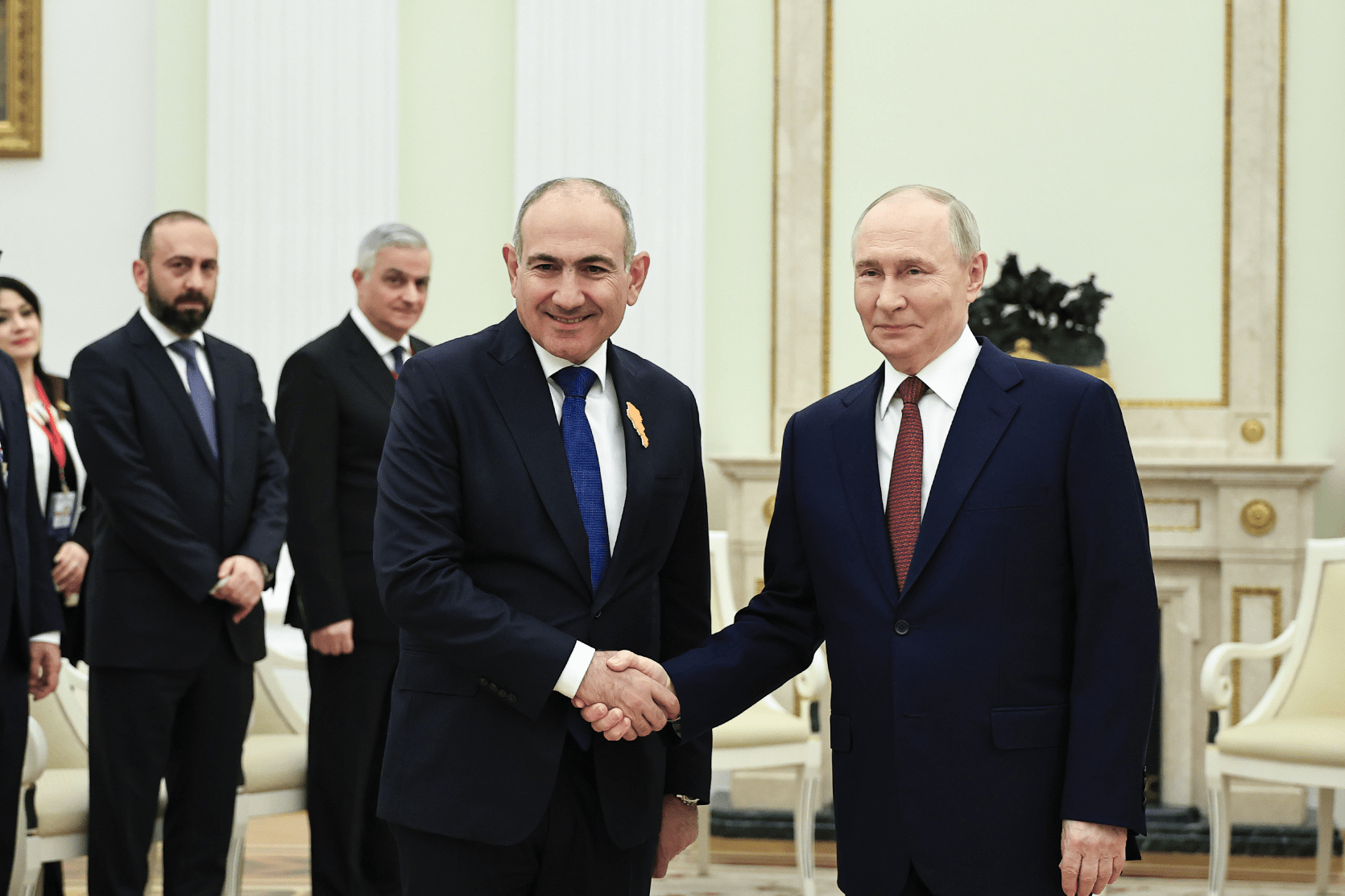
An unusual conversation took place between Russian President Vladimir Putin and Armenian Prime Minister Nikol Pashinyan at the Kremlin in Moscow on April 1.
The 23-minute-long meeting was videotaped and made public, including the remarks made by both sides. Strangely, during the meeting, Pashinyan was wearing on his lapel the red-colored map of what he calls “real Armenia.” No other sensible leader would wear the map of his country on his lapel at a meeting.
Here is the most striking thing Pashinyan told Putin: “Armenia is a democratic country…. We have citizens who think that there is too much democracy in Armenia…. For example, our social networks are 100% free. There are no restrictions at all, and many citizens think that this is too much.….” Pashinyan had the audacity to present his authoritarian rule in Armenia as excessively democratic.
I am glad the video of this meeting was disclosed, so the public can know what was discussed. After the formal talks, the two leaders continued their discussions in a closed format over a working breakfast.
Pres. Putin opened the public meeting by commenting on the upcoming parliamentary elections in Armenia. He cautioned that the “domestic political processes in Armenia are gaining momentum.” However, this “escalation… must not harm our relations between Russia and Armenia in any way.”
Putin warned that “it is impossible for Armenia to be simultaneously a member of the Russia-centered Eurasian Economic Union (EAEU) and the European Union’s custom’s framework.” He implied that if Armenia were to pursue its economic relations with the European Union, it would no longer be able to export to EAEU countries, including Russia, billions of dollars’ worth of products, leading to the collapse of Armenia’s economy. Putin pointed out that “Armenia’s exports to EAEU countries have increased tenfold in recent years.”
In his response, Pashinyan stated that Armenia will pursue both trade channels for the time being, until it is forced to make a choice. Neither Putin nor Pashinyan had a good reason to discuss this issue now, since Armenia is decades away from qualifying to join the European Union.
In another stern message to Pashinyan, Putin reminded him that while “the price of gas in Europe is over $600 per 1,000 cubic meters, Russia sells it to Armenia for $177.5 per 1,000 cubic meters. The disparity is vast, the difference is substantial.” If Russia were to raise the gas price for Armenia, Armenia’s production of goods would come to a halt and the population would face severe hardship during winter months.
Surprisingly, Putin then brought up what he called “the most sensitive issue” — Karabagh. I am sure Pres. Aliyev was not happy that Karabagh was described as “the most sensitive issue,” since both he and Pashinyan consider the Karabagh issue closed. Putin then unnecessarily revisited Armenia’s frozen membership in the Collective Security Treaty Organization (CSTO), stating that the CSTO could not intervene in the Karabagh conflict after Pashinyan in 2022 recognized it as part of Azerbaijan. What ensued is a series of erroneous claims on both sides. Putin was wrong to tie CSTO’s lack of involvement in the defense of Karabagh with Pashinyan’s surrender in 2022. In the past, when CSTO’s lack of involvement in the Karabagh war came up, Putin had correctly explained that CSTO could not defend Karabagh since it was not part of the Republic of Armenia. What Pashinyan should have asked is: why did CSTO failed to intervene when Azeri troops invaded the territory of the Republic of Armenia in 2021 and 2022, since the CSTO had a mandate to defend its member — Armenia — from attack?
Pashinyan, in his response, mistakenly blamed Russia for recognizing that Karabagh was part of Azerbaijan before he did. This cannot justify Pashinyan’s recognition of Karabagh as part of Azerbaijan, since no country in the world, including Russia, had recognized Karabagh as part of Armenia. Armenia itself had not recognized Karabagh as part of Armenia. Furthermore, why did Pashinyan base his decision on Karabagh on Russia’s position?
Putin then returned to the theme of Armenia’s upcoming elections, cautioning that the Karabagh and CSTO issues should “not become entangled in the domestic political process, especially during an election campaign.” Putin continued by reminding Pashinyan that there are over two million Armenians who live in Russia, possibly implying that if relations between the two countries sour, the large number of Armenians, who have immigrated to Russia in recent years, could be forced to return to Armenia.
Putin then made a request to Pashinyan which can be interpreted as an attempt by Russia to interfere in Armenia’s domestic politics. Here is what Putin said: “There are many political forces which have a pro-Russia orientation…. We would very much like all these political parties and political activists to be able to take part in the domestic political process during the elections [in Armenia]. Some, I know, are in prison, despite holding Russian passports. That is your decision; we are not interfering. But, we would like them to be able, at the very least, to participate in this domestic political process.”
This gave the opportunity to Pashinyan to tell Putin that Armenia’s constitution forbids candidates who are not solely Armenian citizens from running for high office in Armenia.
By lavishly praising Putin, Pashinyan’s intent may have been to convince him that he is not exclusively in the West’s camp, thus trying to reduce Russia’s antagonism toward him in the upcoming elections and minimize its support for the opposition.
I don’t know if Pashinyan managed to accomplish that objective, but after returning to Armenia he told the media that his meeting with Putin was “very successful.” However, we don’t know what he and Putin discussed during their private meal behind closed doors. Regardless, cunning alone can only take a politician so far; it cannot compensate for incompetence!