Baby in a Brown Basket wrapped in White lace fabric
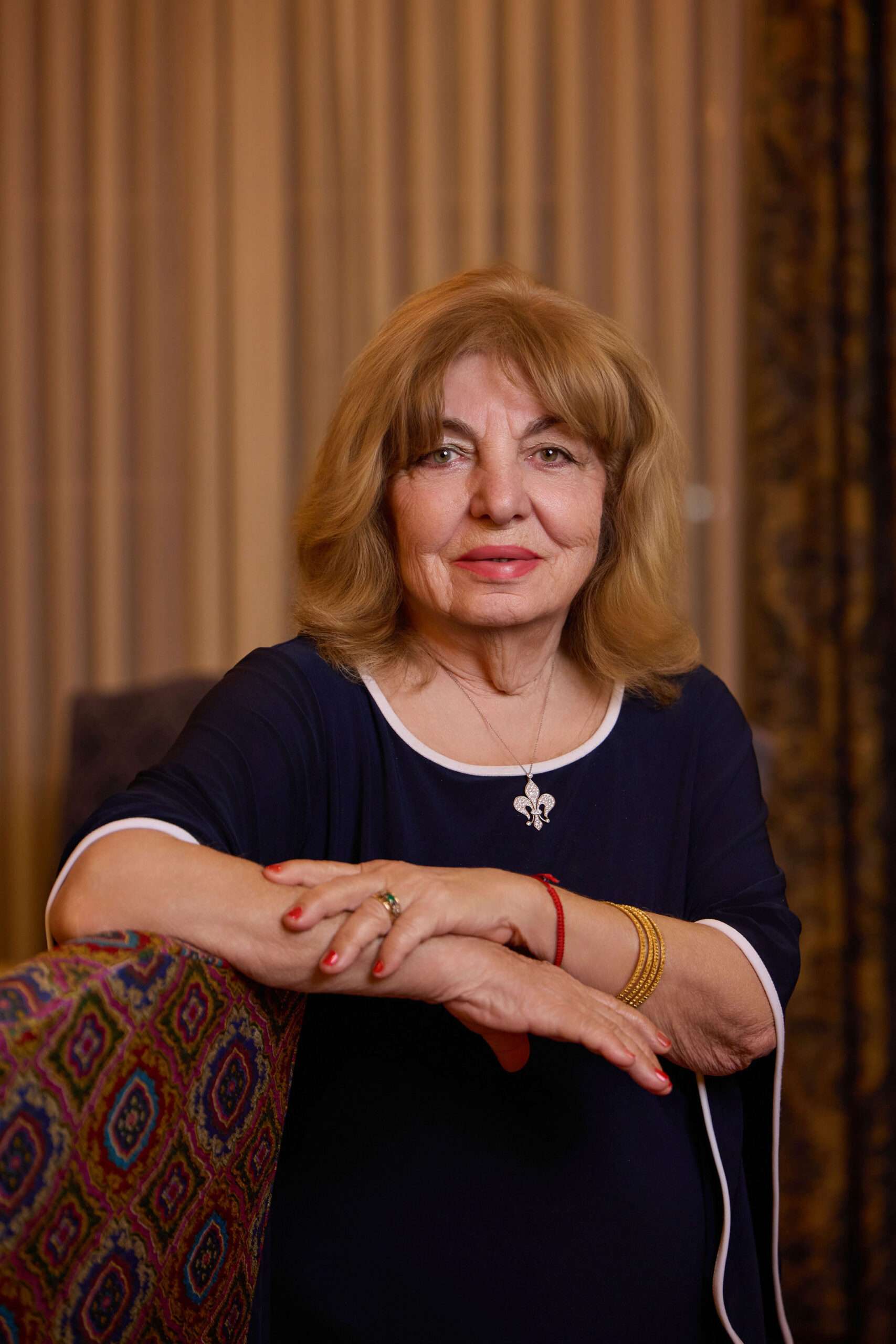
By Rosemary Cohen
I was invited to speak about my book, The Survivor, at the Mazandarani Group in Los Angeles. My book recounts the lives of my grandparents which opened an unknown chapter in history, about the massacre of Armenians and Assyrians in the northwestern cities and villages of Iran in 1918.
As I further discovered, I came to understand that this was not merely a massacre, but a well-organized plan by the Turkish government, carried out by the Ottoman army, to annihilate the Armenian and Assyrian populations—many of whom were Iranian citizens who had lived in the region for centuries. In fact, this tragedy can be seen as a continuation of the Armenian Genocide of 1915, extending into Iran in 1918 and ultimately leading to the destruction of Armenian and Assyrian communities in those regions.
I learned that the Mazandarani organization is composed of Iranian intellectuals and distinguished individuals who held prominent positions before the 1979 revolution in Iran. Its members include engineers, authors, government ministers, artists, and directors of major organizations.
A second speaker at this event was Dr. Kazem Vadiei, a geographer and researcher by training who held several important posts in Iran. He served as a professor and Director of Research at Tehran University and traveled extensively to villages and cities across the country—so much so that it can be said he knows Iran inch by inch. He was later appointed Dean of the Cooperative and Rural Development Faculty, where he contributed significantly to the study and advancement of rural development faculty at Tehran University in Iran.
He later served as Minister of Labor and then as Minister of the Environment. He is a highly respected figure who continues to write for numerous magazines and is frequently interviewed on radio and television, particularly in France, Canada, and the United States. At the time, he had just published his memoir about the events surrounding the 1979 Revolution, Shahed Zaman (in English, Witnessing the Time), and was on a tour to present and speak about his book.
As I looked around at all the distinguished faces present at the meeting, I found myself reflecting on the past. There was a time when anyone wishing to meet one of these men would have had to submit a formal request through a secretary and overcome many obstacles just to secure an appointment. Now, they were all sitting together around a table at a Sizzler restaurant on Wilshire Boulevard (which has since closed).
They all looked tired, and a trace of sadness lingered on their faces. Their sorrow seemed rooted in the fact that they could no longer apply their knowledge and talents in their homeland, to which they could not return. At the same time, many found themselves unable to fully use their expertise in their adopted country, the United States, often due to language barriers. Now, they live with rich memories of the past—remembering who they once were—while navigating a place where they are often seen differently. As when I asked where I could find the group, one of the servers inquired “Are you looking for the old men with canes?”
One comforting reality, however, was that they had all known each other in Iran and continued to treat one another with the same respect they had always shown back home.
They meet once a month for two hours, and during that time, they return—at least in spirit—to Iran. In a sense, they rediscover their true selves. In the company of old friends, their spirits briefly came alive again. They shared news about the lives and fates of longtime acquaintances and exchanged stories about events in both their adopted country and their beloved homeland.
After my talk, the group engaged in a discussion. Most of them were familiar with the Armenian Genocide; however, as is often the case, many were unaware of the massacres carried out by Ottoman Turkish soldiers and Kurdish militias in Khoy and other cities across northwestern Persia in 1918. In my recent work, I have referred to this as the “Hidden Genocide” of the Armenians of Iran by Ottoman Turks. (At the same time, we must not overlook the role of certain Kurdish tribes that participated in the killings with a similar brutality.)
Suddenly, one of the group members, Mr. Zamani—a man in his sixties and a well-known Iranian painter and illustrator—spoke up. He told me that my talk had stirred an old memory and a lingering dilemma within him, one he felt compelled to share.
He said that, although he had been blessed with success and recognition over the years, he had long been haunted by the memory of a dinner during his student days in Turkey, nearly fifty years ago.
“After I finished high school, I wanted to become a dentist. After submitting many applications, I was accepted to the University of Istanbul, where dental training was considered better than in Iran. My parents were pleased and agreed to send me to Turkey to continue my studies.
At first, like many foreigners, I experienced deep loneliness in this new country. Everything felt different from what I was used to in Iran, and adapting was not easy. Gradually, however, my loneliness faded when I met three close friends at the university. Life became more enjoyable for all of us. We studied together and spent much of our time in each other’s company, forming what we jokingly called a four-brother bond.
One of the young men was Turkish, born and raised in Istanbul. The other two were brothers of Armenian origin who had adopted Turkish-sounding names. (After the Genocide of 1915, many surviving Armenians in Turkey changed their names to blend into society and avoid discrimination.) Of course, our Turkish friend was aware of their background.
We belonged to a younger generation, for whom religion and national identity did not seem important. Peace and harmony shaped our thinking. To us, the past felt distant—something old and already left behind
One day, our Turkish friend told us that his parents had invited all of us to their home for dinner. We were thrilled at the thought of a home-cooked meal, especially after he mentioned that his mother was an excellent cook.
His parents lived in a lovely house and welcomed us warmly. They told us that their son had spoken so highly of our friendship that they were eager to meet us. The aroma of food filled the air, making us even hungrier.
As we sat at the dinner table, we struggled to restrain our excitement and appetite. Before us were colorful ceramic dishes, beautifully arranged, and we could hardly wait for the invitation to begin. In a small brown basket, freshly baked bread was wrapped in delicate white cloth, with warmth and steam gently escaping from within.”
As we waited for his mother to bring the rest of the food and join us, his father—who appeared warm, with a gentle smile—began asking about our studies. Then, quite unexpectedly, and while gazing at the brown breadbasket wrapped in lacy white fabric, he told us the following:
“When I was your age, I was called to serve in the Turkish Army. My unit was not sent to the Dardanelles; instead, we were ordered to kill Armenians in villages and cities. We killed hundreds of them every day. At night, we boasted about what we had done and competed to see who had killed more.
Most nights, we were assigned to patrol the streets. One evening, a friend and I were walking slowly through quiet, empty streets. The sun had set, but darkness had not yet fully fallen. Suddenly, we noticed a small shadow in a narrow alley. We could not tell whether it was a man or a woman. The figure placed something in the middle of the alley and then disappeared like a ghost.
Curious, we walked toward the object. As we approached, we saw a small brown basket. Inside it lay a baby, wrapped in a white blanket and covered with delicate lace. We realized that a desperate Armenian mother had left her newborn there, likely hoping that someone kind would find the child, take it in, and save its life.”
As we approached the basket, the baby began to cry. As I looked at the child’s small, hungry mouth, my friend suddenly pulled his rifle from his shoulder and thrust the bayonet toward it. He began to twist it, as if stirring a pot.
As blood filled the baby’s mouth, the cries grew louder. My friend became increasingly agitated, driving the bayonet deeper. I stood there, frozen, unable to react—as though I were no longer part of myself. He acted alone, while I remained a silent witness. After a while, I could no longer endure the sound of the child’s suffering or the sight before me. Finally, I said, “What are you doing? Just finish it.”
Our friend’s father fell silent for a moment. No one at the table spoke. I glanced at the two Armenian brothers, who bore Turkish names, and feared how they might respond. Then I felt a strange sense of relief. Their eyes, filled with sorrow, seemed fixed somewhere far beyond the room—as if trying to escape what they had just heard. They appeared stunned, their bodies motionless, their faces drained of color. It was as though they were no longer present among us, but had retreated into a place of unbearable memory and pain.
No one reacted with anger. Instead, a heavy silence settled over the table—one of shock, discomfort, and something deeper that words could not express.
After a pause, the man continued. He told us that, at his urging, his friend finally pulled the trigger and fired a bullet into the baby’s mouth. The child’s blood and body were left in the small brown basket in that dark, narrow alley.
Around the table, we were all in shock. Our appetites had vanished, and no one touched the food. It was a quiet disappointment for our friend’s mother, who had spent the entire day preparing the meal for us.
I believe that even our Turkish friend had never heard such “glorious,” “brave,” and “heroic” stories from his father before!
For a long moment after the story ended, the members of the Mazandarani Group and I remained silent, honoring the memory of the innocent Armenian baby whose name will forever remain unknown. Finally, with a heavy expression, Mr. Zamani broke the silence.
“Your book, The Survivor, reminded me of this horrifying story. I have never forgotten it, yet for more than fifty years, I had never spoken of it until today.”
It was not long after that evening that I left dental school. I found that I could no longer endure the sight of a bloody mouth. I changed my path and became an artist instead. Still, I have never forgotten my friend’s father or the story he told us.
Over the years, I have asked myself the same questions again and again, without ever finding convincing answers. That is why I am sharing them with you now—perhaps you may have an answer:
Why did our friend’s father choose to tell us this story that night?
Why did he insist, again and again, that he himself had done nothing—that it was his friend who committed the act?
And why tell such a story at the dinner table? Who speaks of such horrors when food is being served?”
This was my answer:
“I am not sure why he told you the story, since I did not know him personally. What I can suggest is that the brown basket of bread, wrapped in a lacy white fabric, may have suddenly triggered his conscience and brought back the image of the basket holding the baby. Seeing four happy young friends together might also have reminded him of his own youth, when he was forced by his government to serve in the army and participate in violence. Their army committed atrocities not only against Armenians and Assyrians, but also against parts of the Muslim population of Iran.
Perhaps, in some deep part of his heart, he envied you. You were young, innocent, studying, and laughing together. At your age, he had been forced into a life as a soldier, compelled to boast about killing hundreds of innocent people each night in order to earn the approval of his peers. In his words, he had blood on his hands.
Now, living in peacetime, I am sure he was burdened by regret. Deep in his soul, was he truly proud of what he had done? The fact that he repeatedly insisted he had not acted himself, but that his friend had, suggests something different: perhaps he suffered for decades as a witness who lacked the courage to intervene and save a helpless baby. In that sense, he may have carried the weight of guilt in silence for fifty years. Had he been the direct perpetrator, he might have justified his actions more easily. But instead, he was a witness who did nothing to help a defenseless child in a brown basket.”
I told Mr. Zamani: “Even after hearing your painful story, I remain, as always, hopeful. I can still see a small light at the end of a dark tunnel. If your friend’s father could not forget the image of that suffering child even after fifty years, then I believe there is always a small trace of God, even in the darkest human soul—a search for light that never fully disappears.
That Ottoman soldier can never undo the past. At the very least, I believe that my grandparents and the one and a half million innocent Armenian souls are now in Heaven.”
I do not believe that any criminal, no matter how powerful, can escape the awakening of their conscience. One day, they hear the voices of their victims calling for justice. This, perhaps, is the burden left behind by those who suffered—a lasting memory that does not fade. As a result, many live in silent torment until the end of their lives. At times, they confess—like your friend’s father did—to strangers, perhaps because it feels safer, or because it temporarily lightens the weight they carry. In many cases, prisoners have also been known to confess their crimes to their cellmates.
“There are many Turks living on this earth; I would be satisfied to hear a word of apology from them and from their government.”
Silence is perhaps the worst sin. Through passivity and silence, we encourage oppressors. Silence can be interpreted as acceptance. In remaining silent, we risk appearing to agree with both past and future actions. Silence opens the door to future nationalist extremists and authoritarian leaders. It sends a message that, when the time comes, repeating such atrocities is permissible.