
Echoes of belonging: The Armenian church’s bells of Chennai and their unseen legacy
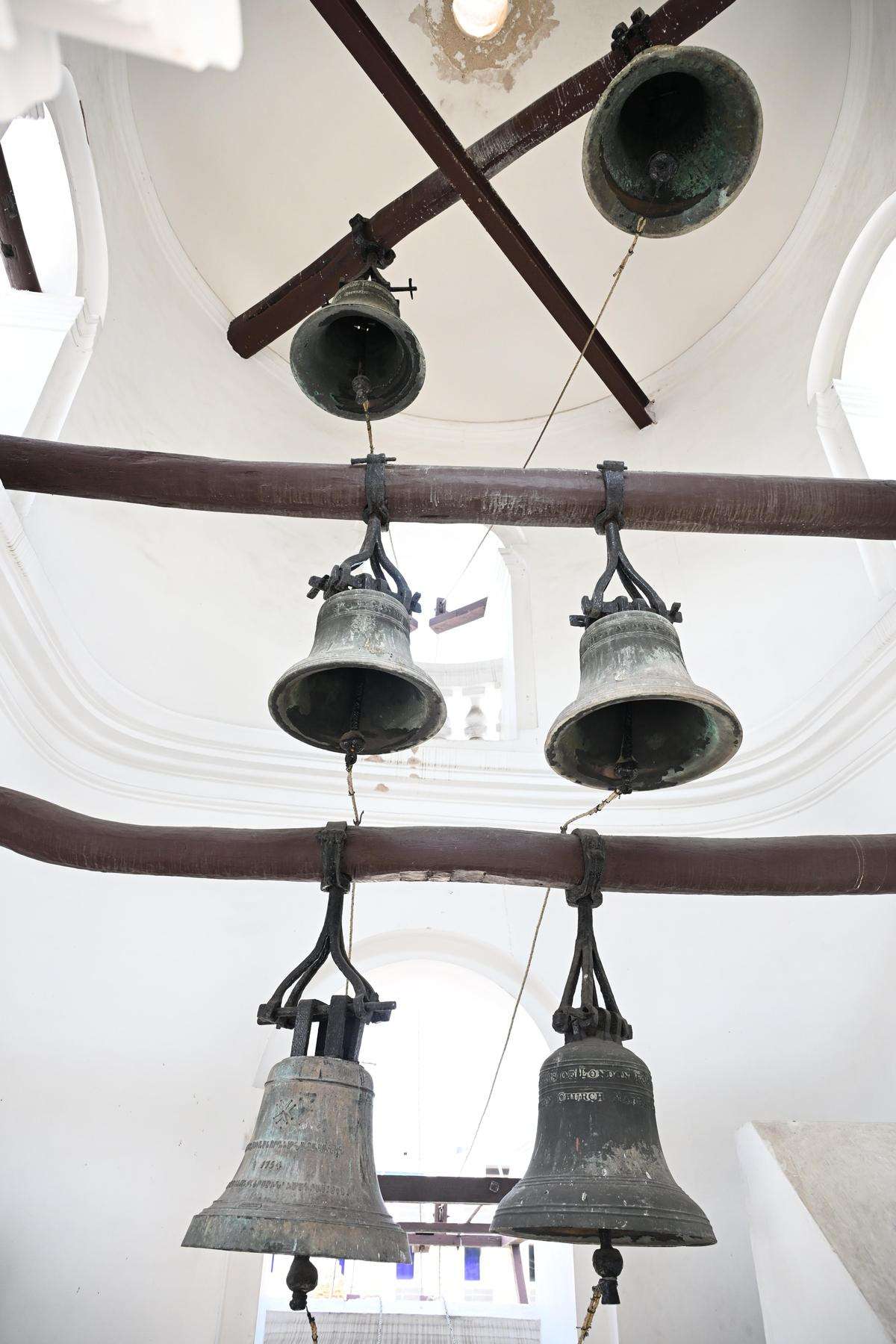
Three hundred years have gone by, but the Armenian church’s six sonorous bells continue to spread calm, and remind some others of a home far and beyond
Do bells clang, chime, or ring? On Armenian Genocide Remembrance Day on April 24, they seemed to toll, ringing across the streets of George Town.

A view of the 6 Armenian Church bells at Armenian Street, Parrys in Chennai. | Photo Credit: JOTHI RAMALINGAM B
Jude Johnson, the caretaker of the Armenian church, stands at the precipice of the structure, holding on to six thick ropes, each connected to its six bells, weighing around 150 kilograms each. “Shall I ring it?” he asks. Several deep, heavy clangs rush through the air. “It is a special day, it is okay to ring it,” he reconciles with himself.
When early Armenians arrived in Chennai as merchants and traders in the mid 1600s, they began realising the need for a formal space of prayer. The church on the eponymous street was built in 1712 as a small wooden chapel, and later reconstructed in 1772. The six bells in the belfry were used to call the congregation to attend services and gatherings. “At that time, Madras had a larger Armenian population, so the bells played an important community role,” she says.

A view of the Armenian Church bell tower at Armenian Street, Parrys in Chennai. | Photo Credit: JOTHI RAMALINGAM B
Ashkhen says that the first and oldest bell, dating to 1754, became even more distinctive when its lettering was reworked in 1808 by a local Madras foundry named Arulapan. The name Arulapan can still be seen on the bell, written in Tamil script. It was gifted in memory of ‘Mnatsakan‘, a then-resident by his father Ghukas. “It makes the bell especially significant, as it reflects a rare meeting of Armenian heritage and Tamil craftsmanship. It shows how the Armenian community in Madras was closely connected with local artisans who helped preserve and maintain their sacred objects,” she says.
There is a reason why the belfry continues to charm visitors till date. The bells are rung every Sunday morning by the caretaker and whenever Armenians visit the church. Ashken says that her son loves pulling the rope and hearing the peals when they visit.

A view of the Armenian Church bell at Armenian Street, Parrys in Chennai. | Photo Credit: JOTHI RAMALINGAM B
They are also rung on Armenian Christmas (celebrated in January) , Easter, Armenian Genocide Remembrance Day, Republic Day, and other meaningful community events. “It serves as a living symbol of the Armenian presence in Chennai. Everytime I am there, I think of the time from centuries ago when people from my country once sat in the same chairs listening to this service,” Ashken says.
She adds that for Armenians who visit today, the bells are deeply emotional. Their sound creates a connection between past and present. “Many visitors say they have never heard bells with such a beautiful and powerful tone as the bells of the Armenian Church in Madras. When they ring, it is more than sound — it is memory, identity, and belonging,” she says. “I am several thousand kilometres away from home but during those moments, I am transported.”