The hypocrisy in Israel’s new Christian outreach
The recent appointment of George Deek as Israel’s special envoy to the Christian world has been framed by the Ministry of Foreign Affairs as a bridge-building masterstroke. Deek — an Arab Christian, seasoned diplomat, and descendant of refugees from the 1948 war — appears, on paper, to be an innocuous choice. However, beneath the layers of diversity and inclusion lies a profound hypocrisy that ignores both Deek’s questionable track record and the lived reality of the very community he is now tasked to serve.
The core of this hypocrisy lies in how the Israeli government instrumentalizes Deek’s identity. By appointing an Arab Christian to court the global Christian community, Israel is attempting to project an image of pluralistic harmony — a harmony that is increasingly absent, both within its own borders and foreign policy.
While Deek is paraded on the world stage as a success story, the indigenous Palestinian Christian community in the Holy Land is facing an existential crisis. Squeezed between the pressures of military occupation in the West Bank and a rising tide of religious intolerance within Israel and East Jerusalem, the community is dwindling. To appoint a “special envoy” while simultaneously presiding over the expansion of settlements on Christian-owned land in the Bethlehem region is not diplomacy; it is a distraction.
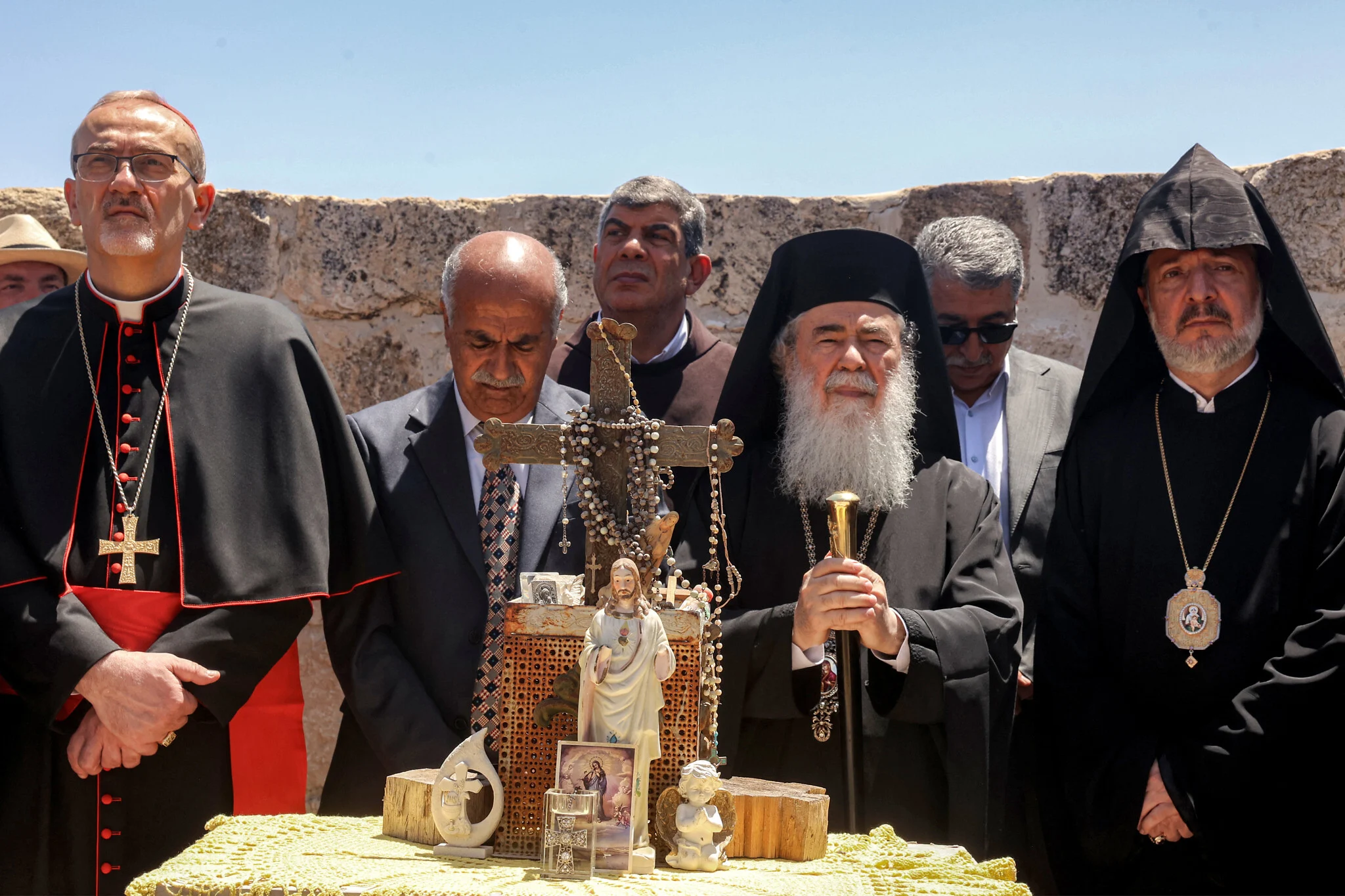
The irony of Deek’s appointment reaches its peak within the walls of Jerusalem itself. While he is tasked with projecting an image of Israel as a haven for Christians, the Armenian Quarter — a cornerstone of the city’s Christian heritage for over 1,600 years — is currently under sustained threat from predatory land grabs.
The ongoing struggle over the “Cow’s Garden” site has forced the Armenian community to maintain 24-hour vigils to protect their land from a controversial development deal. This is no mere real estate dispute; it is a coordinated attempt by settler-linked entities, bolstered by the silence or active cooperation of the state bureaucracy, to erode the Christian character of Jerusalem.
For the Armenian community, Deek’s appointment is a particularly bitter pill to swallow, as there is a terrifying symmetry between his past and his present.

As Israel’s Ambassador to Azerbaijan, Deek presided over a diplomatic era defined by a strategic alliance that directly facilitated the suffering of the Armenians of Nagorno-Karabakh (Artsakh) — home to one of the world’s oldest Christian populations. During the 2020 Nagorno-Karabakh War, Israeli-made weaponry, including “suicide” drones and sophisticated missile systems, played a decisive role in Azerbaijan’s victory. As the diplomat on the ground, Deek was no mere bystander. He was the face of a partnership that provided the hardware for the ethnic cleansing of more than 120,000 Armenian Christians from their ancestral homes.
Deek’s silence during this forced displacement was matched by his indifference to the systematic destruction of Armenian churches and holy sites — a state-sponsored campaign to erase the Armenian cultural footprint that began on his watch and continues to this day. Under the guise of “restoration,” Azerbaijan dismantled the iconic Ghazanchetsots Cathedral in Shushi shortly after capturing the city. This followed the destruction of other sacred sites, including the 177-year-old St. John the Baptist Church and St. Ascension Church.
Across the region, ancient Armenian cross-stones (khachkars) and cemeteries have been leveled to remove any trace of Armenian history. Recent satellite imagery even indicates the systematic dismantling of the Stepanakert Cathedral, a sacred landmark of Armenian life. As Israel’s representative in Baku, Deek’s failure to issue even a standard diplomatic expression of concern over these acts of cultural genocide was not a matter of “diplomatic necessity,” but a policy of choice. He demonstrated that his commitment to the Christian world is entirely transactional.
To name Deek now as a representative to the “Christian world” is a cynical pivot. It asks the global community to forget that his diplomatic success in Baku was built on the ruins of Armenian churches at the expense of its Christian soul.
By including his complicity in the Azerbaijan-Armenia conflict, the narrative of Deek as a bridge-builder crumbles.
In the end, George Deek’s appointment is not about protecting Christians. It is about providing a more palatable face for a foreign policy that prioritizes arms sales to Baku and land grabs in Jerusalem and Bethlehem over the survival of indigenous Christian communities. If his record in Azerbaijan is a harbinger of things to come, his new role will not be to defend the faith, but to provide the diplomatic cover necessary to finish what he watched begin in Baku.