Presbyterians and the Armenian genocide
Presbyterian Historical Society archivist illustrates relationship between Presbyterians and Armenian refugees in preparation for General Assembly overtures on genocide
June 15, 2026
David Staniunas, Presbyterian Historical Society
Presbyterian News Service
With the 227th General Assembly preparing to act on two overtures on genocide, we consider that the Church has in the past acted to support survivors of genocide, well before the term was coined.

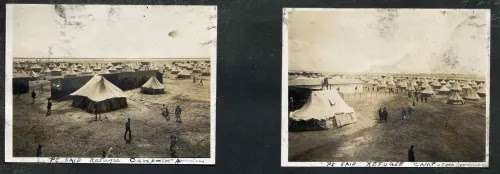
Armenian refugee camps, ‘8000 Armenians,’ from R. E. Magill photograph albums, 1919, Pearl Digital Collections.
The PCUSA Syria Mission lay entirely within the Ottoman Empire, and in 1914 was fervently evangelical and optimistic. The mission’s hope was that the ‘İttihad ve Terakki Cemiyeti‘, then ruling as a dictatorship, would unfetter the evangelization of Muslims: “not only may the missionaries press their work among the Mohammedans, but that if they do not, doubt is raised as to the integrity of their purpose.”

‘The Confines of Armenia,’ from R. E. Magill photograph albums, Pearl Digital Collections.
By the same token, as Henry Gorman describes in “American Ottomans,” Presbyterian mission workers in Syria in the second half of the 19th century scrupulously sought the favor of the authorities. This included malign acts. In 1916, Henry Bliss, president of the Syrian Protestant College, telegraphed a list of the names of Armenian students at SPC to Ahmed Djemal Pasha, military governor of Syria, “even though he was aware of the ongoing Armenian genocide.”
It’s only in 1917 that the Assembly records its awareness of the Ottoman slaughter of Armenians, surprisingly, in the report of the North China Mission: “The sorrows of Armenia have been felt in An Su, and old ladies who earn one or two coppers a day for spinning and weaving have contributed as much as 20 coppers apiece to relieve that distress.” For its part, the Syria mission reports some concern that, should the United States break off relations with the Ottomans, “the property of the Mission might be imperiled.” Missionaries, with the help of U.S. ambassador Henry Morgenthau, were offered safe passage back to the States. The vast majority declined. “They are remaining at the posts and the work is going on uninterruptedly.”

Ruins of Kharberd/Harput and Orfu/Urfa, and Armenian family returning, from R. E. Magill photograph albums, 1919, Pearl Digital Collections.
Actual news would trickle out only after the Armistice of October 1918. The 1919 report of the Syria Mission to the Assembly tells of mission stations serving their neighbors and incoming refugees, suffering famine and malaria early on, influenza later. Mission schools became refugee shelters. In Sidon, Presbyterians maintained two soup kitchens, serving 500 people a day.
The Mission also reports the whereabouts of two mission workers whom they’d lost contact — Charles Dana of Beirut and William S. Nelson of Tripoli. The BFM reports that both were “deported and imprisoned because of their relief work, which was exceedingly distasteful to the Turkish government.”

Charles and Lanice Dana, RG 360. Presbyterian Historical Society.
Dana and the American Press operated a relief fund of some three million dollars (about $90 million in today’s dollars). Asked in June 1916 by the mission magazine Assembly Herald for highlights of Syria mission work, Dana was, as a person in charge of significant funds might be, circumspect: “The less limelight, spotlight, or highlight on the work of the Press, the better.”

Refugees on train, Turkey, May 1919; from Magill photo albums, Pearl Digital Collections.
It’s worth examining Dana’s testimony carefully because Christians in America frequently identified the Ottoman Empire as the enemy of its own people, Christian and Muslim, Arab and Armenian and Greek. (All this notwithstanding American Presbyterian accommodation and collaboration with Ottoman authorities in the half-century prior.)

Left: refugees at work in Orfu/Urfa; Right: Interior Orfu Church, 5000 massacred here in 1894, from R. E. Magill photograph albums, Pearl Digital Collections.
Writing of struggles to publish and evangelize in Anatolia and Iran, missionary magazine The Presbyterian reported in 1892, “The Turk never did believe much in tolerance, and never allows it where he can help it.” The 1919 Assembly rejoices at the end of the World War: “Words cannot express our thanks to God the Lord of Hosts for his great deliverance that he has given Syria and to us all from the tyranny of the Turks and their allies.”
With relief at the end of the Great War, Presbyterians greeted the 20th century. In a second article, we find the shadow of the Armenian genocide over the next hundred years.