Free After 1 891 Days in Azerbaijani Captivity
When the war in Nagorno-Karabakh came to an end, Vicken Euljekjian was captured by Azerbaijani soldiers. In an interview with Blankspot, he recounts his 1 891 days in captivity, the years he spent in solitary confinement, and the freedom he ultimately regained.
Av RASMUS CANBÄCK
Blankspot.se
It was late in the evening on 9 November 2020 when news broke that the war in Nagorno-Karabakh had come to an end. At the time, Vicken Euljekjian, an Armenian-Lebanese citizen who had emigrated to the breakaway region, was in Armenia’s capital, Yerevan.
His home near the town of Shushi — known as Shusha in Azerbaijani — was about to fall under Azerbaijani control. He believed he had until 1 December to clear out his belongings.
What he did not realize was that the village where his house was located was not covered by that timetable. Hoping to salvage as much as possible, he returned home with his friend Maral. It proved a costly mistake. Azerbaijani troops detained them both and quickly separated them.
The next day, the beatings began.
“First they hit my right ear. Then the back of my neck. The blows were so hard that my ears started ringing,” Euljekjian recalls.
Only later did he realize that he was being held at a detention facility in Azerbaijan’s capital, Baku.
“Since then, I have had hearing problems. I have lost between 40 and 50 percent of my hearing in both ears. My spine was damaged so badly that I now need support around my neck to hold my head upright.”
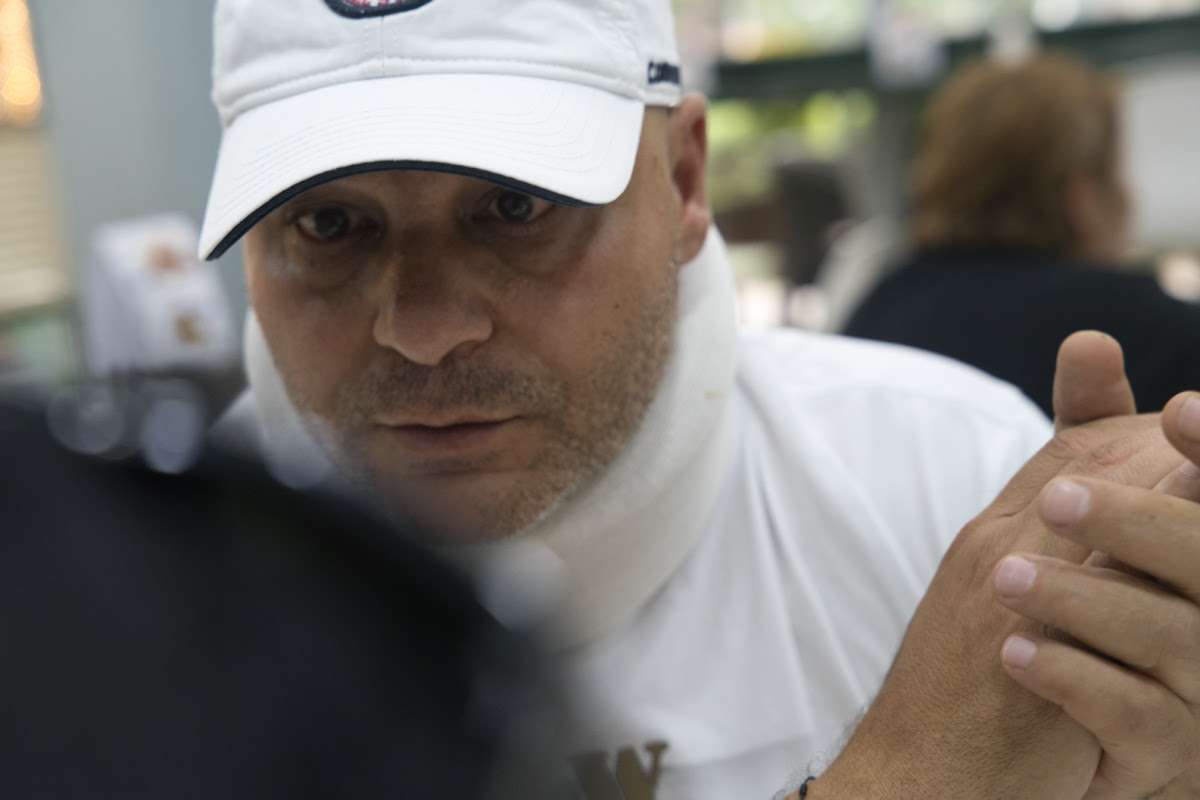
We meet at a café in Yerevan. Two childhood friends from Lebanon accompany him, having travelled to Armenia to support him. He leans forward as far as his neck brace allows in order to hear the questions. He repeats them to make sure he has understood them correctly.
During the final period of his imprisonment, he was confined to a wheelchair. At least he no longer needs it, but moving quickly remains difficult.

Vicken Euljekjian, 46, moved to Nagorno-Karabakh in 2018 to start his own business. Photo: Rasmus Canbäck
Released on 14 January this year, Euljekjian spent a total of 1,891 days — five years and two months — in Azerbaijani custody. His friend Maral was released just a few months after the arrest.
Today, his medical treatment is being financed through donations, support from friends, and assistance from an opposition political party.
“There is both a lot and very little to say about my time in Azerbaijan,” Vicken Euljekjian says.
Prison, he explains, is monotonous. Every day resembles the last. The memories that remain most vivid come from the first seven months of his captivity, when he was awaiting trial. At the time, he was being held at a State Security Service detention facility in Baku, not far from the city’s iconic Flame Towers.
“For about 20 days, the Red Cross managed to arrange for me to share a cell with another Armenian prisoner. It was the only time during those years that I was not alone. I had started hallucinating. I saw my mother in dreams. But it did not last long.”
The arrangement ended, he says, because Azerbaijani investigators had come to view him as a Lebanese terrorist.
A Lebanese terrorist?
“Yes. When they captured me, I gave them my Armenian passport. Somehow they looked into my background and discovered that I was from Lebanon. I confirmed it. Then they told me they would charge me as a Lebanese mercenary.”
Euljekjian says he tried to explain that his family were descendants of survivors of the Armenian Genocide.
“I told them, ‘I am Armenian by blood. My grandparents survived the genocide of 1915.’”

There are currently more than 250 political prisoners in Azerbaijan. Armenian detainees are rarely included in these counts. Today, an estimated 19 Armenians remain in Azerbaijani custody.
According to him, the investigator responded that he had never seen an Armenian passport.
“I had handed it to him only minutes earlier. It was lying on the desk in front of him. But he repeated that he had never seen it and locked it away in a safe. It was as if the passport had been erased from existence.”
Soon afterwards, he says, he learned that the authorities intended to film a video portraying him as a foreign mercenary. Because he already understood Turkish, which is closely related to Azerbaijani, he could follow much of what was being said.
“They accused me of receiving $2,500 a month from the Armenian government. At that point I gave up. I told them: ‘OK, do whatever you want.’ I understood that they were not interested in the truth.”
He nevertheless attempted to defend himself during the trial.
“But it felt as though the verdict had already been decided. The whole thing was theatre. You can talk until dawn and try to defend yourself, but in the end it changes nothing.”
He was sentenced to 20 years in prison and transferred to Gobustan Prison, a high-security facility around 50 kilometres southwest of Baku.
Just beyond the prison walls lie the famous Gobustan rock carvings, a popular tourist attraction. Inside, however, was a very different reality.

Five months after returning from more than five years in captivity, Vicken Euljekjian says the process of rebuilding his life has been slow. Photo: Rasmus Canbäck
For decades, the prison has been criticized internationally for poor conditions. In its most isolated section, in a small cell with the number 85 on the door, the third cell from the eastern flank of the building, where he would spend the next four years, Euljekjian lived entirely alone.
When asked whether he was allowed to leave his cell, he looks surprised.
“Leave the cell? No.”
Not once?
“No. Never.”
The cell measured roughly two and a half by four metres. A small window near the ceiling allowed in some daylight.
“You have to understand how bad it was,” he says. “The air was humid – suffocating. In summer the heat was unbearable. There were mice everywhere. It was the worst place you can imagine.”
The loneliness set in quickly.
He imagined cracks in the walls widening into escape routes. Perhaps the damp damage would soften the concrete. He pictured life beyond the prison walls: tourists visiting the nearby rock carvings, his family gathering for dinners without him.
The sense of loss deepened as one piece of bad news followed another. One by one, people close to him died, and he was unable to attend their funerals.
First, his father passed away. Then his brother. When his mother died as well, without him having the chance to say goodbye, it felt as though the walls were closing in around him. He tried to remember the last words he had spoken to them. He hoped they had been something positive.
Outside the prison, his wife Linda struggled to keep the family together. His late brother’s children moved in with her. Both children of Vicken and Linda were forced to abandon their studies to help earn enough money for the family to survive.
“A large part of my time in prison was spent imagining that I was helping my family, making sure there was food on the table,” he says. “It was a very difficult situation for my wife. All the bills that had to be paid.”
For him, imagination became a routine.
Every small detail he learned about life on the outside was woven into an imagined world in which he could still participate. When he closed his eyes, he let conversations between family members play out in his mind. He thought about what he would have said at the funerals. He reconstructed the scenes, over and over again, inside his head.

The interview with Vicken Euljekjian was conducted with the assistance of an interpreter. Photo: Rasmus Canbäck
Could you communicate with other prisoners?
“I need to repeat this: it was the worst place. I could not speak to anyone. Other inmates at different quarters had access to a yard where they could walk. We who were having a life sentence had nothing like that.”
His gaze shifts for the first time during our conversation. Tears begin to form.
The water, he says, was green. The food was barely edible.
“Usually it was some mixture of pasta, buckwheat and flour with boiling water poured over it. The bread was the only thing I could eat.”
When representatives of the International Committee of the Red Cross visited, he repeatedly asked them for one thing.
“Water. That was all I wanted.”
The delegates were foreign staff members working with the ICRC mission in Azerbaijan.
How often did they visit?
“According to the rules, about once a month. In reality, every 40 or 45 days. Maybe nine times a year.”
During the visits, he was allowed to speak with family members for two minutes.
“After four years, even that changed. We could no longer communicate through Red Cross channels and instead had to use a government telephone.”
Was that your only human contact?
“Yes. And they were only allowed into my cell. I was never allowed out.”
The visitors usually brought tomatoes and cucumbers. Occasionally, a tube of melted cheese.
“I asked for more cheese so I could put it on the bread, but they said it was not permitted. Once they brought me a cabbage. I marinated it in salt water and tried to preserve it. After that I was not allowed cabbage again.”
He also asked whether they could bring sausage or other protein-rich food.
“The prison governor claimed it might spoil. I told him I would eat it immediately. It made no difference.”
Eventually, Euljekjian told the ICRC delegates that there was little point in visiting him.
“Three tomatoes and two cucumbers were not worth it.”
Yet the visits continued.
“They would not listen to me, so I kept eating their tomatoes,” he says with a faint smile.
“As a foreigner, I had nobody to stand up for my rights. Whenever I complained to the Red Cross, they referred me to the prison administration. When I complained to the prison administration, they referred me back to the Red Cross.”
According to Euljekjian, Azerbaijani prisoners enjoyed significantly better conditions. Their families could visit more frequently and many cells contained refrigerators.
What kept you alive?
“There was only one thing: the idea that I might eventually get out.”
And a Bible.
“That was the only book I had. I brought it with me. There were some Russian books in the prison, but I do not speak Russian.”

By late 2025, he began to sense that something might be changing. During one visit from ICRC on Christmas day, he learned that discussions were taking place about his deteriorating health.
The injuries he says he sustained during the first days of detention had worsened to the point where he needed a wheelchair. Without adequate medical care, walking had become increasingly difficult.
Before dawn on 14 January 2026, guards suddenly woke him.
“They told me to pack my things.”
He protested.
“I asked them to at least wait until sunrise so I could see what I was packing.”
The guards refused.
“I wanted to know the truth. If I was being transferred to another prison, I needed to think about what to take with me. If I was going home, I would need nothing.”
Eventually, prison officials told him that he was being released.
“I said, ‘Then I do not need anything at all.’”
He smiles.
“But they suggested I at least put on my shoes.”
He was taken to the Lachin Corridor, the road that between 2020 and 2023 served as the only connection between Armenia and Nagorno-Karabakh. The route became internationally known after it was blocked for nine months before Azerbaijan’s September 2023 offensive, which triggered the mass exodus of more than 100,000 ethnic Armenians from the region.
Together with three other Armenian detainees — Gevorg Sujyan, Davit Davtyan, and Vagif Khachatryan — he was handed over to Armenian authorities.
Unlike the others, who had family in Armenia, Euljekjian had spent most of his life in Lebanon. Upon arrival, he was taken directly to hospital. He was allowed to stay longer than needed, while finding a solution for accommodation.
Since then, he says, he has received support from the opposition party Armenian Revolutionary Federation and from members of the party’s Lebanese branch. They also helped pay for airline tickets for his wife, Linda, who had, throughout the years, fought hard to raise awareness of her husband’s case.

Today, Vicken Euljekjian lives with his daughter in an apartment in the suburbs of Yerevan. His wife, Linda, remains in Lebanon, where she works. Photo: Rasmus Canbäck
What was it like seeing your family again?
“Almost six years had passed since I last saw my daughter. It took another four months after my release before she could come here. We simply did not have the money.”
He pauses.
“Seeing her again is the best thing that has happened to me. She was a teenager when I was captured. Now she is 24.”
How has prison changed you?
“I would never allow it to change me,” he says. “I am still the same person I was before.”
Toppbild: Only a few times during the interview does Vicken Euljekjian pause. It is when he speaks about his years in Azerbaijani prison. Photo: Rasmus Canbäck