Armenia is turning westward — the West should take it seriously
By Grigor Hovhannissian
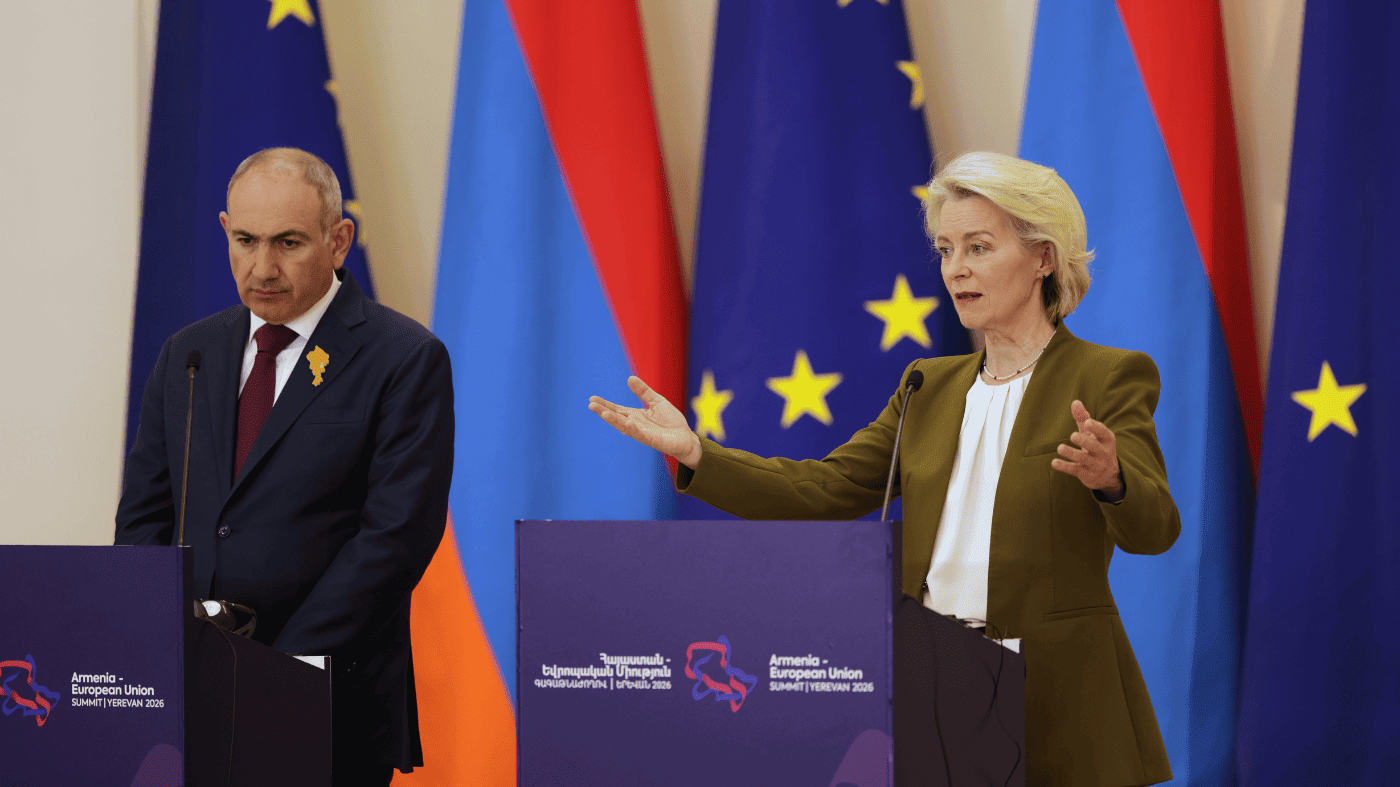
Kremlin spokesman Dmitry Peskov responded to Pashinyan’s announcement by warning of “deep trade contradictions that will primarily harm Armenia.” The message is unmistakably clear: Russia has considerable power to make Armenia’s journey to Europe painful.
There is another risk. Armenia could incur the costs of leaving the Russian orbit without ever being securely anchored in the West. It is an old problem for the world’s oldest Christian nation. Armenia has spent much of its history maneuvering between greater powers in search of security, from Rome and Persia to Russia and the West.
Eventually, Russia inherited that role, emerging as the Christian great power capable of challenging Persian and Ottoman domination. That security logic endured into the post-Soviet era. After 1991, Armenia faced Azerbaijan, a closed border with Turkey and no comparable Western security guarantee. In that context, it accepted strategic dependence on Moscow in return for protection.
Then there is the diaspora. The U.S. is home to the world’s largest Armenian community outside the former Soviet Union. A deeper U.S.-Armenian relationship could turn that community from an advocate into a conduit for capital, expertise, technology and institutional connections.
That is why Pashinyan’s EU announcement is not simply a European story. Armenia’s movement toward Europe is occurring alongside a potentially transformative relationship with the U.S., most visibly through the Trump Route for International Peace and Prosperity, or TRIPP.
That U.S.-brokered project envisions a 43-kilometer transit route across southern Armenia connecting Azerbaijan with Nakhchivan and Turkey. It could eventually link Central Asia with Europe while reducing regional dependence on Russia and Iran, while creating opportunities for U.S.-Armenian cooperation in infrastructure, technology, energy and trade.
After a major agreement was reached in June, last month Pashinyan met senior U.S. officials specifically to advance the project, with both sides promising more visible practical steps soon. Negotiations to establish the joint U.S.-Armenian development company are also nearing completion, creating the prospect of sustained American involvement in Armenia’s infrastructure, technology and trade.
This does not mean Armenia is simply exchanging Moscow for Washington. It wants consequential relationships with Europe and the U.S., but also with China, India, Iran and others.
For a country whose history has repeatedly left it dependent on a single external protector, diversification is itself a form of sovereignty. EU membership, however, would be different in kind. It would eventually place Armenia inside a Western political, economic and institutional system. Combined with an expanding American relationship, it would amount to a genuine geopolitical realignment.
Armenia has attempted a Western turn during a period of Russian weakness before. When the Russian Empire collapsed in 1917, independent Armenia similarly looked West. Woodrow Wilson became the symbol of Armenian hopes for an external guarantee, but Western sympathy never became enforceable protection. In the aftermath of the Armenian Genocide, caught between Turkish forces and Bolshevik Russia, the First Republic disappeared in 1920.
A century later, Armenians are taking another chance. The West has an opportunity to do it right this time.
Grigor Hovhannissian is a former Armenian ambassador to the United States and Mexico and a former deputy foreign minister of Armenia.