THE CRANES OF YEREVAN
Most Armenian readers encountering the title of this essay would naturally assume a poetic turn. The crane, Groong, occupies an almost sacred perch in the national imagination: romanticized in scores of folk songs, praised in hundreds of verses, depicted standing vigilantly on one leg atop its nest. It is the enduring symbol of longing, of exile (pandkhdootyoon), and of the homeland left behind.
Yet this is not a piece about ornithology or nostalgic folklore. It is about a very different kind of bird: a mechanical creature of iron, steel, and counterweights that brings a far more immediate kind of comfort, one that signals renewal, economic vitality, and tangible hope.
Having visited Armenia regularly over the past decade, I have often watched the city from my balcony with a heavy heart. For years, Yerevan’s skyline was stubbornly quiet. Over a stretch of some 20 kilometers, one could barely spot five to ten construction cranes dotting the horizon; at best, the city added two or three a year. As someone whose professional life is tied to the construction industry, I could not help but scrutinize these silhouettes, drawing grim conclusions from what was missing.
The crane, specifically the modern tower crane, is a marvel of industrial utility. Whoever bestowed the Armenian name verambardz Groong (“elevating crane”) achieved a stroke of descriptive brilliance. Rising as a lattice tower of structural steel with a square profile roughly two meters wide, it extends a horizontal jib that carries the heavy burdens of modern development. Typically painted in vivid orange and illuminated by floodlights that cast a bright glow over building sites long after dark, these machines stand anywhere from 4 to 40-storeys high. From the moment ground is excavated, they execute the precise vertical and horizontal movements required to move materials, doing in a single day within a 25-meter radius what might otherwise take fifty workers to accomplish.
Where cranes operate, capital flows and economic activity thrives. In my book, My Journey with Iron, I wrote at length about the transformative power of steel and machinery. But setting theory aside, the absence of these iron structures in Yerevan was once deeply troubling.
To an observer of urban dynamics, an empty skyline carries an ominous message. No cranes mean no construction; no construction means stagnation. And stagnation breeds a vicious cycle: a lack of development leads to joblessness, which feeds its twin blights, poverty and emigration. The specter of systemic decline, social strain, and rising crime felt all too real. For anyone invested in the country’s future, it was a painful sight.
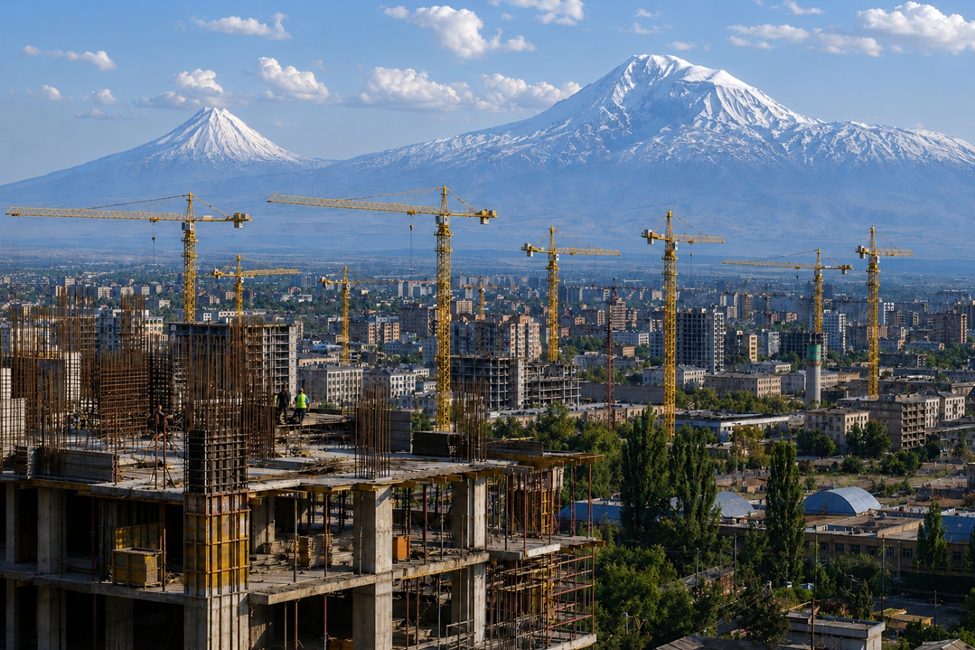
Happily, the picture has shifted dramatically over the past two to three years. Today, Yerevan’s horizon is crowded with cranes. Major construction projects now deploy two to four units apiece, a clear indicator of the expanding scale, footprint, and ambition of these developments.
During a recent trip across the capital, traveling east to west and north to south, plots of land that had lay barren for years were teeming with heavy machinery, concrete mixers, and bustling work crews. The roads were busy with industrial traffic. Rising everywhere were massive residential complexes designed to house hundreds of families across a spectrum of income levels. These are not bleak monoliths; they feature thoughtful modern architecture, sleek glass facades, and sophisticated exterior finishes. Inside, contemporary floor plans and high-grade European fixtures are raising the standard of urban living in Armenia.
The empty horizon that once caused such worry has been filled. The cranes have returned—not as birds of passage singing of exile, but as iron sentinels ushering in a new era. One can only hope that the other sectors of Armenia’s economy will follow the construction boom, building a future that is equally robust, dynamic, and enduring.