Forgotten Lives, Shared History: Britain’s Armenians at War
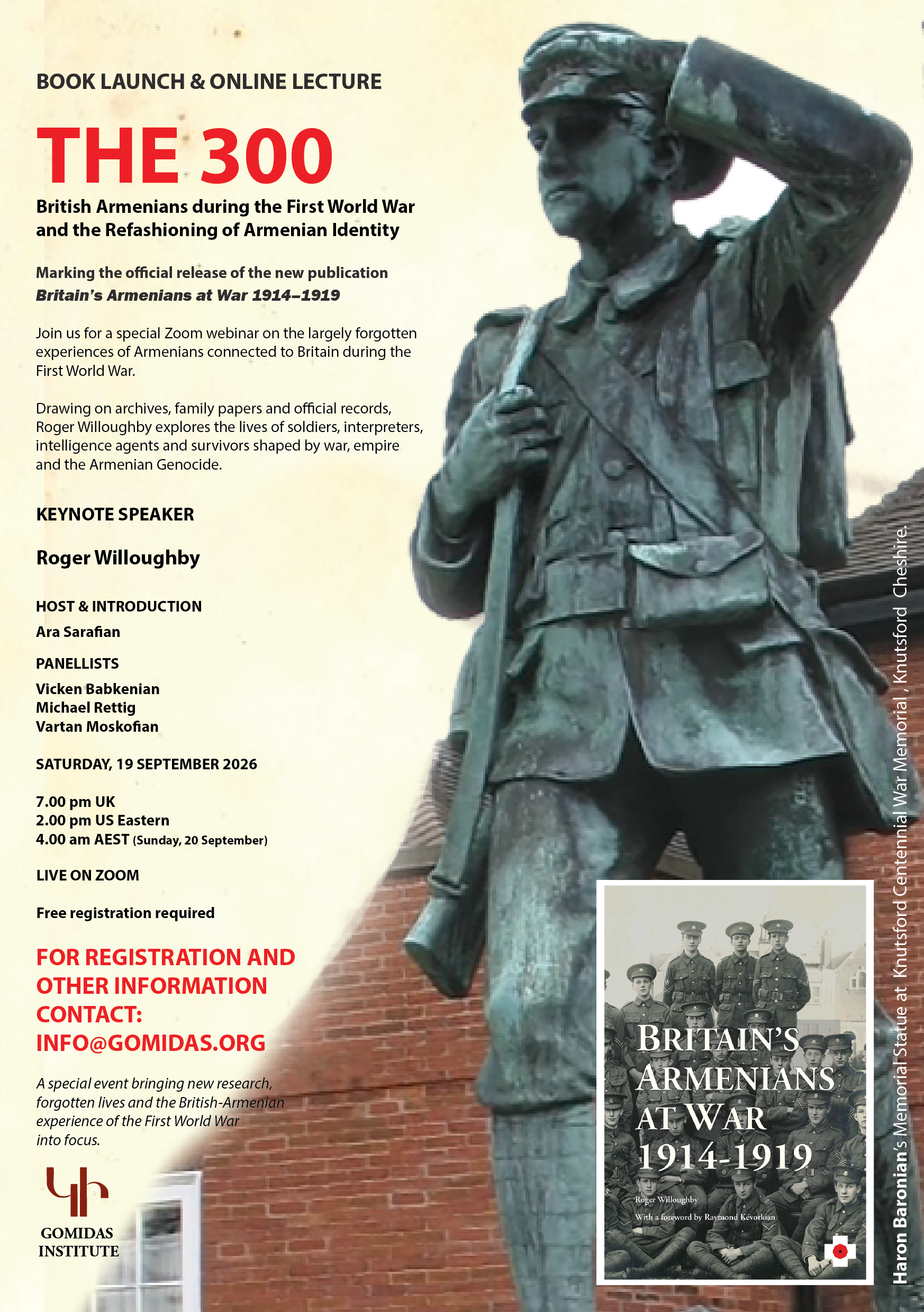
The Gomidas Institute will hold a Zoom launch for Roger Willoughby’s new book, Britain’s Armenians at War 1914–1919, on Saturday, 19 September, 2026 at 7.00 pm UK / 2.00 pm US Eastern.
The event, “The 300: British Armenians during the First World War and the Refashioning of Armenian Identity,” will explore the largely forgotten experiences of Armenians connected to Britain during the First World War.
Speaker: Roger Willoughby
Host: Ara Sarafian
Panellists: Vicken Babkenian, Michael Rettig and Vartan Moskofian
Live on Zoom — free registration required. For registration and information: [email protected]
Ara Sarafian
Gomidas Institute, London
Britain’s Armenians at War, 1914–1919 recovers the experiences of a community whose contribution to the First World War has too often remained at the margins of British history. Among the most moving stories in the book is that of Zaven Sarkis Manoukian, known to his friends as “Nooky”, a British-Armenian student, writer and soldier whose
remarkable promise was extinguished at the age of nineteen. Born in Manchester in 1898 to an Armenian family with roots in the Ottoman Empire, Manoukian won a scholarship to Repton School, where his intellectual gifts quickly became apparent. He distinguished himself academically, won a classical scholarship to Oriel College, Oxford, and developed into an accomplished poet, essayist and debater before war intervened.
Manoukian’s surviving writings reveal a young man thinking seriously about some of the largest questions of his age. His prize-winning poem “Gallipoli”, the haunting “To an Unknown God”, and essays such as “Armenia Irredenta”, “Revolution” and “Idealism and Education” demonstrate an extraordinary breadth of interest. He wrote about
nationalism, democracy, oppression, prejudice, education, war and the moral responsibilities of powerful states. His defence of Armenians against contemporary stereotypes was particularly striking, combining personal identification with a wider argument for the rights of small nations. His school contemporaries later remembered his contributions as among the outstanding pieces published in Repton’s short-lived magazine A Public School Looks at the World.
Yet Manoukian’s story was shaped by a profound contradiction. Although deeply conscious of the brutality and moral degradation of war, he volunteered for military service while still seventeen and sought an officer’s commission. His Armenian-Ottoman family background complicated his position: his mother repeatedly warned the War Office that, if he were captured and handed over to Ottoman authorities, he might be treated as a traitor. Despite these fears, Manoukian accepted a combatant commission in the Lancashire Fusiliers and was sent to France in June 1918. On 3 September 1918, while carrying out reconnaissance near Givenchy, he was killed by a sniper. A senior officer described him as his “best officer” and recalled that his men would have followed him anywhere.
His death places Manoukian among a wider generation of writers whose literary futures were destroyed by the First World War. Wilfred Owen, killed at twenty-five only days before the Armistice, had only just reached the extraordinary poetic maturity for which he is now remembered. Isaac Rosenberg, the son of Jewish immigrants, was
developing one of the most distinctive voices of wartime poetry when he was killed in 1918. Charles Hamilton Sorley, dead at twenty, had already produced poetry of remarkable scepticism and intellectual control, while Edward Thomas, though older, had discovered his poetic vocation only shortly before the war and was killed at Arras in 1917. Even Rupert Brooke, who died in 1915 before experiencing prolonged trench warfare, left open the question of how his early idealism might have developed had he survived. Manoukian belongs in this company not because we can know what he would have become, but because the work he left behind shows unmistakably that a serious literary and intellectual career had begun.
That sense of lives interrupted and possibilities lost runs through Britain’s Armenians at War, 1914–1919. Manoukian’s story is especially powerful because he was far more than another name on a casualty list: he was a British schoolboy of Armenian heritage wrestling with questions of identity, injustice and belonging at the very moment when Armenians in the Ottoman Empire were suffering catastrophe and Britain was engaged in a global war. His surviving writings allow us to hear his voice more than a century later—idealistic, argumentative, compassionate and sometimes startlingly modern. By recovering stories such as his, Britain’s Armenians at War, 1914–1919 brings into view a neglected part of Britain’s wartime experience and restores individuality to men and families whose Armenian identity shaped both their service and their fate.