
Traffic Nightmare in Yerevan
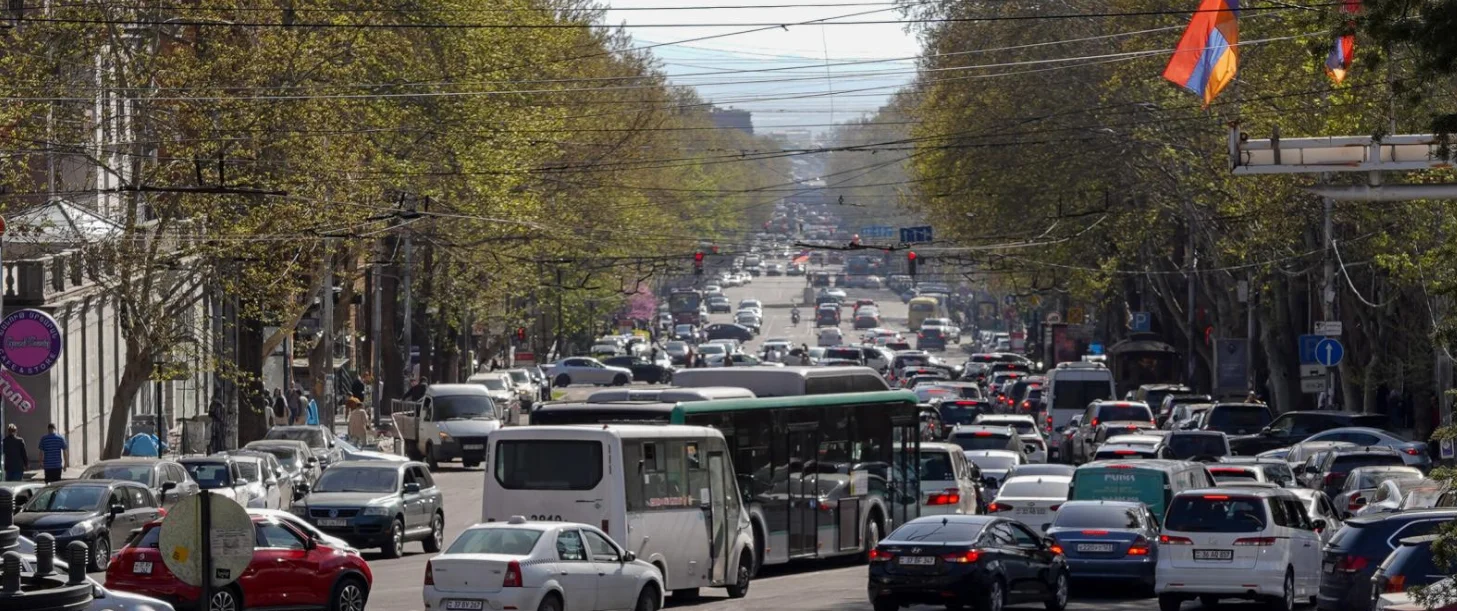
Areg GharabegianThe traffic problem in Yerevan has reached a point where government has declared it a crisis and has urged Yerevan city officials to set up a task force to address it.
In the last few years traffic problems have substantially worsened in Yerevan and now in certain times of the day, traffic is almost at stand still. Traffic congestion has escalated from a daily frustration to a full-blown national crisis.
Yerevan was designed for a maximum occupancy of 250,000 people, transported primarily through a transit network. Present day Yerevan has at least four times more occupants than it was designed for and a transit system that is inadequate for a city of that size. In last few years massive construction of high-rise buildings complexes is underway in Yerevan and a large number of these complexes are located in the city center. Once these high-raise buildings are fully occupied, the traffic conditions will be worsened by several folds. City streets and other infrastructure are not designed to handle such an influx of cars used by residences of these new complexes.
Over the past few years, car imports to Armenia have surged dramatically, partly due to relaxed import regulations and the rising affordability of used vehicles. Growth has far outpaced the development of road networks, parking facilities, and public transport infrastructure in Yerevan. Approximately 12,000 additional cars are registered each year in Yerevan.Of Armenia’s 954,000 vehicles, more than one-third (around 343,000) are registered in Yerevan, though the actual number of cars driving in Yerevan is much higher since many vehicles registered elsewhere are driven in Yerevan. According to Yerevan’s Development Program, the number of vehicles in the city is around 600,000.Main Causes of Traffic CongestionsThere are many reasons for the horrendous traffic issues in Yerevan, but four issues can be considered as the top ones causing most of the grid lock. The first issue is when by law, motorists are required to remain at the scene of a traffic collision and not to move vehicles that are involved in the accident, even it is a minor fender bender, until insurance agents of both drivers and road police arrive to document the incident. Depending on the location and time of the day, sometimes motorists have to wait for a long time and this creates major grid locks in a large area. In some major cities in the world, drivers are allowed to move the vehicles to the side of the road when there is a minor accident and wait for police and insurance agent arrival. Implementing such an easy and practical procedure in Yerevan will be beneficial.The second main issue is when drivers enter an intersection when they clearly see that they cannot clear the intersection due to the traffic on the other side. While those drivers are in the intersection, light changes and the cross road drives rush into the intersection. A perfect recipe for a locked intersection. Few years ago, city painted yellow lines in some major intersection and it was announced that if people are on those yellow line areas when light is changed, they will be fined. However, like a lot of other good laws, this one was not properly enforced and eventually those yellow lines disappeared. Solution to prevent this issue is fining violators on a regular basis.Double parked cars at the street behind the main government buildingThe third main issue is double parking, which icommon in the city and it is cause of traffic flow distractions. Some just double park because they are waiting for someone or they just need to do something at that point, but others do for the necessity. Just a reminder that during the day it is almost impossible to find a parking spot in the city center. Sometimes it takes 45 minutes of driving around to find a parking spot. Now, if a parent needs to pick up their child from the school, what other choice that parent has besides double parking and waiting for their child to come out of the school. Keep in mind that schools in Yerevan do not have their dedicated parking or waiting areas.The same is true for delivery vans. Supermarkets and other stores across the city center receive deliveries at all times of the day, causing all sorts of unnecessary traffic disruptions. What other choices does the delivery van driver have? Is he supposed to circle around for a long time, then find a spot to park the van, which probably is far from the store, and then haul the goods from the van to the store? Obviously, that is not practical and as a reminder that only handful of large supermarkets in Yerevan have their dedicated parking lots, but none of them are located at the city center. This brings us to an important question, why there are no paid public parking structures or lots in the city center?Delivery van double parked in front of Carrefour even though there is an empty parking spotThe fourth major issue related to traffic problem is the poor condition of the roads, especially in the winter. Each year, as the snow melts, Yerevan enters another pothole-filled spring. While drivers assess the damage to their cars, city officials make up excuses and claiming the climatic conditions. Winter in Yerevan has freezing temperatures and rain; therefore, such a climate conditions shall not surprise anyone. A well-maintained road with a quality asphalt, shall withstand winter condition but not a substandard asphalt work.It is typical to have manholes on the streets in Yerevan, and almost in all of them, the cover is seating bellow roadway surface. Drivers try to avoid such uneven manholes and potholes and as a result they create a condition for possible accident. Even a small accident will cause a major traffic issue.During late summer and early fall, city repaints street lines; however, after few rainfalls, most of these lines disappear because of the low-quality paint. When there are no lines on a major street, it causes traffic congestion issues as drivers do not have any specific markers to drive properly. Using a quality epoxy paint will element this issue altogether.
Is this a pothole or a crater?
Then there is issue of patching streets. Typically, in late evening a crew shaves off parts of the damaged asphalt of a street and make it ready for the next crew to put on the new asphalt; however, it may take days for the second crew to do its job. Meanwhile, the uneven roadway surfaces caused by the shaved asphalt creates major traffic congestions as drivers slow down to go over the edges of the shaved spots. In civilized cities, the two crew work during the same evening and night, as one shaves off, the next one puts on the new asphalt, and road is ready for the morning peak hour commute.Lack of proper driving culture is also causing traffic problems. Many Armenians view car ownership as a tangible symbol of success in the new economy and larger the car, it means the person is more successful. The fact that so many of the capital’s car owners are also first-generation drivers is evident in their peculiar driving etiquette. Many routinely violate the traffic code or leave their cars in dangerous locations.In the past, it was common to “buy” a driver license; however, in recent years that practice has almost disappeared, but then there are probably thousands of drivers who received their licenses through illicit means. Dangerous traffic code violations by such drivers who have not passed the driving exams can been seen everywhere.Public TransportationThere are basically three modes of public transportation in Yerevan, metro, buses, and taxi. Metro has a single north-south line of 10 stations and serves nearly 30 million riders in a year. While its affordability and central location make it a key asset, the system lacks adequate coverage. Major residential districts remain disconnected, leaving many dependent on overcrowded buses.During last two years city has replaced the old buses, which were a major source of air pollution, with new natural gas operated and comfortable German and Chinese made buses. City has also banned use of vans (marshoutke) for public transportation and has deployed buses at routes that were served by those vans. Eliminating vans had some positive impact on traffic flow, as those van drivers were notorious for their bad driving habits and they were causing problems for the other vehicles. However, number of buses are still not adequate to carry morning and afternoon peak hour passengers.Overcrowded bus during peak hourTaxis are used extensively as they can go to areas that are not served by bus routes and they are relatively cheap. In the past there were numerous taxi agencies, some with strange names, one could call to request a taxi from these agencies or hail one on the street. Minimum charge was 700 drams for 6 kilometers and then 100 drams for any additional kilometer. Majority of taxi rides within city were 700 drams due to the short distances.Then, in 2016, Yandex, a Russian taxi service similar to Uber and Bolt, where people request a taxi using their phone, started operating in Armenia. At first, Yandex was charging a minimum of 300 dram for a 3-kilometer ride and then 100 drams for any additional kilometer, as a result, a lot of people started using it because lots of trips in the city could be 3 kilometers or less. After three or four years all those local taxi agencies closed out because they were not able to compete with Yandex. Now you cannot get a Yandex ride for less than 1,000 drams. There is also a smaller locally based agency called gg, which operates using its own phone app. Nowadays these are basically the only two taxi agencies that one can use in Yerevan.As it can be seen in the chart, about half of the Yerevan commuters use public transportation and a large percentage use private cars to go to work and school. Most probably use of public transportation would be increased if bus system is expanded so more people can utilize it.Addressing Parking IssueThere are red lines on sides of most of the streets in city center and blue lines in Arabkier area, which means one has to pay to park in those areas. Until two years ago the annual cost for parking at the red line zones was 12,000 drams ($33), then city raised it to 160,000 drams ($440) for the city center. The idea was that this substantial increase would discourage people from using their cars when going to the city center. However, this price hike did not change anything as most people are paying the higher rate and still driving their cars to the city center.As of late 2026, there were only four paid public parking areas in city center – three story parking under the open area next to the Opera, one story parking under Northen Avenue, three story parking under Holiday Inn hotel, and an open parking lot at the end of Seasons Park (old Malibu Park). Building at least three or four large parking structures in the city center is essential to alleviate some of the parking issues, which it then would eliminate most of the double parking that causes major traffic flow interruptions.Addressing Traffic IssuesIn late 2025, the Yerevan City Hall created a Traffic Management Center to address Yerevan’s traffic congestion issues and to propose solutions. Making few streets one way in the city center and creating dedicated public transport lanes along four streets were efforts by this center to address traffic congestion. In most cases making certain streets one way has a positive impact, but when it is not well though, it creates additional issues. A good example is a traffic mess created at the intersection of Moskovyan and Baghramyan streets, where Moskovyan Street is one way in opposite directions connecting to the Baghramyan Street.In theory, using dedicated public transport lanes along major streets is a good idea as it makes buses go faster which then encourage more people to use them. However, when some drivers put their hazard flashing lights and stop on the side of street in a bus lane, it causes major issues for the buses, which have to wave into the general traffic lane. Unfortunately, police cars just drive by without giving hefty fines to such violators.Imposing restrictions on passenger vehicles is a traffic reduction tool that some cities use. Many cities restrict which vehicles can travel on certain days of the week based on odd or even license plate numbers. This approach could be beneficial if it is coupled with continued development of public transport.Most major cities have found a simple solution for eliminating some of the traffic issues by restricting delivery times to early morning or late evening hours. Given Yerevan is still in deep sleep until 8 am, if a restriction is imposed that delivery vans and trucks must complete their delivery before 8 am, this would stop disrupting traffic flow where deliveries are done. In mid-2025, city imposed a restriction of large trucks, which are mainly related to the construction projects, at the city center from 9 am to 9 pm during weekdays. This restriction had some limited success.There are plenty of discussions about constructing the Ajapnyak metro station, which is expected to increase the number of metro users. About half of the tunnel to this station, which is from Barekamoutun Square to the Hrazdan gorge, was bored during Soviet time. It is now required to build a long bridge over the Hrazdan gorge and bore the tunnel on the other side of the gorge. Even though extending the metro is a good idea, it is a costly project and it would take many years to complete. It would be much more beneficial if money is spent on constructing large parking structures at the city center and completing portion of the North-South highway that would allow vehicles that are not going to Yerevan, to bypass the city entirely.Outlet of metro tunnels near Hrazdan gorgeUnfortunately, the public transportation in Yerevan cannot be expanded to a level that it would provide coverage to the entire city, because there are large residential neighborhoods with narrow winding streets where buses cannot operate. These areas are mainly accessible by cars and even it is difficult to travel in these areas smoothly by a car because people just park their cars wherever they want with no consideration of others.Potential SolutionsThere is no quick fix for Yerevan’s ongoing congestion woes. As the country grows wealthier, families are now buying second or third cars, which is unavoidable.
It has been three years that this segment of the North-South highway in western part of
Yerevan is just like thisThe most cost-effective solution which can be completed in about seven or eight months, is construction of three or four parking structures in city center. After completion of these structures, parking can be restricted along some of the main streets and transfer the parking areas to bus only lanes. As less people would park along streets, it would also eliminate most of the double parking which is presently a major cause of traffic disturbance.Increasing number of buses and adding new routes would encourage more people to use buses instead of using private cars.Finishing the missing links of the North-South highway to provide a bypass road around Yerevan would also have a positive impact on traffic congestions in the city.Redistricting cars at the city center on certain days based on odd and even license plate numbers is a drastic measure, but this approach has shown a substantial improvement in traffic issues in other major cities around the world; therefore, it may need to be considered as an option for Yerevan.A restriction of constructing large high-raise buildings in Yerevan will limit creating additional stress on city streets which are already congested.Keeping up city street in a good condition and proper scheduling of the necessary repair works, will eliminate causes of major traffic congestions and drivers’ frustrations. If quality asphalt work is done, the possibility of developing numerous potholes would be reduced substantially, which will then create conditions for smooth traffic movements.As a last word, it needs to be specified that no solution would make a dent in the traffic crisis unless the law is adequately enforced. Now, lots of violations are often taking place in full view of the police vehicles with no reaction from the police.