
What could the US midterms mean for the Caucasus?
Democrats’ sweeping win could revive the MEGOBARI Act, bring scrutiny to the Trump Route, and put human rights back on Washington’s agenda.
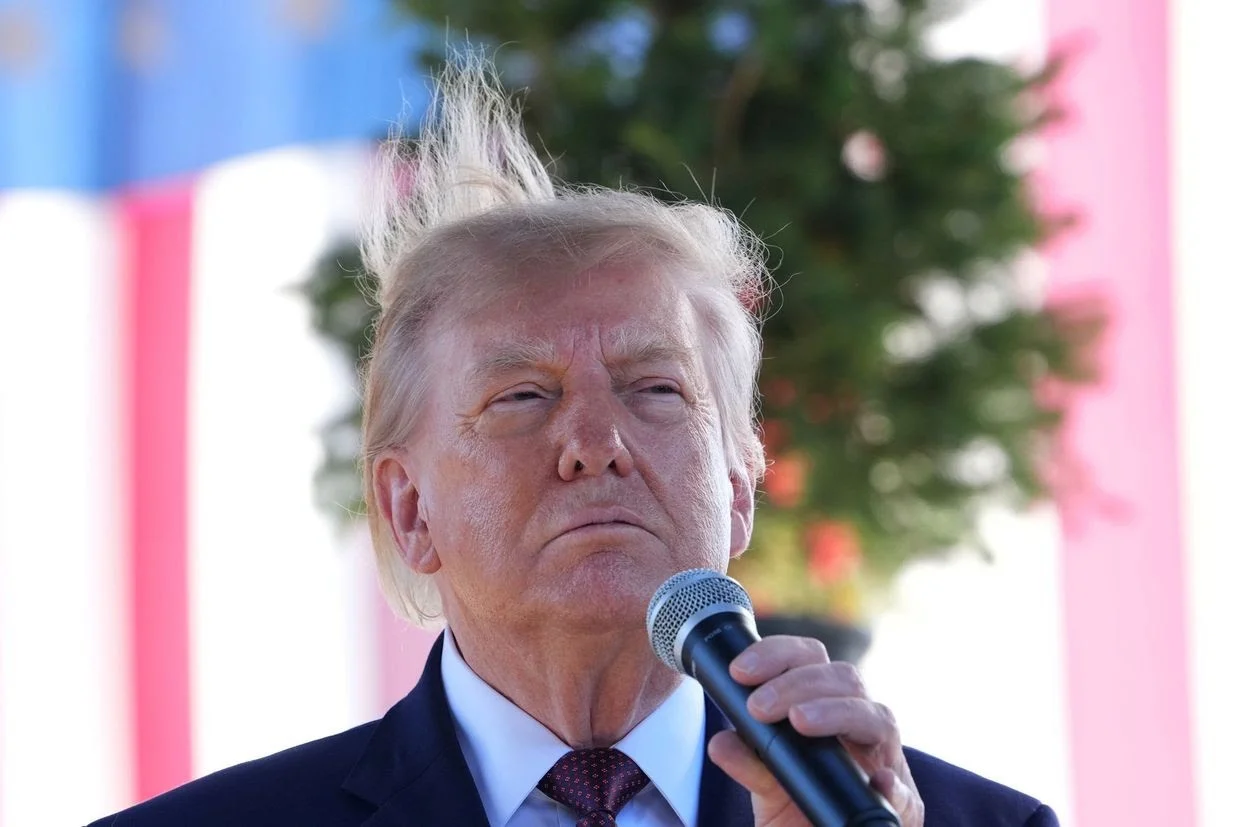
US President Donald Trump speaks during a tour of the White House Ballroom construction at the White House on 4 November 2026. Photo: Alex Brandon/AP Photo.
The blue tsunami in the US midterm elections is already upending the realm of possibilities within domestic politics in the US. But beyond the implications for the country itself, American elections have a unique ability to make ripples around the world — including in the Caucasus.
The Caucasus rarely rises to the top of the agenda in the US, although that has somewhat changed over the past year with US President Donald Trump’s personal involvement in the peace process between Armenia and Azerbaijan.
Nonetheless, all three countries in the South Caucasus have their respective congressional groupings, most of whose members were re-elected.
Beyond that, there are a few members of Congress whose dealings in the Caucasus (for better or worse) have attracted attention both in the US and in the region. Perhaps no other US politician has become more associated with Georgia than Republican Representative Joe Wilson, who has long been the most outspoken opponent of the ruling Georgian Dream party.
 Georgian protesters carrying US flags and photos of US President Donald Trump and Representative Joe Wilson. Photo: Mariam Nikuradze/OC Media.Wilson appears to have just eked out a victory, although his showing in the election is his worst since he joined Congress in 2001. Wilson has been crucial in authoring various pieces of legislation targeting Georgian Dream, including the MEGOBARI Act.
Another figure with a controversial connection to the Caucasus, Democratic Representative Henry Cuellar, has been re-elected. Cuellar was indicted in 2024 for allegedly receiving $600,000 in bribes from Azerbaijan and others, in part for promoting Azerbaijan, but was pardoned by Trump in 2025 before the case went to trial.
Regarding Georgia, one of the most tangible impacts of the midterm elections could be the MEGOBARI Act. The bill, which was passed by the House in 2025 but failed to make it to a vote in the Senate, would sanction Georgian Dream and further distance the US government from Georgia as long as democratic backsliding continues. Should the trend be reversed, the bill would also offer carrots to Georgia, such as the liberalization of the visa regime.
If Wilson were to reintroduce the bill, the institutional roadblocks that prevented it being taken to a vote in 2025 and 2026 would no longer be an issue, at least on paper.
Previously, opposition appeared to stem from then-Republican Senator Markwayne Mullin — serving as the Homeland Security Secretary since 2026 — who in turn was allegedly being influenced by businessperson Steve Nicandros, CEO of Frontera, an oil firm with interests in Georgia. Reportedly under pressure from Mullin, outgoing Senate Majority Leader John Thune refused to bring the bill to a vote.
 US Senator Markwayne Mullin (left) and Azerbaijani President Ilham Aliyev (right) meeting in Baku in January 2026. Official photo.A Democratic House and Senate is likely to be more willing to at least bring the bill to a vote. The MEGOBARI Act passed the House with overwhelming bipartisan support in 2025, and there is no indication that the mood throughout either party has changed since then.
The Washington summit in August 2025 between Trump, Armenian Prime Minister Nikol Pashinyan, and Azerbaijani President Ilham Aliyev was one of the highest-profile demonstrations of US diplomacy in the Caucasus in years. Although the associated peace treaty remains unsigned, the summit resulted in an agreement to create the Trump Route, which would connect Azerbaijan to its exclave of Nakhchivan through Armenian territory. The plans for the Trump Route stipulate significant US involvement.
 From left to right: Azerbaijani President Ilham Aliyev, US President Donald Trump, and Armenian Prime Minister Nikol Pashinyan meeting in August 2025. Photo via social media.Though the Democratic Party will surely work to roll back much of what Trump has done over the past two years, they likely will not be so petty as to prevent the Trump Route from going forward simply because it bears the president’s name. However, the project may encounter other roadblocks and complications now, namely that Democrats will be looking for any chance to investigate potential cases of corruption.
The Trump Route and its associated fund were immediately highlighted as an area of possible unsavory mixing of money and politics, specifically after it emerged that the fund would be headed by Russian-born businessperson Konstantin Sokolov. Although lacking relevant political experience, Sokolov had donated to Trump’s White House ballroom project, raising concerns of a pay-to-play arrangement. Sokolov also has extensive business interests in Armenia and was granted permission by the Treasury Department to bypass restrictions on doing business with the sanctioned Russian bank VTB.
In a more abstract sense, voters appear to have rejected Trump’s foreign policy. While the brunt of this rejection almost surely stems from the disastrous war with Iran, there seems to be a deeper disagreement with how shared values have been almost completely taken off the table.
The US has frequently chosen to look the other way when it came to forging alliances with authoritarian countries when it has suited Washington’s interests, but the complete removal of democracy abroad from the foreign policy agenda became much more obvious in Trump’s second term. Polls have indicated that a majority of voters do not agree with this approach, with only tiny minorities saying defending human rights around the world or helping smaller countries fight back against aggression is not important.
 Azerbaijani President Ilham Aliyev and US President Donald Trump meeting in Davos, Switzerland. Official photo.
The most important impact of the midterms, particularly from a foreign policy sense, has yet to be seen, and likely will not until the next election in 2028. The White House has significant power to dictate foreign policy, including to pursue military action (despite limits that Congress has abdicated), and Tuesday’s election will likely not fundamentally alter the current agenda.
That being said, the Democratic Party is now in a much better position to both retain the Senate, and if the election is viewed as a referendum on Trump and the Republican Party, win the presidential election.