Numerous Skulls and Bones Discovered in a Cave in Silvan, Diyarbakir, Turkey
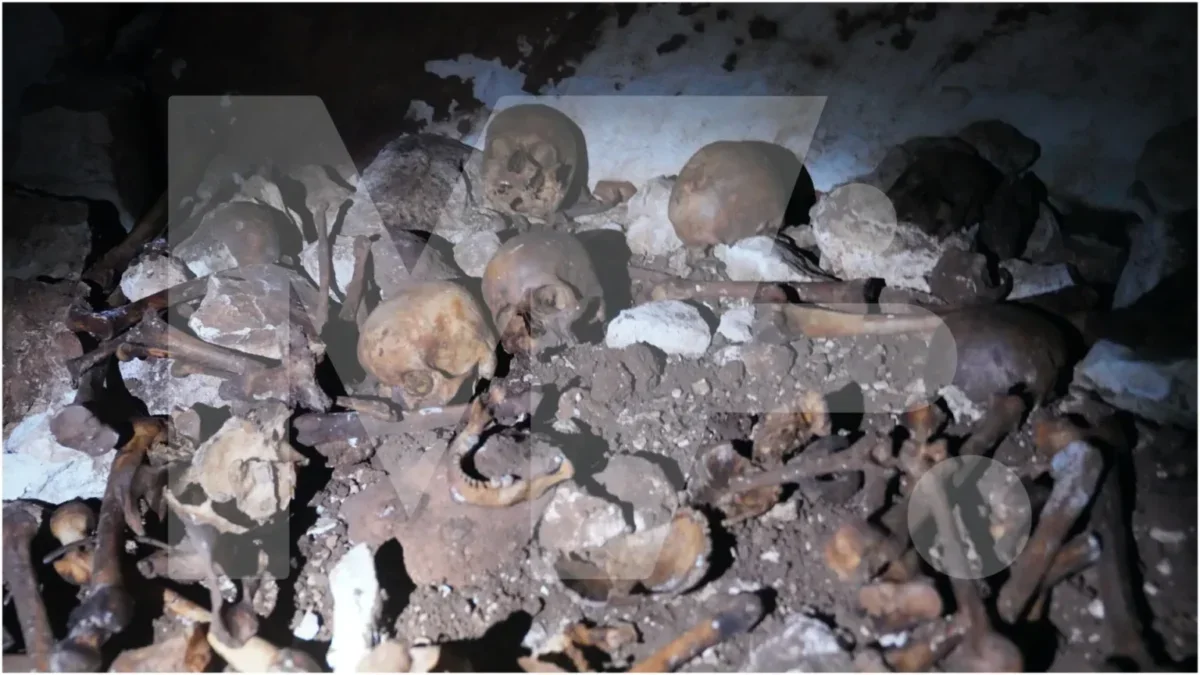
ISTANBUL (Medyascope) – Skulls and bones, believed to be human remains, have been discovered in a cave known as “Ecnebi Mağarası” (Foreigner’s Cave) in the Silvan district of Diyarbakır. A delegation comprising representatives from the Human Rights Association (İHD), the Diyarbakır Bar Association, and the Association of Lawyers for Freedom (ÖHD) encountered the bones across three different layers of the cave. The organizations have submitted an application to the public prosecutor’s office, requesting the identification of the remains and an investigation into whether they are linked to potential cases of enforced disappearance.
Skulls and bones, suspected to be human remains, were found in “Ecnebi Mağarası,” located in the rural area of the Silvan district in Diyarbakır. Following a tip-off, a delegation consisting of representatives from the Human Rights Association (İHD), the Diyarbakır Bar Association, and the Diyarbakır branch of the Association of Lawyers for Freedom (ÖHD) conducted an inspection of the cave on November 19. The inspection was also followed and documented by the Mesopotamia Agency (MA).
During the examination of the site—a region that gained notoriety in the 1990s due to allegations of enforced disappearances and unsolved murders linked to JİTEM—human bones were discovered across three distinct layers of the cave. The delegation has applied to the Silvan Chief Public Prosecutor’s Office, calling for the preservation of the remains, their identification, and a full investigation to shed light on the incident. Human bones discovered across three levels of a cave
During an inspection that lasted approximately an hour and a half, several skulls and various bones were found among fragmented stones on the first level of the cave. Upon descending to the second level, the team encountered further human remains.
It was reported that 15 to 20 skulls, scattered across different spots, along with hundreds of bones, were discovered in this section. Some of the skulls appeared to belong to children. Certain skulls featured holes suggestive of bullet impacts, while some of the bones were observed to be broken or fragmented.
In the central part of this level, blackened stones—possibly resulting from fire or an explosive device—were also noted. A beverage can, in good condition, was found in the same area. Bone remains were also observed on the third level of the cave.
The inspection further noted that, despite the presence of numerous bones throughout various parts of the cave, no fragments of clothing were found.
Fırat Akdeniz, a member of the Missing Persons Commission of the Human Rights Association (İHD) Diyarbakır Branch—who took part in the inspection—stated that the cave entrance was hazardous, making the descent inside quite difficult. Akdeniz noted that they encountered a significantly higher number of human remains than anticipated, particularly on the second level. Akdeniz described what he observed during the inspection as follows:
“The entrance to the cave is dangerous; we could barely make our way down. On the second level, we encountered even more human bones. It was darker there, and there was a heavy, pungent odor. We found far more human remains than we had anticipated. It is clear that some of the bones had remained buried beneath the soil. Some of the skulls bore marks that could potentially be bullet holes, while others were deformed. We suspect that some of the skulls may have belonged to children—they were extremely small.”
Application to the Public Prosecutor’s Office by the IHD, the Diyarbakır Bar Association, and the ÖHD
The Human Rights Association (IHD), the Diyarbakır Bar Association, and the Diyarbakır branch of the Association of Lawyers for Freedom (ÖHD)—all of which participated in the inspection—have submitted an application to the Silvan Chief Public Prosecutor’s Office, requesting an investigation into the remains found in the cave and the clarification of the incident. In their submission, these organizations urged the immediate initiation of an investigation and the implementation of necessary measures to preserve the evidence.
The application requests that an on-site inspection of the cave be conducted without delay—with the participation of the individuals who provided the initial tip—and that the discovered skulls and bones be collected under appropriate conditions and sent to the Forensic Medicine Institute for identification and age determination.
Furthermore, it was requested that DNA samples be collected from the relatives of individuals who were forcibly disappeared in the region in the past, in order to facilitate DNA matching.
In the submission to the Public Prosecutor’s Office, the organizations requested that the site be secured to prevent the destruction or tampering of evidence, and that the remains found within the cave be collected in accordance with proper legal and forensic procedures. The submission further requested an examination of past detention records in the region, the questioning of witnesses who may have information regarding the incident, the identification of those responsible—including public officials—and the initiation of the necessary judicial proceedings against them.
The organizations demanded that the identities of the human remains found in the cave be established, that any potential links to cases of enforced disappearance or murder be investigated, and that the incident be clarified in all its aspects.
The Human Rights Association (İHD) called for the identification of human remains found in a cave in Silvan district of Diyarbakır to be carried out in accordance with international forensic standards and for the incident to be investigated in all its aspects. The İHD emphasized that the inclusion of families of those forcibly disappeared in the region in the past, the conduct of DNA matching, and regular informing of families should be fundamental elements of the investigation.
The İHD’s statement noted that enforced disappearances and extrajudicial killings are among the gravest human rights violations in Turkey’s recent history. It stated that cases of enforced disappearances and extrajudicial killings, particularly those intensified in the 1990s, remain unclarified despite the passage of years, the fate of the disappeared remains unknown, and a significant portion of the perpetrators are protected by policies of impunity. The statement highlighted that despite the struggle for justice by the families of the disappeared, the obligations to uncover the truth and hold those responsible accountable have not been fulfilled.
The Human Rights Association (İHD) recalled that on November 19, following a tip received by its Diyarbakır branch, a delegation consisting of representatives from the association, the Diyarbakır Bar Association, and the Diyarbakır branch of the Lawyers for Freedom Association (ÖHD) conducted an investigation in a cave in the rural areas of Boşat and Çîçika neighborhoods in Silvan district. The discovery of numerous human skulls and bones in different parts of the cave, the presence of possible gunshot wounds on the skulls, and the assessment that some of the remains may belong to children, necessitated a thorough investigation of all aspects of the incident. In this context, it was reported that the Diyarbakır branch, the Diyarbakır Bar Association, and the ÖHD Diyarbakır branch applied to the Silvan Chief Public Prosecutor’s Office requesting an official investigation.
The İHD stated that the area where the human remains were found should be protected to prevent the loss or destruction of evidence, and requested that the identification process be carried out in accordance with international forensic standards. The association also called on the authorities to sign, ratify and effectively implement the provisions of the United Nations International Convention for the Protection of All Persons from Forced Disappearance.
(Translated from Turkish)