Armenia Impact Report – a marketing document
Mount Aragats, Armenia’s highest peak, symbolizes the nation’s spirit, history and enduring connection to its land.
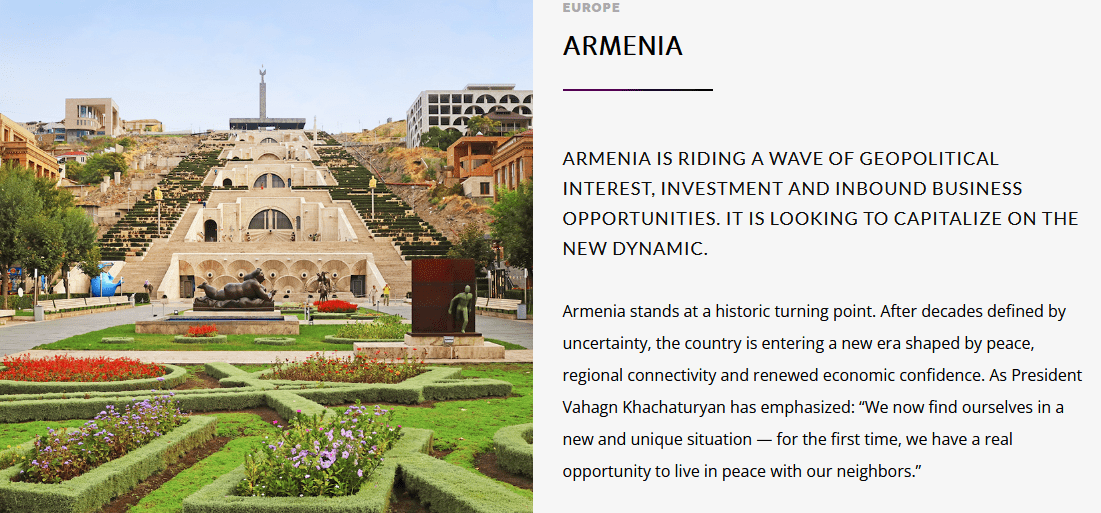
ARMENIA
Armenia stands at a historic turn-
ing point. After decades defined by
uncertainty, the country is entering a new
era shaped by peace, regional connectivi-
ty and renewed economic confidence. As
President Vahagn Khachaturyan has em-
phasized: “We now find ourselves in a new
and unique situation — for the first time,
we have a real opportunity to live in peace
with our neighbors.”
The landscape has been transformed
since the signing of a peace document in
August 2025. “The agreements foresee
open borders and renewed
connections — railways,
roads, gas and oil pipelines
and power lines. This is a new
reality, not only for Armenia
but for the entire region.”
This external transfor-
mation is reinforced by deep
domestic reforms. Under the
president’s leadership, Arme-
nia continues to strengthen
democratic institutions, im-
prove governance and accel-
erate national digitalization.
These reforms are creating a more pre-
dictable, transparent, and investor-friend-
ly business environment. As the president
notes, “We continue to strengthen our
democratic institutions and capacity-build-
ing and it is important that the current U.S.
administration sees Armenia as a reliable
partner.” Clear economic legislation, low
taxes and ongoing automation of permits
and public services further enhance Arme-
nia’s appeal to international investors.
Furthermore, high technology, AI,
semiconductors, clean energy and educa-
tion are now central pillars of national de-
velopment. “It is no coincidence that the
U.S. signed a memorandum of understand-
ing with us on AI and semiconductors,
recognizing Armenia’s grow-
ing global role,” stressed the
president. Flagship initiatives
such as the $500 million Fire-
bird project are positioning
Armenia within global tech-
nology networks, while the
planned Academic City near
Yerevan aims to cultivate the
next generation of scientists,
engineers and entrepreneurs.
Clean energy underpins
this transformation. Arme-
nia’s diversified energy mix —
nuclear, hydro and rapidly
expanding solar — provides
both stability and sustain-
ability. “This year, our solar
capacity reached around
800 megawatts, equivalent
to two nuclear plants, and
during summer days, solar
supplied up to 90% of our
energy.” This achievement
directly supports energy-intensive sectors
such as AI and semiconductor production,
reinforcing Armenia’s competitiveness.
The peace dividend
Peace is also reshaping human capital dy-
namics. “Migration from Armenia over
the past 30 years has had many causes,
but war has been among the main ones.
Peace, however, brings new responsibilities
and new hope.” The hope is that talent will
increasingly return, bringing skills, invest-
ment and global experience back home.
Armenia presents itself as a stable,
safe and open economy, supported by in-
frastructure development, clear rules and
growing international partnerships, partic-
ularly with the U.S. As President Khachatu-
ryan has suggested, enhanced connectivity,
including the prospect of direct flights be-
tween Yerevan and Los Angeles, would fur-
ther strengthen trade and investment ties
at this pivotal moment.
Armenia is an agile, forward-looking
nation — one that offers global investors
not only opportunity, but partnership in
shaping a peaceful, innovative and sustain-
able future.
Armenia is riding a wave
of geopolitical interest,
investment and inbound
business opportunities.
It is looking to capitalize
on the new dynamic.
Armenia pins its growth hopes
on peace
The government wants to focus on
the future but not forget the past
“It is no coincidence that the
U.S. signed a memorandum of
understanding with us on AI and
semiconductors, recognizing
Armenia’s growing global role.”
Vahagn Khachaturyan, President, Republic of Armenia
Vahagn Khachaturyan
President
Republic of Armenia
www.impact-reports.com
Nathalie Martin-Bea Mardinian, International Senior Director
2 · ARMENIA SPECIAL REPORT ARMENIA SPECIAL REPORT · 3
Armenia’s economic resilience has
been shaped by disciplined fiscal
management and innovative, best-in-class
monetary policy. At the centre of this per-
formance stand two institutions — and two
leaders — whose policies are redefining the
country’s trajectory: Minister of Finance
Vahe Hovhannisyan and Central Bank Gov-
ernor Martin Galstyan.
As Armenia recorded 5.6% growth in the
first half of 2025, the finance ministry has
focused on ensuring that momentum trans-
lates into long-term fiscal health. Hovhanni-
syan has outlined a clear and credible con-
solidation path: “Our fiscal policy plan aims
to gradually reduce the deficit from 5.5%
of GDP this year to 2.8% of GDP by 2028,
decreasing by about one per-
centage point annually.” This
trajectory is designed to con-
tain debt growth and keep
public debt at around 50% of
GDP over the medium term,
reinforcing macroeconomic
stability.
Tax reform has followed
the same ideals. Adjustments
to the turnover tax were in-
troduced to close loopholes and shrink the
shadow economy, while avoiding penaliz-
ing compliant firms. The ministry is moving
away from ad hoc policy changes to a single
annual window for tax amendments, inte-
grated into the budget process.
For international investors, Armenia is
emphasizing transparency over exemptions.
“Through the Ministry of Economy, investors
can receive cash support for infrastructure
or high-complexity greenfield investments
— up to 35% of total investment,” Hovhan-
nisyan explained, underlining a system that
is visible in the budget and aligned with
global best practices.
Geopolitics have also shifted decisively
in Armenia’s favor. With borders reopen-
ing and transport links being restored, the
country is reclaiming its historical role as a
connector. “Armenia sits at a strategic cross-
roads, connecting East and West, North and
South,” the minister noted, pointing to the
significant investment opportunities this cre-
ates, backed by a skilled and capable work-
force.
Trust, innovation and financial depth
If fiscal discipline sets the foundation, Arme-
nia’s Central Bank has become the engine of
confidence and innovation. Governor Mar-
tin Galstyan frames the institution’s role in
human terms: “When people think of a Cen-
tral Bank, they often picture an institution
focused mainly on rates and inflation. For
me, its real mission is trust — trust that we
are a reliable partner for citizens, businesses
and the state.”
The results are clear: “since 2022,
growth has averaged around 9% annually
while inflation has remained at or below our
3% target — a remarkable convergence un-
der challenging conditions.”
Financial stability has been reinforced
through robust macroprudential tools,
strong capital and advanced stress testing.
Armenia’s banking sector has expanded
dramatically, with assets now equivalent to
roughly 110% of GDP, reflecting deepening
financial intermediation and public trust.
Crucially, local banks now have the capacity
to finance scale. “Large projects,
like Firebird, require substan-
tial financing and the Armenian
banks — working together with
pension funds — can now fund
ventures of half a billion dollars,”
Galstyan observed — an unthink-
able prospect just a decade ago.
Sustainable finance is equal-
ly central. “Climate change is no
longer theoretical — it is already
impacting the financial system
and we must be part of the solu-
tion,” he says. Armenia’s nation-
al sustainable finance roadmap,
green bonds and recent €100 million ($117
million) loan from the European Investment
Bank, with 40% dedicated to green proj-
ects, are embedding environmental, social
and governance principles into the financial
system while opening new investment chan-
nels.
The broader message is clear. “Armenia
offers immense opportunities for interna-
tional players because we have repeatedly
proven to be a reliable partner and a place
of stability in the region.” Strong ties to Sil-
icon Valley, skilled talent and banks capable
of financing complex projects make Armenia
a hub where “talent, innovation and oppor-
tunity converge.” As Galstyan puts it, “Here,
you can combine personal fulfillment with
contributing to the country’s future, building
a better tomorrow.”
This message is reinforced by Garegin
Gevorgyan, CFO & Member of the Board of
Ardshinbank, who highlighted: “Armenia
has become increasingly visible and attrac-
tive to investors due to its growing stability
and predictability.” Armenia’s largest bank
when ranked by assets is doing all it can to
channel investment into the country. It re-
cently financed ContourGlobal, a U.S. hy-
dropower company that is expanding into
solar in Armenia.
Echoing Hovhannisyan, he added that
Armenia’s strategic location can make it a
central node where it can “serve as a bridge
where nations meet, trade and exchange
ideas — a foundation for sustainable region-
al growth.”
The opportunities in Armenia are enor-
mous and it’s time to seize them.
Inside Armenia’s macro-stability strategy
Armenia has sustained
strong economic growth
and low inflation with the
government and central
bank in alignment.
Stability and predictability are the
key hallmarks of the Ministry of
Finance, so businesses can plan
Low and stable inflation have made
the Central Bank of Armenia a
stabilizing force
Martin Galstyan
Governor, Central Bank
of Armenia
Vahe Hovhannisyan
Minister of Finance
Armenia’s central bank has presided over consistently strong economic growth with low and stable inflation.
“Since 2022, growth has averaged
around 9% annually while inflation
has remained at or below our 3%
target — a remarkable convergence
under challenging conditions.”
Vahe Hovhannisyan
Minister of Finance
Individuals and businesses, near and far, all welcome
As Armenia becomes defined by re-
stored connectivity and investor con-
fidence, Ameriabank stands at the forefront
of the country’s financial transformation.
Under the leadership of Artak Hanesyan,
the bank has evolved into a cornerstone in-
stitution, one that combines scale with in-
novation.
Ameriabank has long dif-
ferentiated itself by redefin-
ing how banking is done in
Armenia. “Ameriabank isn’t
just a business, it is an envi-
ronment built around peo-
ple,” Hanesyan explained.
The bank was the first to in-
troduce a truly client-centric
model, designed around per-
sonalization and long-term
relationships. “We operate
like a boutique bank in terms
of personalization, but with
the scale and openness of a universal bank,”
serving corporate and retail clients, inves-
tors and the broader community.
Today, “99% of client transactions hap-
pen outside branches,” online banking pen-
etration has reached 80% and more than
30% of Armenia’s bankable population
banks with Ameriabank, despite the institu-
tion operating just 28 branches nationwide.
Platforms such as MyAmeria,
MyHome, MyCar and MyIn-
vest enable seamless onboard-
ing, lending, investing and
property transactions, serving
residents, non-residents and
diaspora clients alike.
For SMEs, the bank has
created a fully digital ecosys-
tem that allows businesses to
register, open accounts and
receive scoring-based loans
online. “Instead of competing
on financial terms, we com-
pete on quality and service,”
Hanesyan noted. Female entrepreneurs are
equally serviced: over the last 12 months,
the bank has closed transactions worth
about $800 million, a significant portion
of which will go toward supporting women
and MSMES. “Women-owned and wom-
en-managed companies tend to be highly
responsible and transparent,” he added,
“and we truly enjoy working with them.”
Size and scale give greater reach
Ameriabank’s scale also enables it to finance
Armenia’s largest ambitions. With a loan
portfolio of about $4.5 billion and relation-
ships with around 80% of the country’s top
1,000 taxpayers, the bank is a leading finan-
cier of infrastructure, energy — including
renewables — technology, agribusiness and
mining. Many of Armenia’s landmark proj-
ects are fully or partially financed by Ameri-
abank, underscoring its capacity to support
multi-hundred-million-dollar investments.
For investors and the diaspora, Ameria-
bank serves as a trusted gateway. Through
its investment banking, legal and advisory
capabilities, it supports deals from first in-
terest to final execution.
Diaspora clients, particularly from Cal-
ifornia, can open accounts remotely, access
tailored mortgages and invest while remain-
ing closely connected to Armenia. Armenia
is poised to emerge as a regional hub and
Ameriabank is helping turn that promise
into reality.
Ameriabank offers
impactful services to
individuals and large
businesses alike with
everyone equal.
Ameriabank manages to be client-
focused enough to feel personal and
large enough to have major clout
It is a universal bank with a full
portfolio of financial services
Mortgage Loans for the Diaspora
Ameriabank CJSC is supervised by the CBA. www.ameriabank.am
Artak Hanesyan
Chairman of the
Management Board
and CEO, Ameriabank
4 · ARMENIA SPECIAL REPORT ARMENIA SPECIAL REPORT · 5
Begin your story with Enterprise Armenia
The future-proof bank for tomorrow
Armenia has entered a decisive
chapter in its economic story — one
defined by stability, innovation and glob-
al connectivity. As Gohar Abajyan, CEO of
Enterprise Armenia, observes, “Armenia
has undergone one of the most significant
economic transformations in its modern
history — from a small tran-
sition economy to an emerg-
ing regional hub driven by
knowledge, peace, stability,
democracy and technology.”
At the heart of this is
Enterprise Armenia, the na-
tional investment promotion
authority operating under
the prime minister’s office.
Designed as a single-window
platform, the agency guides
investors from first inquiry to
execution, ensuring transpar-
ency, speed and direct government engage-
ment. “Many investors tell me how surpris-
ingly easy it is to do business in Armenia,”
Abajyan said. “It is not that we are perfect
or free of bureaucracy, but decisions here
are made quickly, and government institu-
tions are directly engaged with investors.”
Peace is a central pillar of Armenia’s
economic strategy. “Peace is not just an
abstract concept; it opens markets, attracts
capital and builds investor
confidence in Armenia’s fu-
ture,” Abajyan explained.
This approach has delivered:
“With GDP growth averaging
7% since 2021, one of the
highest in the region, and
a trade portfolio diversified
across the EU, Middle East
and the Eurasian Economic
Union, Armenia is entering a
new phase of integration.”
Landmark investments
One of the most visible symbols of this
momentum is Firebird — a landmark pub-
lic-private partnership with a world-lead-
ing U.S.-based AI and supercomputing
company. “One highlight is Firebird – the
AI Factory Project, a public-private part-
nership which we aim to launch in early
2026,” Abajyan noted. The project reflects
Armenia’s ambition to become a regional
center for AI, advanced computing and
semiconductor-related R&D.
Human capital remains key. “Armenia
has 80,000 science, technology, engineer-
ing and math professionals, with an equal
balance of women and men — one of
the highest ratios globally,” Abajyan said,
pointing to Engineering City and national
programs that connect education direct-
ly to innovation. Two additional forces
reinforce this ecosystem: “Government
programs like Neruzh attract talented pro-
fessionals,” while “our diaspora is a major
strength,” particularly in high-tech, where
Silicon Valley-founded Armenian compa-
nies increasingly operate from Armenia.
Looking ahead, Enterprise Armenia is
sharpening its global outreach. “In 2026,
we plan an investment mission to the U.S.
focusing on high-tech and semiconduc-
tors,” building on existing U.S. corporate
presence and Firebird’s momentum.
Her message to investors is simple: “If
you are looking to invest in Armenia, En-
terprise Armenia is the best place to start.”
Evocabank is a major
force in Armenia’s dig-
ital banking transformation,
aligning itself with the coun-
try’s broader modernization
and renewed economic con-
fidence in the post-peace era.
Purpose-built as a mobile-first
institution, the bank is rede-
fining how capital, technology
and trust converge in a rapid-
ly evolving market.
“Evocabank is positioning
itself as an agile, digital and
investor-friendly gateway to
the market,” says Karen Yeghiazaryan, the
chairman of its management board. At the
core of Evocabank’s strategy is a deliberate
shift toward products specifically designed
for a digital world. “Evocabank’s mobile-first
strategy is fundamentally reshaping how
clients interact with the bank and setting a
new benchmark for Armenia’s financial sec-
tor,” he notes. This approach
has accelerated cashless pay-
ments, enhanced user experi-
ence and supported a broader
digital ecosystem.
The bank also plays a piv-
otal role in SME development,
combining advanced tech-
nology with long-term fund-
ing from global institutions.
AI-powered services and fully
remote onboarding are ex-
panding financial inclusion,
enabling Armenians at home
and abroad to access banking
seamlessly.
Enterprise Armenia
highlights many of
the country’s vast and
compelling assets, from
people to technology.
Armenia as an R&D hub for
advanced manufacturing and
green technology
The synergy between Armenia and
its diaspora attracts investments
Evocabank’s proposition
of being mobile-first with
remote, digital services
gives it a leading edge.
Karen Yeghiazaryan
Chairman of the
Management Board
Evocabank
Gohar Abajyan
CEO, Enterprise Armenia
IDBank goes global: US representative office launched
Following the August 2025 peace
agreement, Armenia is entering a
new phase marked by renewed confidence,
long-term stability and sustainable eco-
nomic growth. As geopolitical risk recedes,
international attention is increasingly fo-
cused on Armenia’s institutional strength
— particularly its banking sector, which has
emerged as a cornerstone of resilience and
credibility. At the forefront of this transfor-
mation stands IDBank, which has become
a national leader in digital innovation and
financial inclusion.
“We see growing interest from both lo-
cal and foreign investors who are encour-
aged by the prospect of future stability and
new economic opportunities,” said Mher
Abrahamyan, the chairman of the bank’s
management board. That optimism is un-
derpinned by a banking system that has
proven its durability through multiple glob-
al shocks. “Today, Armenia’s banking system
is considered one of the strongest not only
in the region but also beyond,” he boasted.
“The last bank bankruptcy in Armenia oc-
curred about 25 years ago and since then,
no customer or depositor has faced losses.”
This stability has allowed banks to play
a proactive role in development. IDBank
exemplifies this through a strategy cen-
tered on organic expansion and technolo-
gy-led transformation. “Over
the past few years, IDBank
has strengthened its position,
becoming one of Armenia’s
leading banks in innovation,
digitalization and client base
profitability,” he explains.
“While still mid-sized, it is
recognized as a market leader
and has begun expanding into
international markets.”
Investing in core strengths
Rather than looking outside,
IDBank invested in fundamen-
tals. “Our strategy has focused on organic
growth,” Abrahamyan said. “We invested
heavily in our people, digital platforms and
technologies.” The results are clear: “Over
five to six years, our customer base grew
from 10,000 to 400,000 active clients,”
driven by rebranding, digital products and
high-quality service.
Digital accessibility has been central to
IDBank’s success. “We offer
fully digital onboarding for
both individuals and business-
es,” Abrahamyan explained.
“Armenian citizens, even
those living abroad, can be-
come clients 100% online.”
For entrepreneurs, “our more
than 20,000 business clients”
are supported through the
IDBusiness mobile app, offer-
ing loans, guarantees, trade
finance and insurance.
IDBank’s international
ambitions further reinforce
Armenia’s global connectivity. “We also
received final approval from the U.S. Fed-
eral Reserve to open an IDBank represen-
tative office in Glendale,” Abrahamyan an-
nounced, creating a direct bridge to one of
the world’s largest Armenian diaspora. In a
country redefining its economic future, ID-
Bank stands as both a symbol and an en-
abler of Armenia’s new economic era.
Aligned with global best
practices, IDBank and
the whole banking sector
is serving Armenia’s
thriving economy well.
IDBank’s rapid growth in client
base demonstrates its strong and
successful strategies
All are welcome — diaspora, locals,
individuals and businesses
Mher Abrahamyan
Chairman of the
Management Board, IDBank
6 · ARMENIA SPECIAL REPORT ARMENIA SPECIAL REPORT · 7
How is Evocabank utilizing Armenia’s
stability to build investor confidence?
Peace effectively widens Armenia’s op-
portunity set and Evocabank is positioning
itself as an agile, digital and investor-friend-
ly gateway to the market. We are deliber-
ately shaping our value proposition around
fast and transparent onboarding for foreign
investors and corporates es-
tablishing a presence in Ar-
menia.
At the same time, we are
concentrating our business
development on sectors that
are likely to be the main win-
ners from peace: logistics,
trade, tourism and scalable
SMEs. We are doing this on
a digital-first operating model, which allows
us to scale client volumes without propor-
tionately increasing our cost base; this helps
us maintain an attractive cost-to-income
profile and support sustainable profitability.
How do you support SMEs through financing
tools and partnerships with institutions?
Evocabank positions itself as a key finan-
cial partner for SMEs by combining a mod-
ern, technology-driven product suite with
long-term funding from institutions such as
the International Finance Corporation, Euro-
pean Bank for Reconstruction and Develop-
ment and others. In practice, this means that
clients see simple, transparent Evocabank
products, investment loans, working-capital
facilities, revolving lines, trade finance and
guarantees while, behind the scenes, we
structure those transactions using dedicat-
ed international credit lines that allow us to
offer longer maturities, competitive pricing
and, where needed, local-currency funding.
This model is particularly powerful for
growing companies that need to invest in
new equipment, expand capacity, digitalize
operations or enter export markets, but may
not have access to capital markets on their
own. By doing our own underwriting and
risk management, we effectively act as a
conduit that channels development capital
directly into Armenian businesses.
What steps is the bank taking to attract inter-
national investors?
Evocabank focuses on maintaining high
standards of transparency, governance and
risk management, while consistently deliv-
ering profitable, technology-driven growth
in a well-capitalized and prudently regulat-
ed banking system. To a potential investor,
I would underline three key points: Arme-
nia is a small but fast-evolving market with
transparent institutions; Evocabank is one
of the frontrunners in digital banking, with
a scalable mobile-first model and strong
brand; and the combination of solid asset
quality and a focused growth strategy cre-
ates an attractive risk–return profile.
How is Evocabank’s mobile-first model help-
ing modernize Armenia’s financial sector?
Our mobile-first strategy is fundamen-
tally reshaping how clients interact with
the bank and, more broadly, setting a new
benchmark for Armenia’s financial sector. By
designing products to be digital-first rather
than simply digitizing existing processes, we
provide customers with seamless, end-to-
end journeys for payments, transfers, cards,
deposits and loans directly from their smart-
phones, with intuitive interfaces and near
real-time execution.
This shift materially reduces the need for
in-person visits, shortens time-to-yes for key
products and allows us to roll out new fea-
tures and services far more quickly than in a
traditional branch-centric model.
Innovations such as AI-powered services
and fully remote account opening have sig-
nificantly improved financial inclusion and
accessibility both for clients within Armenia
and for Armenians living abroad. Remote
onboarding allows individuals and entre-
preneurs to open accounts, order cards and
start using core banking services without
visiting a branch, which is particularly im-
portant for regions with limited physical ac-
cess and non-resident Armenians who wish
to maintain a banking relationship with
their home country.
How are you encouraging the diaspora to par-
ticipate in Armenia’s economic growth?
Evocabank is a financial bridge between
the Armenian diaspora and the domestic
economy by combining a fully digital ser-
vice model with globally accessible bank-
ing products. Through remote onboarding,
multi-currency accounts, modern payment
solutions and seamless cross-border trans-
fers, Armenians living abroad can open and
manage accounts, send funds to family and
businesses and participate in local saving
and investment products without the need
for physical presence.
In parallel, we are enhancing our pres-
ence in the U.S. by developing tailored offers
for the Armenian diaspora, including invest-
ment opportunities that convert emotional
ties into structured financial participation in
Armenia’s growth story and we encourage
investment from the diaspora.
In 2024, cashless
transactions accounted for
over half of all payments
As of year-end 2023, the
fintech sector was worth $1.6
billion — about 7% of GDP
Mobile banking applications
represent 76% of banking
interactions in Armenia
Armenia’s digital banking landscape in numbers
Forward and
not looking back
Evocabank is pitching itself to the Armenian diaspora to maintain a connection to home.
Looking firmly into the
future is Evocabank’s
strategy and it’s reaping
rewards.
Mobile and online services allow
customers to conduct most of their
banking without visiting a branch
The Aremenian diaspora is welcome
and encouraged to invest at home
“By designing products to be digital-
first rather than simply digitizing
existing processes, we provide
customers with seamless journeys.”
Karen Yeghiazaryan
Chairman of the Management Board, Evocabank
Trust and reach across the globe
As the largest lender in Armenia,
with proven digital infrastructure
and risk management, Ameriabank is a
trusted partner for many diaspora Arme-
nians who prefer to save and invest in Ar-
menia. The chairman of its management
board and CEO, Artak Hanesyan, explains
how it has earned this position.
How has Ameriabank evolved to become one
of Armenia’s leading financial institutions?
Ameriabank isn’t just a business, it is an
environment built around people. From
the very beginning, we differentiated our-
selves by placing customers at the center of
everything we do. We were among the first
in Armenia to introduce a
genuinely customer-centric
approach to banking — one
based on listening carefully,
understanding real needs
and pain points and design-
ing products and services
around them.
Over time, this mindset
evolved into a strong focus
on digitalization. We invest-
ed early in omnichannel distribution, dig-
ital products and ecosystem development
to make banking seamless and accessible.
Digital banking, for us, is not just about
efficiency — it is a tool for inclusion and
integration. Today, digital solutions allow
us to serve customers across Armenia and
abroad, including diaspora representa-
tives and international investors. Despite
serving more than 30% of Armenia’s adult
(15+) population, we operate only 28
branches, which reflects the broad avail-
ability of our digital services across the
country.
How has Ameriabank’s culture evolved?
Ameriabank’s cultural evolution has mir-
rored its institutional growth. When I
joined the bank, the team consisted of
about 30 people. Today, there are more
than 2,400. Scaling the organization while
maintaining alignment, trust and a shared
sense of purpose has required deliberate
effort. A few years ago, we revisited and
redefined our mission and values, articu-
lating a clear ambition to grow beyond a
traditional bank and become a technologi-
cal space centered on all stakeholders.
Our culture is merit-based and inclu-
sive, recognizing the unique value each
team member brings. We invest heavily
in communication, onboarding, training,
leadership development and internal dia-
logue to ensure our values are consistently
lived across the organization.
Which sectors does the bank operate in?
We are a universal bank and are actively
engaged across all sectors of the Armenian
economy and household needs. Being the
largest lender to both the corporate and
retail sectors entails immense responsibili-
ty that we happily undertake. The largest
sectors in our balance sheet include con-
struction, industrial agriculture and trade.
When assessing major corporate or in-
frastructure projects, we apply rigorous
evaluation metrics. Key considerations in-
clude the investor’s reputation, experience
and execution capacity, as well as the proj-
ect’s commercial viability and its contribu-
tion to economic development. Equally im-
portant is transparency and adherence to
ESG principles. Both the investor and the
project must meet Ameriabank’s minimum
ESG standards, which are aligned with in-
ternationally recognized frameworks.
As the largest lender in Armenia, what fac-
tors do you consider when designing solu-
tions to support MSMEs
MSMEs are a key focus for Ameriabank.
We see them as the backbone of our econo-
my and an absolute necessity for balanced
development of the regions. Our services
are tailored to cover the needs of MSMEs
and we periodically conduct research to
understand the needs of our customers
better. We also offer tailored financial
products developed with support from
many international financial institutions.
These include programs for women-led
businesses, green and clean-energy SMEs,
youth financing, and others. We are very
proud to enjoy the trust of more than 30%
of newly opened businesses that are open-
ing their first account with us.
We enjoy the trust and partnership of
many development institutions and over
the course of the last year we have closed
transactions worth about $800 million.
In general, these partnerships sup-
port sustainable investments, strengthen
MSMEs and contribute to long-term eco-
nomic resilience and inclusive growth.
Ameriabank runs a range of programs
supporting women in business, a segment
that is growing steadily. Women-owned
and women-managed companies tend to
demonstrate a high level of responsibili-
ty and transparency in their relationships
with banks, making them a valued client
segment. A particular focus is put on re-
gional clients and new borrowers.
What message would you like to share with
U.S. investors, especially with the Armenian
diaspora in America?
Armenia offers a high-quality living and
business environment. Major internation-
al cards — Visa, MasterCard and selected
American Express — are widely accepted,
digital wallets such as Apple Wallet func-
tion seamlessly and ATMs and merchant
infrastructure provide convenient, reliable
service across the country. While the past
years have been challenging, with greater
stability returning to the region, new op-
portunities have opened up. Armenia, with
its talented and highly educated work-
force, strong medical system and growing
tourism sector, is well positioned to attract
investment and develop as a regional hub.
With a loan portfolio
of around $4.5 billion,
Ameriabank is a major
force in Armenia’s
financial landscape.
In one way or another, Ameriabank
is involved with every large-scale
corporate project in Armenia
But it also considers MSMEs the
backbone of Armenia’s economy
Ameriabank is a universal bank engaged across all sectors of the Armenian economy and household needs.
“We enjoy the trust and partnership
of many development institutions
and over the course of the last year
we have closed transactions worth
about $800 million.”
Artak Hanesyan, Chairman of the Management Board
and CEO, Ameriabank
© PHOTO: PAN PHOTO
8 · ARMENIA SPECIAL REPORT ARMENIA SPECIAL REPORT · 9
Roman Khudoliy has worked in Ar-
menia since 2007 so is well placed
to discuss the mining sector’s successes and
shortcomings. He leads ZCMC, a company
at the heart of the industry.
How has ZCMC earned its
historical role in Armenia’s
industrial landscape?
In 2022, we celebrated
ZCMC’s 70th anniversary —
project operations began in
1952. However, mining in
this region goes back much
further, to the Stone, Bronze
and Iron Ages. Archaeolog-
ical finds show that people were mining
here as early as the 6th–7th centuries BC.
The company started producing in
1952 with 215 tons of ore. Today, we pro-
duce 23 million tons a year — what took
a year then is produced in just three days
now. Built during Soviet times, ZCMC was
an important enterprise that offered train-
ing and recognition for skilled workers. The
company even received the Order of Lenin,
the highest honor, showing appreciation
for the people and their work. Beyond any
ideology, it was about community.
Many families have worked here for
generations, which adds an emotional and
managerial responsibility. Today, ZCMC
employs 4,700 people, mostly from the
surrounding communities of Kapan and
Kajaran. The mine supports not only direct
jobs but also a wider economic ecosystem,
including supply chains and local services.
We are proud to be the top taxpayer in
Armenia for the fourth year in a row. Our
contribution to GDP is around 3%, and we
account for 5–7% of exports. Even more
meaningful is our impact on the local com-
munity: while Armenia’s average poverty
rate is 24% and some regions reach 40%,
in Syunik, where we operate, it’s just 7%.
Today, we have plans to expand the
processing capacity to 30 million tons of
ore in the coming years and we aim to
reach 40 million later on.
How does the global mining sector affect
your business?
Mining globally faces declining ore
grades: when ZCMC started, copper con-
tent was 1% per ton; today, it’s only 0.22–
0.23%. To stay competitive, a mining com-
pany needs to do two things: use advanced
technology to enhance production and
work towards growth. Expansion isn’t just
adding more ore — it requires upgrading
the entire infrastructure, including crush-
ing systems, tailings management, water
and energy. Every part is interconnected:
without water, electricity or proper tailings
management, even the best technology
can’t operate. This complex, integrated ap-
proach has guided ZCMC for years.
Our strategy is to approach expansion
as a technological challenge. We are inte-
grating the latest technologies with lead-
ing global engineering companies like
Metso and FLSmidth. This includes mod-
ernization, planning a large water-thick-
ening system and implementing a circular
water system — projects that save water
and improve efficiency. We are also invest-
ing in new equipment, including Komatsu
and Caterpillar machines, ensuring the pit
and operations are fully modernized and
ready for increased production.
What steps should the government and pri-
vate sector take to restart exploration?
Developing Armenia’s mining sector
requires a joint effort between the gov-
ernment and private companies. Almost
all current mines were discovered during
Soviet times, except for Amulsar. Most ex-
isting mines have only 10–15 years of life
left, so new discoveries are urgently need-
ed. Geological exploration requires huge
investments and at least a decade to turn
a deposit into a mine.
This can be done by creating a strong
investment environment to attract private
investors or by government-backed geo-
logical enterprises that prepare sites for
auction. The government has digitized old
Soviet mining databases, but they only
contain existing knowledge; no new dis-
coveries have come from them. More work
needs to be done toward this. You can have
the best technology, talent and investment
but without ore, there is nothing you can
do. Armenia’s soil is underexplored and its
mining potential is huge yet undervalued.
What can ZCMC offer a partner looking to
enter Armenia’s mining sector?
With Armenia, we bring experience —
not just technical, but understanding local
nuances and relationships. I have worked
in Armenia since 2007 and much has im-
proved. Investing isn’t easy; it requires
effort, patience and navigating clear,
well-defined rules. Only those willing to
do the work will succeed.
In investment, we must work, commu-
nicate and cooperate, otherwise even small
problems can derail everything. I love Ar-
menia and see a lot of potential for devel-
oping good investment opportunities.
The sector contributes about
5% to GDP despite covering
0.5% of Armenia’s land area
Copper and molybdenum
concentrates make up over
half of merchandise exports
Armenia has hundreds of
deposits of copper, gold, iron,
zinc and other metals
Armenia’s mining industry in figures
Mining since
time immemorial
Mining in Armenia dates back millennia and ZCMC is hopeful for new discoveries to maintain production.
Armenia’s mining sector
dates back to the dawn
of time, but needs
continued investment.
ZCMC is one of the largest
contributors to Armenia’s GDP
and its export balance
It brings decades of experience to a
key pillar of the country’s economy
“Expansion isn’t just adding more
ore — it requires upgrading the entire
infrastructure, including crushing
systems, water and energy.”
Roman Khudoliy, General Director, Zangezur
Copper-Molybdenum Combine (ZCMC)
Friends across the region
Still going strong As Armenia enters a
new era shaped by
peace and renewed regional
openness, the Ministry of Ter-
ritorial Administration and
Infrastructures, under Davit
Khudatyan, is playing a deci-
sive role in transforming the
country into a hub for con-
nectivity and growth.
At the core of this strategy
is regional integration. Un-
der the government’s Cross-
roads of Peace Initiative,
Khudatyan noted that “we
are working to reopen all transportation
routes passing through Armenia, based on
principles of sovereignty, reciprocity and
mutual respect.” Flagship projects such as
the North–South Road Corridor, new tun-
nels in Syunik and planned rail and bridge
links with neighboring countries are posi-
tioning Armenia as a vital transit route be-
tween the Persian Gulf, the Black Sea and
Europe.
Energy security is another pillar of
modernization. Armenia has rapidly ad-
vanced its renewable agenda, with Khu-
datyan emphasizing: “Our 2030 strategy
aimed for 1,000 megawatts of solar power,
a target we reached four years ahead of
schedule.” The government is now devel-
oping storage capacity and strengthening
cross-border energy links, re-
inforcing Armenia’s role as a
regional clean energy player.
Urban progress is advanc-
ing in parallel. “Yerevan is
leading Armenia’s smart city
initiatives, with modern tools
like smart transport payment
systems and connected trans-
port stops already in use,” he
explained.
With peace established
and strong international part-
nerships, particularly with
the U.S., Armenia is becom-
ing an open, investor-friend-
ly destination. Strategic infrastructure,
renewable energy and smart technologies
are reshaping the country.
The Zangezur Cop-
p e r – M o l y b d e n u m
Combine occupies a major po-
sition in Armenia’s econom-
ic and industrial landscape,
embodying the country’s her-
itage and future potential.
Founded in 1952, ZCMC is
built on ancient foundations:
mining in the Syunik region
dates back to the Stone and
Bronze Ages, showcasing
Armenia’s long-standing re-
source riches.
“Enterprises like ZCMC
often give rise to ‘mono cities’ and Kajaran
is a prime example — the town was estab-
lished after the mine,” said Roman Khu-
doliy, general director of ZCMC and pres-
ident of the GeoProMining Group. “This
creates a deep connection with the com-
munity. Many families have worked here
for generations, which adds an emotional
and managerial responsibility.”
ZCMC’s macroeconomic significance is
equally substantial. “We are proud to be
the top taxpayer in Armenia for the fourth
year in a row. Our contribution to GDP is
around 3% and we account for 5–7% of
exports,” Khudoliy exclaimed. The compa-
ny’s local impact is particularly visible in
Syunik, where poverty levels are signifi-
cantly lower than the national average.
Facing declining global ore grades,
ZCMC has prioritized technological mod-
ernization and sustainability. The company
plans to expand processing
capacity to 30 million tons of
ore by 2028 and 40 million
tons after 2030. Investments
span advanced processing
technology, water-saving
circular systems, tailings
management and heavy
equipment modernization.
Governance reform has been
central to this transition:
“We now manage 3,000 sup-
ply-chain tenders annually
and have been the only com-
pany in Armenia reporting on
sustainability for four years in
a row, following international standards.”
Optimism is rife but caution remains.
“Developing Armenia’s mining sector re-
quires a joint effort between the govern-
ment and private companies,” advised
Khudoliy, adding, “most existing mines
have only 10–15 years of life left, so new
discoveries are urgently needed.” Arme-
nia’s mining future, he argued, depends on
trust, transparent regulation and renewed
geological exploration. “Armenia’s soil is
underexplored and its mining potential is
enormous yet undervalued.”
A modern, connected
hub for regional and
global investors,
including the diaspora.
Armenia is firmly part of the
global community with advancing
infrastructure projects in all areas
The U.S. brokered peace treaty
with Azerbaijan was the catalyst
With origins in the Soviet
era yet using modern
technology, ZCMC is
Armenia personified.
ZCMC organized a tree planting event in the Artsvanik settlement of Kapan.
Roman Khudoliy
General Director, Zangezur
Copper-Molybdenum
Combine (ZCMC)
Davit Khudatyan
Minister of Territorial
Administration and
Infrastructures
© PHOTO: ZCMC
© PHOTO: ZCMC
10 · ARMENIA SPECIAL REPORT ARMENIA SPECIAL REPORT · 11
Armenia’s tech boom
Armenia’s ambition to become a
technology hub is being driven by a
clear and deliberate government strategy,
led by the Ministry of High-Tech Indus-
try. Under Minister Mkhitar Hayrapetyan,
technology is not treated as a niche sector,
but as a national growth engine connecting
Europe, the Middle East and Central Asia.
The philosophy was formalized through
a reform agenda. Hayrapetyan explained:
“Last year, the government adopted a sev-
en-year legislative program introducing
amendments that provide tech companies
with incentives and tax benefits.”
Armenia has already built a strong tech-
nological base. “Although we are a small
country with limited re-
sources, our tech sector has
achieved remarkable suc-
cess. We have over 50,000
engineers and the industry
contributes more than 7%
to our GDP, showing strong
and dynamic growth,”
Hayrapetyan notes. The
ministry’s ambition goes
further. “Our goal is to move from being a
‘code-writing’ nation to a true technology
hub — designing, manufacturing and ex-
porting high-tech products worldwide.”
To support this transition, Armenia has
introduced highly competitive incentive re-
gimes. The government offers “up to 60%
cashback on income tax” for companies
creating new jobs, hiring graduates or at-
tracting highly qualified specialists. Firms
investing in staff training can receive “up
to 50% cashback,” while R&D-driven com-
panies benefit from reduced profit tax rates
and a lower turnover tax.
Foreign investors face few barriers.
There is no such legal requirement for
foreign companies to partner with a local
firm. Instead, many multinationals volun-
tarily acquire or collaborate with Armenian
startups to secure talent and resources.
Startups are viewed as vital. Agile and
fast-learning, they are seen as the foun-
dation of Armenia’s future tech leaders.
Hayrapetyan highlighted partnerships such
as Plug and Play’s permanent presence in
Yerevan, alongside government grants and
large-scale events like the Seaside Startup
Summit. “The key lesson we have learned
is that nothing is impossible for Armenia’s
tech sector,” he said, citing companies like
Picsart that grew from small startups into
billion-dollar enterprises.
AI has become a defining pillar of Arme-
nia’s competitiveness. “The Firebird project
and AI development are of strategic impor-
tance for Armenia,” Hayrapetyan stated.
Hosting AI data-centre infrastructure is
a strategic decision that extends beyond
economic value. The computing capacity
will support startups, researchers and ed-
ucational institutions, positioning Armenia
as a regional AI hub. Complementing this
is the AI Virtual Institute, developed with
partners from the U.S. and France, offering
cloud resources and ready-to-use solutions
for innovators. “The government is funding
institutions, advanced courses and AI pro-
grams across hundreds of public schools,
including public-private partnerships that
will soon become mandatory.”
International cooperation further
strengthens this agenda. U.S. tech com-
panies have long been active in Armenia
and the August 8 signing of
the U.S.–Armenia memoran-
dum of understanding in AI
and semiconductors marks
“a new era of cooperation” in
R&D, education and technol-
ogy transfer. The Armenian
diaspora, particularly in Sili-
con Valley, also plays a crucial
role by bringing global ex-
pertise, networks and invest-
ment back to the country.
Manufacturing comes next
While policy, talent and digital infra-
structure form the backbone of Armenia’s
high-tech rise, the next phase is physical
production. This transition is taking shape
within Engineering City and more specifi-
cally through the planned Factory City.
Engineering City was designed as an
integrated environment where multiple
sectors converge. According to Aram Sa-
latian, president of the Engineering Asso-
ciation, “Engineering City is a hub where
engineering, science, production and edu-
cation come together to tackle 21st-centu-
ry challenges.” As of 2024, the Ministry of
High-Tech Industry reported 22 companies
and around 350 employees on site, with
approximately 30 resident
firms operating independent-
ly across different markets.
The government provides
land and infrastructure, with
World Bank support, while
companies either rent space
or build their own facilities.
About 90% of the land has
already been allocated so far.
Factory City represents
the next, decisive step.
Planned within Engineering
City, it will provide dedicat-
ed manufacturing facilities for high-tech
companies ready to scale. “Engineering
isn’t complete until designs reach the fac-
tory floor,” Salatian explained. Factory City
aims to attract a third wave of multination-
als, focused on production rather than just
software or design, particularly in electron-
ics, robotics and advanced manufacturing.
With an estimated initial investment of
$50 million and the goal of securing an-
chor companies, Factory City is intended
to close the loop between engineering, re-
search and manufacturing, transforming
Armenian innovation into globally compet-
itive products and putting Armenia firmly
at the front of the global technology race.
From tiny nation
to tech powerhouse,
Armenia sees surging
investments both local
and international.
Armenia’s Engineering City is now
building a $50 million Factory City
to spur investment into this sector
The government backs the sector
with incentives and lower taxes
Mkhitar Hayrapetyan
Minister of High-Tech
Industry
President Khachaturyan and Minister Hayrapetyan at the opening of DIGITECH conference 2025 in Yerevan.
“Although we are a small country
with limited resources, our tech
sector has achieved remarkable
success. We have over 50,000
engineers contributing 7% to GDP.”
Mkhitar Hayrapetyan, Minister of High-Tech Industry
When Armenia emerged from in-
dependence in the early 1990s, the
country faced immense uncertainty. Infra-
structure was weak, energy shortages were
common and, for many, the safest option
was to seek opportunities elsewhere. For
members of the Armenian diaspora such
as Dr. Yervant Zorian and Ashot Hovane-
sian, however, those difficult conditions
became a personal call to action. Both men
returned not out of obligation, but out of
conviction — believing that Armenia’s
future would be defined not by what it
lacked, but by the talent of its people.
Zorian, now president of Synopsys
Armenia, recalls that from the very begin-
ning, the country’s true wealth was clear.
“Armenia’s greatest natural resource is its
people — their minds,” he says. “Unlike
oil, talent can easily leave the country,
so after independence in 1991, our main
concern was preventing brain drain.” That
belief shaped Synopsys Armenia’s evolu-
tion from a small group of engineers into
the country’s largest R&D employer and a
strategic pillar of the global semiconductor
ecosystem. Today, Armenia is “a key hub
for Synopsys globally,” Zorian noted, hav-
ing proven its “strong innovation and prod-
uct development capabilities.”
The impact has been transformation-
al. High-tech, once almost invisible in the
national economy, now accounts for more
than 7% of GDP. “High-tech brain drain in
Armenia is minimal, thanks to competitive
salaries and stable opportunities,” Zori-
an explained. His vision has always been
realistic as well as ambitious. “Manufac-
turing is important, but not every country
needs to do it to succeed in tech,” he said.
“Armenia excels in creativity and product
design,” demonstrating how small nations
can compete globally through specializa-
tion rather than scale.
Beyond economic metrics, Zorian em-
phasizes continuity — refreshing
skills, mentoring new genera-
tions and building institutional
memory so that progress com-
pounds rather than resets with
each decade.
Quality over quantity
Ashot Hovanesian’s path reflects
a similar sense of responsibility
and foresight. After founding
Synergy International Systems
in the U.S., he made a conscious
decision to invest in Armenia
when conditions were still frag-
ile and the technology sector was barely
formed. “Investing in Armenia is investing
in people — they grow fast and deliver
strong returns,” he said. Today, Synergy
provides advanced digital solutions to gov-
ernments in over 80 countries, exporting
Armenian intelligence, reliability and in-
novation to every region of the world. “Ar-
menian IT is a driving force for the entire
economy,” Hovanesian boasted, supporting
sectors from finance and banking to agri-
culture and public administration.
Equally important to Hovanesian is
the kind of society technology helps build.
“We don’t want to create just technicians
or engineers,” he says. “People should be
well-rounded and self-sufficient,” equipped
to represent Armenia’s culture, history
and values alongside technical excellence.
As AI becomes central to public systems,
Synergy’s focus remains clear. “The core
of our business has always been smarter
systems,” he noted, while cautioning that
“AI cannot be left completely unregulated,”
particularly in sensitive areas such as jus-
tice and governance. For him, technology
is ultimately a nation-building tool — one
that strengthens institutions, restores trust
and improves everyday life for citizens.
Together, Zorian and Hovanesian ex-
emplify the power of purposeful diaspora
engagement. Their journeys send a clear
message to Armenians worldwide: mean-
ingful national transformation does not
require perfect conditions — only com-
mitment. As Hovanesian put it, “Synergy
aims to be a credible hub for innovation,
showcasing Armenia as a source of high-
tech solutions.” Their legacy extends be-
yond companies and technologies; it is a
renewed confidence that Armenia’s future
can be sustained by its global community.
A tech-driven future
Armenia has quietly
built a world-beating
technology sector which
it is now exporting. Many
countries have already
taken notice.
Armenians hold many skills which
can build their country’s future
if they commit to it
Synergy and Synopsys are two
examples of this talent taking over
Dr. Yervant Zorian
President
Synopsys Armenia
Ashot Hovanesian
Founder and CEO, Synergy
International Systems
© PHOTO: MINISTRY OF HIGH TECH, INDUSTRY, REPUBLIC OF ARMENIA
12 · ARMENIA SPECIAL REPORT ARMENIA SPECIAL REPORT · 13
As Armenia advanc
–
es toward a technol
–
ogy-driven future, Yerevan
State University (YSU) is
emerging as a central pillar
of the country’s knowledge
economy. “YSU is not only
an educational institution; it
is a research institution,” its
rector, Hovhannes Hovhan
–
nisyan, said, noting that YSU
operates 21 faculties and
nine research institutes and
publishes more international
–
ly peer-reviewed research than any other
institution in Armenia.
Recently, this research has been sup
–
ported by major public investment. “In the
past three or four years, the state invested
billions of Armenian drams to purchase
scientific equipment for universities and
research institutions,” he explained.
A flagship initiative is
YSU’s leadership in artificial
intelligence. “In December,
we are going to open the
biggest AI center at Yerevan
State University,” Hovhanni
–
syan explained, describing an
$8 million GPU-based system
that will be “the biggest and
most powerful computer in
Armenia and the region.”
YSU’s strategy is ground
–
ed in strong governance and
market alignment. “We start
–
ed to put values as the core of
our activities,” Hovhannisyan said, citing
“responsibility, transparency and account
–
ability” alongside academic freedom and
innovation. “We identify the knowledge
and skills that your graduates will need
then we update the curricula accordingly.”
Internationalization is equally central.
“Science should not be isolated. It should
be part of the world,” Hovhannisyan em
–
phasized. With partnerships spanning
more than 50 countries, YSU is position
–
ing Armenia as a regional hub for research
and talent, demonstrating how investment
in higher education directly fuels competi
–
tiveness, innovation and long-term nation
–
al growth.
Triple S Venture Capital stands out
for its community-first approach and
its role in accelerating Armenia’s transition
from outsourcing to product-driven innova
–
tion. Co-founded by Avag Simonyan, Arthur
Janibekyan and Hakob Hakobyan, Triple
S Venture Capital grew out of the Seaside
Startup Summit, which was developed in
2016 by the same team, at a time when
Armenia had only one local venture capi
–
tal firm. “The Armenian startup ecosystem
is booming and effective. Anyone who has
the opportunity to visit Armenia or interact
with Armenian people can see
the great progress, especially
over the last 10 years,” Simon
–
yan highlighted.
Triple S formally launched
its first fund in 2022 and has
since invested in 19 compa
–
nies, many of which it sup
–
ports as active Armenian
founders, offering hands-on
assistance beyond capital.
That support extends
across borders. Triple S helps
portfolio companies secure
international partnerships, manufacturing
channels, and follow-on funding. In prac
–
tice, this has meant helping founders re
–
fine their positioning and raise investment
rounds from new markets across the U.S.,
MENA, Armenia and beyond. In a standout
case, Triple S helped an Armenian biotech
team connect with investors in Doha, which
led to a $1.5 million investment and an ad
–
ditional $500,000 from Qatar
National Bank.
An international reach
Armenia’s broader ecosystem
is evolving just as rapidly.
With around 1,300 tech com
–
panies — nearly 500 of them
product-focused — the coun
–
try is decisively shifting away
from pure outsourcing.
Simonyan noted Armenia’s
moves in building national AI
capacity, citing the new super
AI computer and new data center projects
as signals of its ambition in advanced tech
–
nologies. “Everyone in the world is working
on AI. If we leverage this and execute well,
it’s a winning ticket for us.”
Triple S also plays a critical role in con
–
necting Armenia with global capital and tal
–
ent. “Usually, when we want to attract any
investor, the first step is we invite them to
Armenia to participate in the Sevan Start
–
up Summit,” Simonyan explained. “When
they come and see the whole ecosystem in
one place, there is no way that they will not
come the second time or not be interested
in the ecosystem.”
The next summit is scheduled for July
26-August 1, 2026, returning to the beauti
–
ful Sevan Festival City. The lakeside setting
offers both business and fun for entrepre
–
neurs.
At its core, Triple S reflects a broader
philosophy shaping Armenia’s innovation
story. “For us, writing the check is just the
first step. That’s when the real work begins
— bringing expertise, mentorship, and stra
–
tegic guidance to help founders scale,” Si
–
monyan emphasized. By combining capital
with networks and global integration, Triple
S Venture Capital is helping position Arme
–
nia as a credible, competitive destination
for an innovation-driven investment land
–
scape rapidly gaining traction.
Academic excellence
Innovation and investment at every level
Substantial expansions,
an AI supercomputer
and dozens of programs
distinguish YSU.
Yerevan State University is the oldest and largest continuously operating public university in Armenia.
Armenia is a hotbed of
talent and innovation
and these startups now
have the funding to bring
ideas to life.
Hovhannes Hovhannisyan
Rector, Yerevan
State University
Avag Simonyan
Co-Founder,
Triple S Venture Capital © PHOTO: COURTESY OF YSU / TATEVIK NAJARYAN
14 · ARMENIA SPECIAL REPORT ARMENIA SPECIAL REPORT · 15
Few institutions capture Armenia’s
innovative spirit as powerfully as
the TUMO Center for Creative Technolo-
gies. Founded in 2011, TUMO has become
a flagship investment in human capital,
demonstrating how education, creativity
and technology can shape a country’s glob-
al identity as a true ‘creative republic.’
“TUMO started with the ambition of
having a couple of thousand students in Ye-
revan, and the change in the mission was
about scale because the high-tech sector
was showing a promising future,” said Pe-
gor Papazian, its chief development officer.
“TUMO became very popular and we re-
alized we’re not talking about thousands;
we’re talking about tens of thousands. Our
mission became to make TUMO accessible
to every single teenager in Armenia.” To-
day, that ambition is reflected in a nation-
wide network of centers and TUMO Boxes
reaching youth in cities and villages alike.
At the core of TUMO’s success is its free,
hands-on educational model. “In school,
you’re told what to do, but here you can
pick and choose,” Papazian explained. The
emphasis is on self-directed learning, cre-
ativity and real-world skills. “We want to
rely exclusively on the intrinsic motivation
of the students and develop their motiva-
tion muscles, because in the end, that’s
what matters, that’s the only thing that’s
going to be AI-proof.”
Paris comes calling
TUMO’s influence extends far beyond
Armenia. “To our surprise, Anne Hidalgo,
the Mayor of Paris, showed up and that
took us international,” Papazian recalled.
“It quickly developed a franchising model
to be able to spread worldwide.” From Los
Angeles and Paris to Mumbai and beyond,
TUMO is reshaping how the world views
Armenian innovation. “By the end of next
year, we’re going to have 30 centers around
the world in 15 countries.”
TUMO is integrating cutting-edge
technologies, including AI and access
to the Firebird supercomputer, while
drawing guidance from global industry
leaders. Through it, Armenia is proving
that education and technology are not just
tools for growth — but the foundation of a
confident, future-ready nation.
Firebird AI marks a
transformative mile-
stone in Armenia’s economic
and technological evolution,
positioning the country as a
new global hub for high-per-
formance computing and ar-
tificial intelligence. Backed
by a strong U.S.–Armenia
partnership and supported
by global technology leaders,
the project combines world-
class infrastructure with a
clear commitment to talent
development, research and
sustainable industry growth.
Designed as a catalyst for
long-term innovation, Fire-
bird AI is not only an infra-
structure project but a stra-
tegic platform for economic
resilience.
“AI is fundamentally an
enabling technology and at
Firebird, we are building a
massive supercomputer to al-
low others to do cutting-edge
research and build new products,” said
Razmig Hovaghimian, co-founder of Fire-
bird AI Armenia. “Our vision is to make
AI accessible to all.” Although Firebird is
headquartered in the U.S., its first major
deployment is in Armenia — by design.
“Armenia is ideal to start: it’s small, punch-
es above its weight and has abundant,
clean energy. We will scale clusters from 20
to 100–200 megawatts locally, Hovaghim-
ian explained.
Much more to come
Firebird AI is a fully private U.S. company,
but that is not a limitation. “Although
we are a U.S. company using a U.S.
technology stack, our platform allows
researchers and startups to work in fields
like life sciences, robotics and space,” he
said. The project allocates roughly 20% of
its computing capacity to local researchers,
universities, and startups, while 80%
serves international customers, ensuring
both global competitiveness and domestic
impact.
Construction is already
underway on a 27-
acre greenfield site in
Hrazdan. Phase one of the
supercomputer is scheduled
to launch in early Q2 2026,
with phase two expanding
later that year. “Even phase
one will be the fastest, largest
supercomputer cluster in the
region between Europe and
Asia,” Hovaghimian noted.
The Armenian govern-
ment has played a critical fa-
cilitative role. “For the Arme-
nian market, the Armenian
government, the Ministry of
Technology, the Ministry of
Foreign Affairs and Enter-
prise Armenia have been phe-
nomenal — advocating with
European and U.S. partners,
helping with licenses, and
opening Armenia’s tech sec-
tor,” he stressed.
The long-term economic
implications are substantial.
Once fully operational, Fire-
bird AI could add billions to GDP over its
lifetime and perhaps double Armenia’s cur-
rent tech sector turnover. As Alexander Ye-
sayan, co-founder of Firebird, states: “We
are laying the groundwork for a modern
digital and AI ecosystem in Armenia, one
that can elevate local talent and attract
global innovation. This is an important
step for Armenia’s technological future.”
In a world where only a handful of
countries host large-scale AI infrastructure,
“maybe a dozen have AI data centers of 20
megawatts or more,” according to Hov-
aghimian Firebird AI places Armenia firm-
ly on the global map, turning advanced
computing into a catalyst for innovation,
investment and inclusive growth.
Tomorow’s leaders
The AI frontier
Armenian ingenuity
meets U.S. expertise at
TUMO, inspiring the next
generation.
Starting small but
rapidly scaling, Firebird
AI is making Armenia
a vital AI center.
TUMO empowers teens to learn by
doing, building technical and creative
skills through hands-on projects
Growth has been meteoric; it aims
to teach 80,000 teenagers
Razmig Hovaghimian
Co-Founder, Firebird AI
Alexander Yesayan
Co-Founder, Firebird AI
Students are supported at all levels no matter how fast their progression in TUMO’s programs.
Pallada Tsaghkadzor
more than a premium residence, your investment
opportunity, your home with quality and comfort.
© PHOTO: TUMO CENTER FOR CREATIVE TECHNOLOGIES
16 · ARMENIA SPECIAL REPORT ARMENIA SPECIAL REPORT · 17
Khakhamyan Heritage stands at the
forefront of Armenia’s evolving ar-
chitectural identity, where contemporary
design, cultural memory and reverence
for nature are woven into a single, living
vision. At the heart of this philosophy is
Amanoo, a residential district conceived
not merely as a place to live, but as an
emotional and cultural statement about
what modern Armenia aspires to be. As
Avetis Khakhamyan, founder and CEO of
Khakhamyan Heritage, explained: “I creat-
ed the Amanoo residential district out of
love for my homeland. My
vision was to capture the har-
mony between our nature,
culture and identity.”
That devotion is evident
in every aspect of Amanoo,
from its siting on the green
hills outside Yerevan’s histor-
ic core to its carefully layered
integration of landscape, ar-
chitecture and craftsmanship.
Rather than competing
with the legacy of Alexander
Tamanyan’s Yerevan, Ama-
noo complements it. Positioned above the
city, the district offers what Khakhamyan
describes as two dimensions of urban ex-
perience: the historic center as Armenia’s
past and Amanoo as its future — where
nature and modern life coexist in quiet
balance. Spread across 17 acres, the mas-
ter plan unfolds over 11 distinct buildings,
each with its own architectural identity,
yet united by a futuristic aesthetic rooted
in Armenian sensibility and executed en-
tirely by Armenian architects,
designers and builders.
New heights of living
Luxury at Amanoo is rede-
fined. “True luxury is a life-
style — living close to nature,
surrounded by beauty, peace
and meaning,” Khakhamyan
said. Homes are designed
with UV-protective windows,
smart systems, Feng Shui and
Vastu prin-
ciples. Rain-
water collection, recycling
infrastructure and ener-
gy-conscious design under-
score a commitment to sus-
tainability. Here, luxury is
not excess, but intention —
where gardens, water, light and panoramic
views of Yerevan are integral to daily life.
Equally central is community. Ama-
noo’s philosophy is that “your home be-
gins not at your apartment door but from
the very gates of the community.” Shared
recreation areas, wellness amenities and
child-focused nature education foster a
sense of belonging and responsibility —
values that resonate strongly with Arme-
nians both at home and abroad.
Amanoo has become a powerful point
of reconnection for the Armenian diaspo-
ra, particularly from California. Buyers are
drawn not only by design and comfort, but
by meaning. “Giving a home in Yerevan is
like giving jewelry to your loved one — you
do it from the heart,” he said. In this way,
Amanoo becomes a bridge between past
and future, homeland and diaspora, a liv-
ing expression of Armenia’s modern spirit,
shaped by nature and enduring pride.
Yerevan is undergoing a profound
transformation under Mayor Tigran
Avinyan. Contributing more than 60% of
the country’s GDP, it is increasingly seen as
a smart and globally connected city that
reflects Armenia’s ambitions and matches
those of its sister city, Los Angeles.
“Infrastructure, real estate — every-
where you look, the city is expanding,”
Avinyan said. Beyond visible construction,
the municipality is upgrading core systems
such as sewage, gas and electricity, espe-
cially in fast-growing districts developed
by private investors. At the same time,
digitisation is reshaping city governance,
reducing bureaucracy and enabling da-
ta-driven decision-making.
Flagship urban projects are redefining
Yerevan’s skyline and investment appeal.
Among them are “the finalization of the
Cascade Complex, already tendered with
international investors, including a beau-
tiful French design recently approved by
the government,” and the ambitious New
Downtown project. Located near the his-
toric city centre, the district will host sky-
scrapers and focus on finance and technol-
ogy, representing a $2 billion development
with ongoing opportunities for global in-
vestors. Public-private partnerships are
central to this vision.
A sprinkling of L.A. magic, too
Equally important is Yerevan’s deepening
relationship with Los Angeles. Home to the
largest Armenian diaspora communities,
L.A. serves as a natural bridge for exper-
tise, innovation and investment. “Our co-
operation with the diaspora is grounded
in expertise, not just sentiment,” Avinyan
explained, highlighting collaboration with
the Los Angeles mayoralty and Arme-
nian-American specialists in areas such as
traffic management and digital innovation.
Together, these efforts position Yerevan
not only as the beating heart of Armenia’s
economy, but as a confident global city —
ready to collaborate, invest and grow.
Vibrant Yerevan
Digitization, landmark
urban development,
increased air connections
— Yerevan is going places.
The UN conference on biodiversity
(COP17) will be hosted in Yerevan
October 2026
Yerevan has been a sister city
of L.A. since 2007
“True luxury is a lifestyle — living
close to nature, surrounded by
beauty, peace and meaning.”
Avetis Khakhamyan, Founder & CEO, Khakhamyan Heritage
A new chapter of green living in Yerevan
Khakhamyan Heritage
creates a modern
residential landmark
where contemporary
design meets the
calming presence
of nature.
Avetis Khakhamyan
Founder & CEO
Khakhamyan Heritage
The Yerevan Cascade is a city symbol and connects Yerevan to the Kanaker-Zeytun administrative district.
New City Projects is one
of Armenia’s most influ-
ential real estate developers,
reshaping how urban living,
comfort and long-term value
are defined across Yerevan and
key regional centers. Under
CEO Vahe Davtyan, the com-
pany is building more than res-
idential complexes — it is cre-
ating environments designed
to elevate quality of life while
positioning Armenia as an at-
tractive destination for diaspo-
ra and international investment, particularly
from California.
“Our vision is to help transform Armenia
into a modern, liveable and globally connect-
ed nation,” Davtyan explained. At the core
of that vision is a simple philosophy. “Our
first goal is to improve the lives of our res-
idents. Many people don’t
realize how much better and
more comfortable their life-
style can be until they expe-
rience it.”
A range of living options
A defining feature of New City
Projects’ developments is the
concept of complete living clusters. “Today,
when we design a project, we aim to create
a complete living cluster where everything
essential is accessible within a kilometer,”
Davtyan stressed. This philosophy is clearly
reflected in projects such as the Acharyan
Residential Complex, where homes are
constructed next to kindergartens, green
spaces and underground parking.
In the premium segment, New City Proj-
ects is raising the bar with developments
such as Novem Residence, where luxury is
defined not by excess but by comfort, priva-
cy and innovation. Enhanced soundproofing,
thoughtful layouts, underground access and
rooftop terraces reflect a deep understanding
of how families actually live. “For us, a home
isn’t just where you live; it’s about comfort,
lifestyle and sharing moments with friends,”
Davtyan noted — an ethos that resonates
with Armenian families abroad seeking a
meaningful connection to home.
Regionally, the Pallada
project in Tsaghkadzor proves
the company’s ambition to cre-
ate destination developments
beyond Yerevan. Set to include
a Best Western Premier hotel
through an exclusive partner-
ship, Pallada blends residential
living with hospitality, tourism
and investment returns. Proj-
ects like Lotus in Yerevan’s
Nork-Marash district further
grow New City Projects’ appeal
to diaspora buyers, offering
green, family-oriented living
with premium amenities.
Transparency is central to investor con-
fidence. “We are the most innovative com-
pany in Armenia,” Davtyan says, pointing
to live-streamed construction sites, real-time
project tracking and immersive 3D visualiza-
tions. With Armenia’s real estate market still
maturing, he added, “Now is the right time
to invest, as the market is young and prices
will rise with economic growth and border
openings.”
Through Lotus, Pallada, Acharyan, and
Novem Residence, New City Projects is rede-
fining comfort and quality of life.
“Many people don’t realize how
much their lifestyle can improve
until they experience the comfort
of a well-designed home.”
Vahe Davtyan, CEO, New City Projects
Creating comfort
New City Projects is
positioning Armenia
as a future-focused
investment destination.
New City Projects has just signed
an agreement with the Best Western
hotels chain
The company is open to partnerships
and investment proposals
Vahe Davtyan
CEO, New City Projects
WE DON’T JUST SELL A HOUSE,
WE HELP YOU FIND YOUR HOME
18 · ARMENIA SPECIAL REPORT ARMENIA SPECIAL REPORT · 19
Pogossian Luxury
Brand House has be-
come a broad symbol of con-
temporary Armenian luxury.
Built on a foundation of her-
itage while driven by inno-
vation, the brand aligns with
Armenia’s renewed interna-
tional image — one in which
tradition and modernity co-
exist seamlessly. Through
premium products and cu-
rated experiences, Pogossian
seeks to position Armenian
craftsmanship among the
world’s most respected luxury offerings.
Pogossian draws from Armenia’s centu-
ries-old traditions of artisanal production,
particularly in premium
spirits. This philosophy is
evident in successes such
as Godfather Vodka, which
helped place Armenian spir-
its on the international ra-
dar and demonstrated the
company’s focus on quality,
branding and controlled production stan-
dards. Armen Pogossian, the company’s
co-owner, explains how “the key is our ad-
vanced filtration, developed over 30 years
in the vodka industry, making it extremely
pure and anti-hangover.”
At the core of Pogossian’s identity is a
‘Made in Armenia’ ethos — one that pri-
oritizes artistry, provenance and cultural
integrity over mass production. While her-
itage remains central, innovation is the en-
gine of growth.
Pogossian extends this approach into
experiential luxury, introducing exclusive
services designed to redefine consumption.
A notable example is the Live Chef delivery
concept, which transforms dining into a
curated gourmet experience through live,
on-demand chefs and fine dining at home,
while remaining scalable as a franchisable
model. By streaming kitchen performanc-
es, offering on-site chefs and full-service
catering, LiveChef redefines accessibility to
premium dining while preserving the ritual
and theatre of a top-tier restaurant.
Global reach
Pogossian Luxury Brand
House has steadily expand-
ed its international footprint.
Its brands are increasingly
recognized as ambassadors
of Armenian quality and re-
finement, appealing to dis-
cerning consumers who value
authenticity and provenance.
A defining milestone was
the launch of the premium
brandy Jardins d’Arménie,
unveiled in Monaco with the
presence of its royal family.
The event, widely covered
by both Armenian and international me-
dia, symbolized the convergence of Arme-
nian craftsmanship with global prestige.
“Jardins d’Arménie Royal Brandy is our
crown jewel,” Pogossian highlighted. “We
pioneered aging it in both oak and apricot
barrels, inspired by the Armenian instru-
ment dukduk, creating chocolate, vanilla,
smoky and fruity notes, making it a true
symbol of Armenia.”
“The key is our advanced filtration,
developed over 30 years in the
vodka industry.”
Armen Pogossian, Co-Owner, Pogossian Luxury Brand House
Pioneering spirits
Pogossian Luxury Brand
House showcases
Armenian craftsmanship
and is demonstrating it
for the world to see. Its
spirits will be available
in L.A. in 2026.
Decades of experience have led to
the creation of one of the world’s
purest and cleanest vodkas
Its $1,500, 50 year old brandy can
be sampled before buying
Armen Pogossian
Co-Owner, Pogossian Luxury
Brand House
“To us, luxury is giving the consum-
er more than they expect — meeting
unspoken needs they may not even realize
they have.” So said Armen Pogossian, who
expands below on Armenia’s lifestyle solu-
tions, vodka and its flagship, uniquely Ar-
menian brandy.
What are your flagship products and what
makes them unique?
Our Imperial Collection is Cigaronne’s
most premium and globally demanded
line. Unlike typical FMCG trends, our lux-
ury products are the most popular. The
collection features advanced refinements,
including a patented three-part filter de-
veloped through over a decade, offering a
superior experience for users. The collec-
tion also includes various blends and for-
mats, making it a complete luxury offering.
We also produce Godfather Vodka, fea-
turing soft-touch packaging and a real Ar-
menian obsidian stone. It combines bold-
ness with refinement, appealing to all. The
key is our advanced filtration, developed
over 30 years in the vodka industry, mak-
ing it extremely pure and anti-hangover.
By removing toxic substances, it drinks
smoothly, almost like water. Each bottle
comes with a sampler, highlighting its pre-
mium quality. We are introducing a new
culture — Pogossian Luxury Brand House
— beyond Cigaronne. Our philosophy is to
challenge norms and create a refined expe-
rience in everything we do.
Jardins d’Arménie Royal Brandy is our
crown jewel — a 35- to 50-year-old Arme-
nian spirit, crafted from locally sourced
Voskehat grapes. Consumers can try the
product before buying — a $1,500 bottle
— highlighting our focus on quality and
patented technology. We pioneered aging
it in both oak and apricot barrels, inspired
by the Armenian instrument dukduk, cre-
ating chocolate, vanilla, smoky and fruity
notes. Sommeliers worldwide praise its
unique flavor, making it a true symbol of
Armenia. It is a purely Armenian creation
and represents a new product category
where consumers can taste before buying.
Jardins d’Arménie was first launched
in Yerevan, then in Monaco. Monaco pro-
vided the perfect bridge between Armenia
and Western Europe, embodying refine-
ment and sophistication. The launch was
attended by Prince Albert and featured Ar-
menian art, music and dance, blending our
culture with our brandy.
What is your strategy for expanding exports
into California?
We have long sold our spirits in California,
benefiting from its large Armenian diaspo-
ra and size as a launchpad for the rest of
the U.S. Jardins d’Arménie will also enter
the U.S. market starting in California very
soon. We are actively expanding our dis-
tribution and now have international part-
ners across multiple continents.
Cigaronne is a product often given as
a gift and a source of pride for the Arme-
nian diaspora, representing something we
are proud to share with both fellow Ar-
menians and the world. As
Armenians, we all share the
responsibility of represent-
ing our country and culture
to the world, including the
U.S. Our products, brands
and people help shape that
impression, and we hope
Cigaronne complements the
quality and pride we aim to convey.
Which markets hold the strongest potential
for Cigaronne’s next steps of global expan-
sion?
Cigaronne is currently present in almost all
countries in Southeast Asia and East Asia,
such as Japan, Korea and China. In some
places, it is present in duty-free and the du-
ty-free segment has been reaching a very
high level of expansion, along with air-
ports, ports and border shops. Along with
the Asian market, we’re trying our best to
keep up with this development by invest-
ing a lot of capital into machinery, in order
to keep up with the demand.
Currently, we’ve also been expanding
more intensely into the Middle Eastern
and European markets and those markets
are reaching a certain level of demand that
was unseen in the company before. We’re
excited to be re-entering the U.S. market
very soon and that’s going to be a very in-
teresting event.
Right now, we’re working on our ex-
pansion and we’re working on developing
the existing markets as well, because it’s
one thing to have a footing in a market and
it’s a totally different thing to develop that
market and make sure that people know
about the product and know about its
presence. In many places, people are not
aware that the product is present in their
market, so we’re trying our best — within
the reach of our abilities and whatever is
legally permissible — to let people know
that this product is present in the country
where they are. This applies to all of our
products, not simply Cigaronne, but also
Jardins d’Arménie and Godfather. We have
a big portfolio of products.
Around 26% of Armenians
consider themselves able to
purchase luxury goods
Brandy is the most important
spirit: 5.2 million gallons
were produced in 2024
Armenia’s $13 billion of
exports in 2024 is a 418%
rise from $2.5 billion in 2020
Effortless sophistication and solid performance
On track for world-
beating products
Launch of Jardins d’Arménie in Monaco.
Redefining luxury is at
the core of Pogossian
and Cigaronne. They
are Armenia at its best.
A culture of innovation and never
taking the easy road is at the heart
of everything at Cigaronne
Pogossian Luxury Brand House
is upending global spirits markets
“For many consumers, Cigaronne is
their first introduction to Armenia,
which is one of our missions: connect
the world with our country.”
Armen Pogossian, Co-Owner, Pogossian Luxury Brand House
20 · ARMENIA SPECIAL REPORT ARMENIA SPECIAL REPORT · 21
Under Lusine Gevorgyan, Armenia’s
Tourism Committee is guiding a
strategic transformation that is reposition-
ing the country as a dynamic, year-round
destination — one defined by sustainabili-
ty, safety and emotionally rich experiences.
Appointed one year ago, Gevorgyan has
overseen the foundations of a new 2026–
2030 tourism strategy, updated legislation
and targeted initiatives designed to diver-
sify tourism while preserving Armenia’s
cultural and natural heritage.
“Our vision is to achieve sustainable
tourism, which is crucial for a small coun-
try like Armenia with its rich cultural heri-
tage and beautiful nature,” Gevorgyan ex-
plained. The strategy focuses on three core
pillars, “cultural heritage, gastronomy and
gastro-tourism and adventure tourism,”
while expanding into medical and well-
ness tourism, ecotourism and agritourism.
Armenia’s momentum was underscored at
ITB Berlin, where it was named Best Ad-
venture Destination, reflecting its growing
reputation for safe, high-quality nature
and adventure travel.
Cultural depth remains a defining
strength. “Armenia offers 25,000 officially
recognized cultural heritage sites, along
with adventure, cuisine and
festivals, all within easy
reach,” Gevorgyan noted.
From UNESCO World Heri-
tage monasteries to living tra-
ditions such as lavash bread,
khachkars and the Kochari
dance, Armenia delivers re-
markable density and acces-
sibility, allowing visitors to
combine history, wine routes,
Lake Sevan and vibrant ur-
ban life in a single day.
“Armenia attracts inter-
national tourists not only for
its historical and architectural heritage
but increasingly for unique experiences,”
Gevorgyan said, pointing to rising interest
from Arab markets enabled by short direct
flights. Winter sports in Tsaghkadzor, festi-
vals such as the Yerevan Wine Festival and
gastronomy are helping position Armenia
as a four-season destination.
Medical and wellness
tourism is growing strong-
ly too. “After the Soviet era,
Yerevan developed a strong
medical school and highly
skilled doctors. Armenia also
offers high-quality, affordable
medical services compared
to the region.” Platforms like
MedAM integrate healthcare,
hospitality and travel, sup-
ported by diaspora engage-
ment, including from the U.S.
For investors, opportu-
nities are expanding across
hospitality, regional resorts, medical facil-
ities and infrastructure, supported by new
air routes and upcoming cross-border con-
nectivity. Yet Armenia’s strongest appeal
remains human. “In Armenia, visitors don’t
feel like strangers — they are treated like
part of the family,” Gevorgyan said. Arme-
nia’s doors are open.
The story of Armenia’s modern re-
newal, where devotion, entrepre-
neurial courage and ancient heritage con-
verge, would be incomplete without Karas
Wines. At its foundation lies the vision of
Eduardo Eurnekian, the Argentinian-Ar-
menian businessman who transformed a
deeply personal reconnection with his an-
cestral homeland into a world-class winery.
Raised in an Armenian household in
Argentina, Eurnekian carried the memory
of Armenia across generations. Following
the collapse of the Soviet Union, he be-
gan travelling to the country
in the 1990s, searching not
merely for commercial op-
portunities, but for ways to
invest meaningfully in Arme-
nia’s future. In 2004, he dis-
covered a stretch of volcanic
land 4,265 feet above sea
level, facing Mount Ararat.
Inspired by the biblical story
of Noah planting the first vine
after the flood, he planted
Armenia’s modern vineyards
where few believed such an
ambition was possible.
At the time, wine played a limited role
in Armenian daily life, overshadowed by
cognac and vodka. Yet Karas Wines —
named after the traditional Armenian am-
phora — set out to change that narrative.
The first vineyards were planted in 2006–
2007 and the first wines were released in
2010, coinciding with the discovery of the
Areni-1 cave, a 6,200-year-
old winemaking site that
confirmed Armenia’s ancient
vinicultural roots. Karas be-
came both a symbol and a
catalyst of revival, blending
technology with traditional
methods.
The legacy goes forward
Today, that legacy is carried
forward by CEO Juliana
Del Aguila Eurnekian, who
brings a deeply personal
commitment to the role. “One
of the things that guides me most is my
pride in being in Armenia and leading this
incredible project,” she said, describing
her great uncle Eduardo as her mentor and
inspiration. Under her leadership, Karas
has evolved into a benchmark for quality,
sustainability and export-driven growth.
Karas produces exclusively from its
own nearly 400 hectares of vineyards,
focusing on both international varieties and
indigenous Armenian grapes such as Areni
and the rare Sireni. Its wines now reach 15
international markets. “We sell about half
of our production in Armenia. The other
half we export, mainly to Russia, the U.S.
and across Europe,” Del Aguila Eurnekian
explained, highlighting the winery’s role
in reshaping domestic wine culture and
elevating Armenia’s global profile.
Sustainability underpins every aspect of
the operation. “It is a core value for us, not
just a buzzword,” she explained, pointing
to solar energy, gravity-fed irrigation and
a self-sustaining vineyard ecosystem that
supports both people and land.
More than a winery, Karas Wines
represents a bridge between past and
future — a testament to how diasporan
vision, when rooted in respect for heritage
and innovation, can drive Armenia’s
economic and cultural renewal.
A year round destination awaits
A diaspora vision to revive ancient traditions
Offering something for
everyone everyday.
That is the message
Armenia is keen to put
to the world.
Fascinating history, year-round
perfect weather and great food are
Armenia’s calling card
Visitors can be under the hot sun,
yet go skiing in the same day
Armenia has a wine
history stretching over
6,000 years. Karas
Wines is bringing that
history into the present.
Juliana Del Aguila
Eurnekian
CEO, Karas Wines
Lusine Gevorgyan
Head of Tourism Committee,
Ministry of Economy
Few figures embody
Armenia’s economic
revival more clearly than Ti-
gran Harutyunyan, founder
of Myler Mountain Resort
and Mikshin LLC. In the wake
of the peace treaty, Harutyu-
nyan’s projects are helping
reposition Armenia as a com-
petitive regional hub where
tourism, real estate and life-
style development converge
within a stable and predict-
able environment.
The origins of Myler
Mountain Resort are deeply personal. Ha-
rutyunyan discovered skiing as a teenager
in the late 1990s on Mount Aragats, when
Armenia’s only ski facilities were remnants
of the Soviet era. From those early experi-
ences, a long-term vision took shape and
years later, supported by international
expertise, that vision became actionable.
Working with Canadian resort-planning
firm Ecosign, Harutyunyan and his team
evaluated multiple sites across the country
before selecting Myler. “After visiting each
site in winter, including aerial surveys, we
chose Myler for its unique advantages,” he
explained, citing its proximity to Yerevan,
strong vertical drop and water resources
that enable full artificial snowmaking.
Today, Myler Mountain Resort stands
as a flagship $1.3 billion, multi-phase in-
vestment — the largest of its kind in Ar-
menia. The resort currently offers over
13 miles of slopes, with rapid expansion
planned toward more than 60 miles, po-
sitioning Myler among the largest ski des-
tinations in the region. Existing facilities
include six restaurants, Austrian-supplied
Doppelmayr lifts, chalets, a spa, ski school
and rental services. “Accommodation is
currently limited, creating a strong oppor-
tunity for investors to build hotels,” Ha-
rutyunyan highlighted, underscoring the
project’s open, partnership-driven model.
Myler operates within a govern-
ment-designated freezone, offering inves-
tors a 20-year tax holiday on profit and
VAT from 2025 to 2045. These incentives,
combined with Armenia’s improved securi-
ty environment, make large-
scale hospitality and leisure
development both viable and
attractive. Discussions are al-
ready underway with global
hotel brands, while opportu-
nities extend to golf, gaming,
branded residences and man-
aged condominiums.
Primed and ready
Beyond tourism, Mikshin LLC
is shaping modern urban liv-
ing through projects such as
the Yeraz Residential District
in Yerevan — a mixed-use
development designed for a growing, in-
ternationally connected population. Ha-
rutyunyan describes Yerevan as “a large
and very safe city,” offering diverse life-
styles within a compact, accessible capital
increasingly attractive to professionals and
investors alike.
For the Armenian diaspora, the mes-
sage is clear. Myler Mountain Resort rep-
resents not only scale and return, but pur-
pose. “It is the largest investment project
in Armenia,” proclaimed Harutyunyan, be-
fore adding: “Beyond the scale, it is about
joy, lifestyle, family and creating memo-
ries.” In Armenia’s new era of peace and
confidence, Myler invites partners to invest
not just in infrastructure, but in a shared
future of growth and renewal.
From dream to reality
Myler Mountain Resort
is positioned for key
expansion of its skiing,
its hospitality and other
attractions to make it a
year-round destination.
All it needs is financing.
Myler Mountain Resort is an ode
to its founders youth and vision to
create world-class skiing at home
The resort is just one example of
the many Armenian tourism sites
Tigran Harutyunyan
Founder
Myler Mountain Resort
Perched amid Armenia’s most scenic heights, Myler
Mountain Resort, with the slogan “Life is in the
mountains,” o ers 13 miles of ski slopes, advanced
snowmaking systems, panoramic views of Ararat, Ara,
Aragats, and Hatis, and fully developed infrastructure
designed for year-round tourism and residential
growth. With Armenia’s stable economy and investor-
friendly policies, Myler provides unique opportunities
in hospitality, real estate, and leisure development.
Invest early in Armenia’s premier
mountain destination
“LIFE IS IN THE MOUNTAINS’’
www.myler.am
Aparan, V. Yeghipatrush
22 · ARMENIA SPECIAL REPORT ARMENIA SPECIAL REPORT · 23
24 · ARMENIA SPECIAL REPORT ARMENIA SPECIAL REPORT · 25
Guided by a clear, forward-looking vision,
Armenia is positioning healthcare not
only as a social priority, but as a strategic
growth sector that combines high-quality
care, advanced technology and strong in-
ternational partnerships.
At the core of this transformation is
a structured reform framework.
“We have developed a five-year
healthcare strategy focusing on
three pillars: accessibility, quality and dig-
italization,” the health minister, Anahit
Avanesyan, explained. Improving digital
infrastructure and making services more
patient-centered are central
to expanding access while
raising standards across the
system. Supporting this, the
government has launched a
major investment program
to upgrade healthcare infra-
structure and equipment.
Quality assurance is a de-
fining priority. Armenia has
reformed hospitals and pri-
mary care licensing systems
and is advancing profession-
al licensing to align with in-
ternational benchmarks. Several medical
centers already hold Joint Commission
International accreditation, with others in
process, while new policies actively incen-
tivize internationally recognized certifica-
tions. “The most important focus is qual-
ity of care,” Avanesyan emphasized. “We
are upgrading our medical education and
residency programs to Western standards
and we are fortunate to have
a strong Armenian diaspora.”
Highly respected physicians
and professors from the U.S.
and beyond are playing a piv-
otal role in strengthening Ar-
menia’s clinical foundations.
A global pool of talent
Armenia collaborates with
world-class institutions,
enabling rapid adoption
of advanced treatments
and practices. The planned
Academic City near Yerevan will integrate
medical, technological and humanitarian
faculties, “creating an ecosystem where
professionals from different fields
collaborate, essential as healthcare
increasingly integrates AI and advanced
technologies,” Avanesyan expanded.
These reforms lay the groundwork for
a robust medical tourism sector. Armenia
already attracts international patients for
dental care, plastic surgery, orthopedics and
more. offering high-quality and affordable
services. With universal health coverage
set to launch from 2026 and a growing
health-tech ecosystem, opportunities
are expanding in clinical trials, digital
health and wellness tourism. “Armenia
already attracts diaspora and international
patients with high-quality, affordable and
timely care in areas like plastic surgery,
dental services, checkups and orthopedic
procedures. We aim to expand this
sector to meet growing global demand
for convenient, time-efficient healthcare
packages,” confirmed Avanesyan.
It all makes for a compelling proposi-
tion. “Armenia has a history of talented,
entrepreneurial people and a strong global
network,” Avanesyan said. Positioned at
the crossroads of East and West, the coun-
try combines skilled professionals, govern-
ment support and cultural connectivity.
Shengavit Medical Center helps Ar-
menia show itself as an emerging re-
gional hub for medical tourism, combining
European-standard healthcare, advanced
technology and international collaboration
much more economically.
Shengavit offers nearly 20 specialized
departments, including obstetrics and gyne-
cology, plastic and bariatric surgery, general
surgery and advanced diagnostics. Its guid-
ing philosophy reflects global best practice
adapted to local strengths. “Our goal is to
bring the high standards of Europe’s leading
medical institutions to Armenia,” its gener-
al director, Aleksandr Urumyan, explained,
emphasizing evidence-based medicine,
proportional interventions and individual-
ized care. This approach allows Shengavit
to deliver outcomes comparable to Western
Europe or the U.S. while remaining signifi-
cantly more affordable.
What you do, do it well
Trust and quality assurance are central to
Shengavit’s international appeal. It oper-
ates under rigorous local and international
audits to ensure patient safety and con-
tinuous improvement. Its quality manage-
ment team is highly trained and it is now
transitioning to a fully electronic hospital
system. Advanced diagnostic and surgical
equipment from global leaders supports
precise treatment, while telemedicine en-
ables real-time collaboration with interna-
tional specialists. “I believe the future of
medicine lies in intelligent data use, fast
decision-making and AI-driven solutions,”
Urumyan said. AI is already used as a train-
ing and safety tool, reducing human error
and enhancing clinical performance — im-
portant for international patients.
Shengavit’s global partnerships extend
across Germany, the U.S., France, Belgium
and Russia, building on decades-long col-
laboration with diaspora physicians. These
connections, combined with Armenia’s
skilled medical professionals, have at-
tracted patients from the U.S., Russia and
neighboring countries seeking high-quality
care without long waiting times. “Our next
goal is to strengthen ties with the Armenian
diaspora, particularly in Los Angeles, offer-
ing quality care at a fraction of U.S. costs,”
Urumyan highlighted.
Armenia’s health vision
A healthy foundation
Both local and diaspora
expertise and the
government are growing
Armenia’s healthcare.
The center is equipped with the latest technologies and is moving to electronic medical records.
World-leading surgeries
and equipment but
without the bills,
Shengavit Medical
Center is going global.
Anahit Avanesyan
Minister of Health
Can you introduce
Shengavit Medical Cen-
ter and its main specialties?
Shengavit Medical Cen-
ter is a modern, multidisci-
plinary hospital. Our mission
is to advance healthcare by
combining the expertise of
leading European clinics with
our own scientific potential.
Our practice is guided
by scientific evidence, pro-
portional interventions and
patient-centered care. From
admission to discharge, we prioritize pa-
tients’ health, comfort and peace of mind.
Guided by advanced medicine and effective
management, our motto —
“comfort for staff, comfort
for patients” — reflects our
belief that a caring environ-
ment drives better care and
continuous growth.
How does Shengavit stand
out from other medical centers in Armenia?
Today, our center has around 20 spe-
cialized departments, ranging from obstet-
rics and gynecology to plastic, bariatric and
general surgery. Our goal is to bring the
high standards of Europe’s leading medical
institutions to Armenia. We strive to work
like a family. Our goal is for staff to come to
work with a smile, feel supported through-
out the day and return home happy.
What are the latest medical technologies or
diagnostic equipment at Shengavit and is AI
already in use?
Our medical center is equipped with
advanced technology from world-re-
nowned manufacturers. We continuously
update our equipment, enabling precise di-
agnostics and complex surgeries. Our dig-
ital health system — from electronic med-
ical records to telemedicine — supports
real-time collaboration with international
specialists.
We have been developing our AI pro-
gram for two to three years and we expect
very good results in the near future. We
have started using AI as a training tool to
support our team. It helps re-
duce human errors by high-
lighting missed information
and guiding us to stay fo-
cused.
Why is Shengavit attractive to
global medical tourists?
Armenia is emerging as a
destination for medical tour-
ism. We welcome patients
from Georgia, Russia, the
U.S. and beyond, thanks to
highly qualified doctors, af-
fordable care and Armenian
hospitality. We provide full support from
consultation to post-treatment care, in-
cluding accommodation and translation.
Our next goal is to strengthen ties
with the Armenian diaspora, particularly
in L.A., offering quality care at a fraction
of U.S. costs. If our diaspora visits Arme-
nia even once a year, it benefits locals and
encourages investment, creating a positive
flow for collaboration and development.
“Our goal is to strengthen ties with
Armenians in L.A., offering quality
care at a fraction of U.S. costs.”
Aleksandr Urumyan, General Director, Shengavit Medical Center
Here for all your needs
With multiple medical
specialties, cutting-
edge technology and
a burgeoning medical
tourism sector, look no
further than Armenia for
global best practices.
Shengavit Medical Center
is becoming a leading force
in Armenia’s health sector
Maintaining standards from the
U.S. and Europe is a key appeal
Aleksandr Urumyan
General Director
Shengavit Medical Center
At Shengavit Medical Center international patients
can access world-class care and technology at
significantly lower costs, all while discovering
Armenia’s warmth, hospitality, and natural beauty.
www.mcshengavit.am
Healing Begins
Where You Belong
26 · ARMENIA SPECIAL REPORT ARMENIA SPECIAL REPORT · 27
In recent years, Armenia’s health-
care sector has undergone a sig-
nificant transformation as modern infra-
structure has been developed to support
medical expertise. Driven by the govern-
ment, which recognized the potential for
medical tourism, the country now boasts
an array of medical facilities that combine
cutting-edge technology with a patient-cen-
tered approach.
One of the facilities that perfectly rep-
resents this modernization is Nairi Medical
Center in the country’s capital of Yerevan.
Founded in 2004, it has grown into one of
Armenia’s most advanced multidisciplinary
hospitals, offering a wide range of special-
ized medical services, including laboratory
diagnostics, neurology, cardiology, neu-
ro-vascular surgery, plastic surgery, chemo-
therapy and many more.
“Nairi Medical Center is multi-special-
ty, equipped with modern technology and
staffed by leading specialists. We follow
international standards, including ISO and
Joint Commission International accredi-
tations. With world-class care at competi-
tive prices, Armenia stands out as a unique
destination for medical tourism,” states
Dr. Nara Mamikonyan, general director at
Nairi Medical Center. “Over the years, we
have partnered with leading clinics world-
wide, allowing us to exchange
knowledge and best practices.
This enables me to bring the
latest medical advancements
and standards to our clinic.
“Our founder, Professor
Harutyun Kushkyan, believes
in investing only in the new-
est equipment, as it allows the
use of cutting-edge diagnostic
and treatment methods. Our
doctors are trained on this ad-
vanced technology, which has
allowed us to achieve rapid
progress. This commitment
ensures modern, safe and high-quality pa-
tient care.”
Thanks to its continuous innovation and
tradition of excellence, Nairi Medical Cen-
ter is increasingly attracting international
patients and has built a strong connection
with the Armenian community across the
United States.
“We have been working in medical tour-
ism for the past five years and
created a dedicated interna-
tional department to manage
every step of a patient’s jour-
ney,” says Dr. Mamikonyan.
“We provide full support,
including visa assistance,
accommodation, trans-
portation, translation and
post-treatment follow-up.
All our physicians are inter-
nationally trained and stay
updated with the latest stan-
dards. Our goal is to ensure
patients feel supported, cared
for and leave healthy and satisfied.
“It is also a pleasure to see the Armenian
diaspora in the U.S. registering an interest
in receiving treatment in Armenia. We en-
sure the highest level of medical care and
those who choose Armenia for treatment
return home healthy and satisfied, sharing
their positive experiences with friends and
family.”
Pioneering precision in Armenia’s healthcare sector
Serving over 120,000
patients annually,
Nairi Medical Center
provides international-
standard care.
Nairi Medical Center is a full-
service private hospital offering
more than 40 specialties
It has been recognized for
excellence in complex surgeries
Dr. Nara Mamikonyan
General Director
Nairi Medical Center
Nairi Medical Centre
welcomes patients
from the United States
Nairi Medical Centre in Yerevan
stands as one of the region’s
premier hospitals, combining
advanced technology, world-class
specialists, and compassionate
care—making it a top choice
for patients seeking exceptional
quality and value.
www.nairimed.com
The general director at Nairi Med-
ical Center, Dr. Nara Mamikonyan,
explains the range of specialized medical
services on offer at its multidisciplinary
hospital and its efforts to increase medical
tourism in Armenia. Attracting more inter-
national medical tourists is a key goal of
the country in the coming years.
Can you tell us about the medical services
on offer at your multidisciplinary clinics?
We offer a variety of medical services,
which include rheumatology, immunology,
oncology, intensive care, reconstruction
and limb extension, dentistry and oph-
thalmology. We also offer the highest lev-
el of expertise and innovation across our
multidisciplinary team. In addition, we
provide a comprehensive selection of med-
ical check-ups — from routine preventive
screenings to advanced diagnostic evalua-
tions — ensuring your health is monitored,
protected and cared for with precision and
compassion.
Our Erebuni Radiotherapy Center also
features the latest technology, including
Bravos brachytherapy equipment and
Open Pro planning tomography equip-
ment, which is important for the contour-
ing process for effective radiation treat-
ment. Patients can be assured that they
will receive high-quality treatment in ac-
cordance with international protocols.
What certifications or accreditations does
Nairi Medical Center hold to
ensure international quality
standards?
We believe trust starts
with transparency and in-
ternational recognition.
Nairi Medical Center is ac-
credited by Joint Commis-
sion International and ISO
9001, meeting the highest global stan-
dards in medical quality management.
These certifications cover safety, infec-
tion control, protocols, nursing and patient
care, and are renewed every three years to
ensure continuous improvement. This ex-
ternal oversight keeps our standards at the
highest level.
What international collaborations or train-
ing programs are you involved in?
Our international partnerships date
back to 1990 and have been key to devel-
oping our medical services, training spe-
cialists and adopting Western standards.
We actively participate in medical tourism
conferences, showcasing our services and
attracting global attention. We collabo-
rate with leading institutions These part-
nerships, including joint research, sec-
ond-opinion exchanges and clinical trials,
continuously enhance our expertise and
connect Armenian medicine to the global
medical community.
How is Armenia attracting attention as a
medical tourism destination and what is
driving this growth?
There is huge potential for medical
tourism in Armenia. The government has
recognized it as a strategic priority, and
are actively developing programs to sup-
port foreign patients seeking checkups or
treatments. Equally important is the high
quality of our healthcare.
That is why we are planning a new,
state-of-the-art rehabilitation center that
will combine a medical center, hotel for
relatives and the best rehabilitation equip-
ment, including robotic technology. Unlike
other centers that specialize in only one
area, ours will serve children and adults,
offering neurological, orthopedic and
other treatments in one place. The three
buildings will be connected by a skyway
for convenience. We are finalizing approv-
als with the city council and the project is
expected to take three years. The founder
of Nairi sees this as the crown of our med-
ical initiatives, meeting a high demand in
Armenia for advanced rehabilitation ser-
vices.
What is your long-term vision for Nairi Med-
ical Center?
Our checkup packages focus on preven-
tion and early treatment, allowing patients
to continue working and enjoy life. The
packages are flexible and can be tailored
to individual needs. We collaborate with
travel agencies to combine medical exam-
inations with tourism, offering programs
in areas like ophthalmology and dentistry.
Our dental services are high-quality, af-
fordable and designed to catch problems
early for effective treatment.
Delivering the highest quality medical care
Nairi Medical Center
offers expertise across
numerous specialities
as well as the latest
technology.
Nairi Medical Center offers a range
of checkup packages, focused on
prevention and early treatment
There are plans to open a state-of-
the-art rehabilitation center
Nairi Medical Center utilizes cutting-edge diagnostic and treatment methods. The Erebuni Center of Radiotherapy features the latest technology.
“We offer a variety of medical
services and the highest level of
expertise and innovation across
our multidisciplinary team.”
Dr. Nara Mamikonyan, General Director, Nairi Medical Center
28 · ARMENIA SPECIAL REPORT ARMENIA SPECIAL REPORT · 29
The healing powers
of water and time
Under the leadership of Founder and
CEO Ashot Arsenyan, Jermuk Group
has become the principal force behind the
economic and social revitalization of Jer-
muk Municipality, transforming it from a
once-neglected Soviet-era spa town into
one of Armenia’s most promising modern
wellness and medical tourism destinations.
Rooted in the town’s historic mineral water
legacy, the group has expanded far beyond
its original beverage business to redefine
Jermuk as a center of health, hospitality,
and long-term investment opportunity.
“Jermuk has a long history in both
mineral water production and wellness,”
Arsenyan explained. “During Soviet times,
there was a state-controlled mineral water
factory and spa, which collapsed after the
USSR dissolved. We revived both the facto-
ry and the wellness center, bringing them
to a state-of-the-art standard.” This philos-
ophy — “whatever we do must be state-
of-the-art” — has guided Jermuk Group’s
strategic investments across wellness infra-
structure, hospitality and medical services.
At the heart of this transformation
stands the Moselle Armenia Wellness &
Spa Resort, a flagship project that exem-
plifies the group’s vision. Built on Jermuk’s
natural mineral water resources, Moselle
Armenia integrates advanced medical
technologies with time-tested therapeutic
practices. Guests have access to compre-
hensive medical and wellness packages
covering gastroenterology, musculoskele-
tal conditions, respiratory disorders and
urological and gynecological care.
Treatments range from hydrotherapy,
mud and paraffin therapy, electrotherapy
and CO2 (carboxy) therapy to physiother-
apy, inhalation therapies, traction proce-
dures and personalized rehabilitation pro-
grams.
“Our resource was built on mineral
water, which we use in various ways to
treat a range of ailments,” the Moselle Ar-
menia medical team added. “Sometimes
we combine parts of different packages to
offer our clients bespoke services that are
customized to their particular needs.” This
personalized, physician-guided approach
allows Moselle Armenia to function not
only as a luxury spa, but as a serious med-
ical wellness center, with stays typically
lasting from eight days for relaxation to
two or three weeks for chronic conditions
such as diabetes.
Jermuk’s natural environment further
strengthens its competitive advantage.
Nestled in a dramatic mountainous land-
scape with a mild climate and pristine air,
the town offers a holistic healing setting
that rivals and often outperforms tradi-
tional European spa destinations. “People
come here to restore their health and en-
joy the stunning scenery,” Arsenyan says.
“Thanks to the water and advanced tech-
nology we have introduced, many health
issues can be treated effectively.”
Crucially, Moselle Armenia delivers
this experience at exceptional value. At an
average of around $100 per day, visitors
receive accommodation, three meals and
a wide range of treatments — an offering
Arsenyan contrasts with European thermal
resorts that “cost thousands” for compara-
ble services.
Microcosm of a broader rejuventation
Beyond tourism, Jermuk Group’s invest-
ments symbolize Armenia’s broader post-
peace economic renewal. Following the
August peace agreement, hotel occupancy
surged from low-season levels of around
10% to as high as 50%, reflecting renewed
confidence among visitors and investors
alike. For the Armenian diaspora, partic-
ularly in California, the message is clear.
“Come and rediscover your homeland, ad-
dress your health problems,” the Moselle
Armenia team urges, “and if you have the
opportunity, you can also invest here and
help develop our homeland for future gen-
erations.”
Today, Jermuk stands not only as Arme-
nia’s wellness capital, but as a compel-
ling destination where natural resources,
modern medicine and visionary leadership
converge, offering global travelers and in-
vestors alike a rare combination of healing,
hospitality and opportunity.
Left to decay after the
fall of the USSR, the
spa town of Jermuk has
been reborn thanks to
its medicinal properties.
A massive variety of medical
treatments are available from
the Moselle Armenia hotel
Jermuk Group is targeting the
U.S. market with its mineral water
The Moselle Armenia spa welcomes guests and combines hospitality with traditional healing practices.
www.mosellearmenia.com
At Moselle Armenia Wellness & Medical
Spa, wellness is our promise. Experience
luxurious accommodation, modern
amenities, traditional practices, expert
personalized care and the tranquil beauty
of Jermuk, Armenia’s historic healing resort.
Nairi Medical Centre welcomes patients from the United States
Nairi Medical Centre in Yerevan stands as one of the region’s premier hospitals, combining advanced technology, world-
class specialists, and compassionate care—making it a top choice for patients seeking exceptional quality and value.
www.nairimed.com
30 · ARMENIA SPECIAL REPORT ARMENIA SPECIAL REPORT · 31
One of Armenia’s most exciting provinces
Once celebrated mainly for its min-
eral springs and medieval monaster-
ies, Vayots Dzor is rapidly redefining itself
as one of Armenia’s most promising regions
for tourism-led growth and long-term in-
vestment. Anchored by the resort town of
Jermuk and enriched by a millennia-old
wine culture, the province is becoming a
model where sustainable regional develop-
ment, infrastructure modernization, well-
ness and cultural heritage converge.
At the heart of this transformation is
Governor Vahagn Arsenyan, whose admin-
istration has prioritized tourism as the en-
gine of economic growth while positioning
Vayots Dzor as an attractive destination for
both international investors and the Arme-
nian diaspora.
“In cooperation with the Armenian
government, tourism will be the main fo-
cus of economic development. Next year,
the government will invest $15 million to
improve infrastructure, expand resorts,
guest houses and other tourism-related
facilities,” Arsenyan stressed. This invest-
ment program reflects a broader strategy
to enhance accessibility, upgrade public
services and stimulate private-sector par-
ticipation across the province.
One of the most transformative initia-
tives is the construction of a new airport
in Jermuk to improve connectivity and un-
lock new tourism flows. “The construction
of an airport in Jermuk City, starting in
2026 and completing in 2027, initially for
domestic flights, is planned
to expand to international
services.” Modernized road
networks and upgraded
utilities will position Jer-
muk as a year-round desti-
nation for wellness, medical
and eco-tourism.
Flagship private-sector investments are
reinforcing this momentum. Developments
by Jermuk Group and the Moselle Arme-
nia Wellness & Spa Resort are elevating
the region’s hospitality offering, aligning
Jermuk’s historic reputation as a spa town
with modern international standards. To-
gether, these projects are helping trans-
form the city into a comprehensive well-
ness hub.
Beyond wellness, Vayots
Dzor is also asserting itself as
Armenia’s leading enotour-
ism destination. Home to
some of the world’s oldest
vineyards and the famed Are-
ni wine-producing area, the
province has seen a renais-
sance in winemaking and ru-
ral tourism. “The region has
changed greatly over the past
ten years. While Areni Cave
was once the main attraction,
many villages and wineries
are now gaining recognition. Beyond grape
production, high-quality wine is being
made, supported by the annual Areni Festi-
val.” For investors, this evolution presents
opportunities across boutique hotels, win-
ery tourism, gastronomy and export-ori-
ented production.
The government is on your side
Governor Arsenyan emphasized that pub-
lic authorities play an active role in fa-
cilitating investment. “The government
actively supports businesses and is ready
to assist any investors inter-
ested in this region, ensur-
ing they have the help they
need to succeed. We may not
have enough funds to fully
support every project, but
we stand ready to assist the
government.” This hands-
on approach includes direct
engagement with investors,
streamlined coordination and
alignment with national de-
velopment priorities.
The Armenian diaspora,
particularly in California, is seen as a key
partner in the region’s future. “We want
people to visit Jermuk and the region, en-
joy its beauty, feel safe and consider living
here. Once assured, they will be ready to
invest.” Improved infrastructure, new edu-
cational initiatives and expanding services
are designed to encourage long-term en-
gagement, not just seasonal visits.
Confidence in Armenia’s regional out-
look has gone from strength to strength,
further enhancing Vayots Dzor’s appeal. As
Arsenyan concluded: “I invite everyone to
visit Jermuk. Our region is steadily grow-
ing and following the Peace Agreement, we
hope progress continues in the right direc-
tion.” With strategic investments underway
and a clear vision in place, Vayots Dzor is
positioning itself as one of Armenia’s most
compelling destinations for tourism, well-
ness and sustainable growth.
The province of Vayots
Dzor is proving itself
to be the perfect blend
of ancient history and
modernity.
Vayots Dzor may become an engine
of Armenia’s economy where past
meets present
The public sector is just as keen
and ready to support investors
Vahagn Arsenyan
Governor, Vayots Dzor
Province
The Noravank Monastery is a 13th century architectural masterpiece. There is archaeological evidence of wine production and consumption in Armenia from 6,000 years ago.
“The government supports
businesses and will assist any
investors interested in this region.”
Vahagn Arsenyan, Governor, Vayots Dzor Province
Explore dramatic gorges, ancient
monasteries, and the birthplace of
Armenian winemaking. Vayots Dzor
offers pure landscapes, rich culture,
and unforgettable experiences.
VAYOTS DZOR
Armenia’s valley
of wonders
Where nature and history meet
www.vayotsdzor.ruraltourism.am
32 · ARMENIA SPECIAL REPORT