
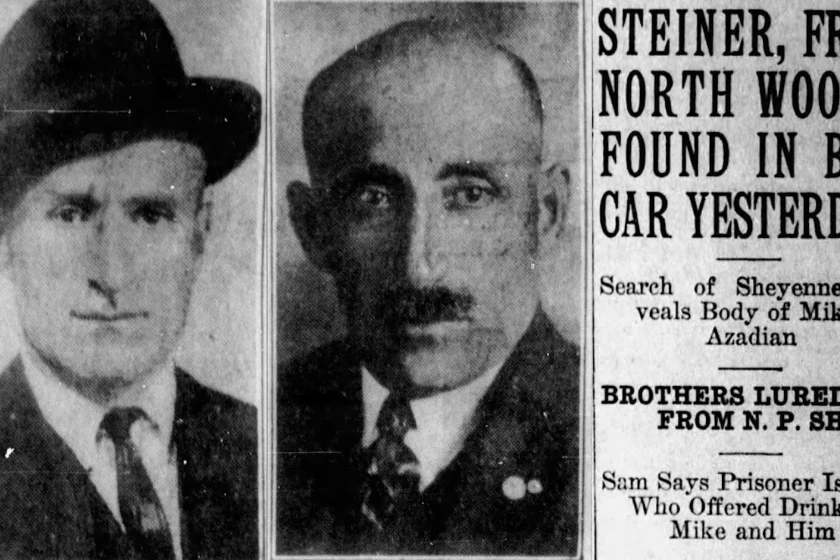
WEST FARGO, N.D. — Sam Azadian awoke with piercing pain from the back of his head. Slowly, his eyes adjusted to the darkness. Scuffling noises to his left. A puppy whined. Was it his brother’s puppy? Without moving, he could make out the box car shack where he and his younger brother lived along the Sheyenne River.
His knuckles ached. With every heartbeat, his head throbbed. Something warm and wet blurred his vision.
A terrifying avalanche of memories returned: it was May 30, 1925. He recalled the late night rap on the door, the sour taste of homemade brew he had been forced to sip, his 29-year-old brother and his puppy, four men intent on robbery. Where was his brother?

Suddenly, hands were clawing at his clothes. Panic forced his limbs into motion; he struck out with his elbow, heard a grunt. Fabric tore and then he was free.
“One is gone already,” a man yelled from the river bank. Distant. He wiped blood from his eyes, but couldn’t see anyone else. The hurried footsteps through early summer foliage was all that remained.
“Mike?” Azadian called out. Silence. What did that mean, “one was gone already?”
A terrible realization forced him to his feet. He screamed for help.
The puppy’s whine called to him. Half running, half crawling, he surged toward the sound. He had survived. His brother had to have survived as well. They hadn’t escaped from their homeland — an Armenian town in Turkey — the forced death marches and firing squads to have everything end here in rural North Dakota at the hands of bootleggers.

The whining drew closer. He hurried forward, and found the puppy. It was his brother’s. Stones, wet with … he looked closer. It appeared to be blood. Where was he? He called out again, but no answer.
Not far away, a train had stopped to refill with water. Using broken English he called out for help. He told them his brother was missing, a murder may have been committed. He needed a gun.
The train pulled away. Grabbing his brother’s puppy up into his arms, he ran back to his shack, put the dog down and grabbed a gun. He was alone, but he no longer cared. Other than a thin makeshift sandbag made from denim, used as a club, the assailants didn’t seem to have any serious weaponry.
He searched the area, but the thieves were gone. Angrily, he fired into the air five times.
“Mike,” he yelled as loud as he could. Spring field crickets chirped in response. He needed help.

Bootlegger robbery
Sam’s story as published by the Forum of Fargo-Moorhead in early June 1925, during the height of the Prohibition era, was told through an interpreter, K.H. Mallarian, a Fargo doctor.
Eventually, Sam made it to the Cass County Sheriff’s Office where he reported the crime, and the fact he could not find his brother. In broken English, he tried to describe what the assailants looked like and what transpired before the attack.
A person, later identified as Walter Steiner, a homeless person and also a woodsman, rapped on the brothers’ door. He had bad luck fishing that day, and asked for a fish to eat.
The brothers were not fishermen; they worked as laborers for the Northern Pacific Railroad.
Steiner then offered Sam a drink; he refused. But the unsolicited guest was insistent, so Sam eventually took a sip, and the homemade brew tasted like brine and vinegar.
Two other men approached, one of them saying that he had lost all his money during a bank crash.
“Then Mike came along with his pup in his arms. The big fellow offered him a drink, but Mike refused. Both of us started back for the shack, but a passing freight cut us off. The big fellow asked me to follow him a little way down the bank where he had some liquor cached. He offered to split with me if I would sell the stuff. I told him I didn’t want to deal with him,” Sam told sheriff’s deputies.
As he turned around to go back home, he was struck in the back of the head. A fight ensued, with Sam, about 43 years old, getting some punches in. But he was outnumbered and was knocked unconscious.

The search
Sheriff’s deputies immediately began scouring the area. They searched box cars and all the usual haunts where homeless people stayed. The search was slow going at night.
But due to Sam’s testimony, at least four men were implicated in the holdup and murder. Meager descriptions were sent out to towns and cities in every direction.
The next day, an expert diver, Mike Markey, of Casseltown, North Dakota, found Mike floating in the Sheyenne River about 40 feet south of the Northern Pacific bridge. Heel marks, as well as a makeshift weapon, a sandbag made from a denim jacket sleeve, a piece of hose, a handkerchief, a nickel and a pair of overalls were found on the opposing bank.
In his pockets, Mike had a roll of $70, worth about $1,300 today, and a gold watch and chain, a gift from his brother. The watch stopped at 10:05 p.m. He was born Aug. 3, 1896, in Turkey, and arrived in America in 1913, according to his death certificate.
An autopsy was performed on Mike’s corpse.
“The body is badly bruised about the face. An autopsy indicated that Mike was stunned but still alive when he fell or was cast into the river,” the Forum of Fargo-Moorhead reported.
The passing Northern Pacific passenger train was running 25 minutes late when it arrived at the bridge around 10:10 p.m. for water, and although nobody helped, the train may have saved Sam’s life.
It “is believed to have saved the man from a fate similar to that which Mike met,” the Forum of Fargo-Moorhead reported.
Steiner was found hidden under a pile of paper in a box car not far from the murder scene and was arrested.
“His clothes were wet to the hips and officers believe this may bear some connection with the finding of a part of Mike Azadian’s overalls and a pool of blood near the river bank,” the Morning Pioneer reported.
Sam identified Steiner as the man who knocked on the door of his freight car home. Before facing murder charges, Steiner received a sentence of 132 days in jail for a vagrancy charge.
Ed Welch, a fisherman and frog catcher, who lived in a dugout along the Sheyenne River, appeared to be helping investigators at first, but his story didn’t match with what others reported and he too, was arrested.

Flags at half mast
The Azadian brothers were considered to be respectable residents of West Fargo. Residents interviewed by reporters in 1925 said the brothers never drank alcohol, that they were generous to a fault, often making loans to people in need.
“Particularly to a family which was in want during the winter, are examples of their characters,” the Forum of Fargo-Moorhead reported.
Their reputation preceded them, however, and it was common knowledge that the brothers frequently kept cash in their pockets.
The attack shocked the community. All of the suspects were considered to be “transients,” or travelers without homes in the area, and residents in West Fargo petitioned the sheriff to “drive away prowlers and suspicious characters,” the Forum of Fargo-Moorhead reported.
The case appeared to be coming together. Investigators believed they had the murderers and filed charges against Steiner and Welch.
Flags in West Fargo flew at half mast on the day of Mike’s funeral, and nearly everyone in the West Fargo community attended his burial at Riverside Cemetery, according to the newspaper.

The trial
In broken English, at times interpreted by Mallarian, Sam told his story in court.
“When giving his account of the fight, he became excited and started to talk fast and more brokenly, and had to be stopped a few times to get him to give his account more slowly,” the Forum of Fargo-Moorhead reported.
The case against Welch soon fizzled as it was based on circumstantial evidence: keys found near the place where the sandbag club was made belonged to him, and the denim used had a fishy smell.
Axel Anderson, a witness from the West Fargo Hotel, also testified that Welch ordered a bowl of ice cream and played pool at the time of the murder.

The cases against two others, who were unnamed, were dismissed in Cass County District Court by April 1926.
After serving nine months in jail, Steiner was released, according to the Forum of Fargo-Moorhead. Despite Sam’s testimony, the charges against him were dismissed as there wasn’t enough evidence against him.
A short time later, Welch was also released, even though he attempted to escape by sawing the bars on a jail window, the Forum of Fargo-Moorhead reported.

Case gone cold
Nearly 101 years have passed since Mike’s murder, and the Forum of Fargo-Moorhead has reported three times — in 1939, 1988 and in 1999 — on the inability of investigators to solve the case.
Sam became a naturalized citizen in Cass County in 1937, according to the North Dakota Naturalization Records Index.
Forum News Service filed an open records request with the West Fargo Police Department, which is still pending.