Armenian Masters of Istanbul’s Grand Bazaar and Avedis Andonyan
By Melinda Andonyan, Istanbul,
Keghart
The Grand Bazaar is more than a commercial center in Istanbul; it’s a place where craftsmanship, trust, and a culture of coexistence have been forged over centuries. One of the unseen pillars of this grand structure is the Armenian tradition of craftsmanship in Istanbul. Particularly in jewelry making, goldsmithing, and metalworking, Armenian masters have been key figures in shaping the aesthetic language and professional ethics of the Grand Bazaar.
The influence of Armenian craftsmen in the Grand Bazaar extended beyond technical skill alone. Their approach to work, their emphasis on simplicity, and their aesthetic understanding based on proportion shaped the overall character of the bazaar. This approach, which prioritizes balance over ostentation and permanence over speed, has been decisive in establishing the concept of “good business” in the Grand Bazaar. The inns became not only places where shops were located, but also schools where craftsmanship was passed down from generation to generation.
Places like Çuhacı Han and Varakçı Han are important centers where Armenian craftsmanship was passed down from generation to generation. Here, apprenticeship meant more than just learning a trade; it meant internalizing patience, silence, and respect for labor. The master-apprentice relationship was shaped more by daily practices than by written rules; a glance, a silence, the handing over of a workbench to another was considered an affirmation of mastery.
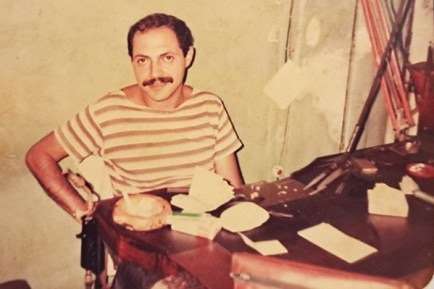
One of the masters who emerged from this tradition is my father, Avedis Andonyan.

Avedis Andonyan’s journey in the Grand Bazaar did not begin as a continuation of a traditional family legacy, but as the result of conscious effort given at an early age. At the age of ten, in 1962, he began his apprenticeship with Hovagim Âşık in the Grand Bazaar. This early period was when he learned the discipline and professional ethics of the trade. Before touching the gold, he grasped the order and rhythm of the workshop.
Later, his path led him to Çuhacı Han, where he became an apprentice to Adom Civanyan. Cuhaci Han was an environment where Armenian craftsmanship flourished, and simple workmanship was valued. Avedis’s relationship with metal deepened during this period; alongside ornate works, he also turned to simplicity that did not conceal imperfections.
Over time, his hard work and attention to detail led him to the rank of journeyman. He begins working as a journeyman alongside Hagop Yayla. He is no longer just someone who implements; he is a master who measures, evaluates, and makes decisions. His aptitude for goldsmithing becomes evident during these years. Works free from unnecessary elements form the basis of his professional approach.
After his master went to France, he continued working with Mıgırdiç Şamlı at Varakçı Han until his military service. This period was a stage in which Avedis Andonyan solidified his professional maturity and experienced a different work pace. After returning from military service, he worked with Mıgırdiç Şamlı for a short time longer.
Years of experience prepared him to forge his own path. In September 1974, he returned to where he started, Çuhacı Han, and opened his own shop. This shop became a quiet but respected place in the Grand Bazaar, representing understated craftsmanship. It was known for its reliability and understated aesthetics.
Avedis Andonyan worked in his shop in Çuhacı Han until his retirement. He witnessed the changing face of the Grand Bazaar, including the closure of inns and the dwindling number of craftsmen. However, he never abandons the fundamental principles of Armenian craftsmanship: not rushing, maintaining moderation, and remaining faithful to one’s labor.
The influence of Armenian craftsmen in the Grand Bazaar lies not in the large signs but in the quality of their work. Avedis Andonyan, as a link in this tradition, has left behind not just his name, but his craftsmanship and the masters he trained.
Some life stories don’t make it into history books. But they live on in the memory of the Grand Bazaar, in the silent gleam of gold.
Unfortunately, the number of Armenian craftsmen in the Grand Bazaar is dwindling today. Some skilled craftsmen have decided to continue their craft abroad, while others have turned to different professions due to economic reasons. Sadly, no new apprentices are being trained to replace them. However, the truth is that when the Grand Bazaar and the jewelry trade are mentioned, it is well known that Armenians are the ones who truly excel in this profession.
*****
Melinda Andonyan was born in Istanbul-Türkiye in 1982. She is a Turkish-Armenian whose

ancestors have lived in these lands for centuries. She graduated with honors from the Department of Teaching. She studied linguistics in Germany, on a scholarship from the German government. She has been actively involved in educational activities in various countries and worked as a teacher at private schools and universities in Türkiye. In addition to her teaching career, she has been an active translator and interpreter in four languages (English, German, Armenian, and Greek) since 2014. She first translated a Turkish book into English, called “Chaldee Letters and The Chaldeans,” (written by Mgr. Francois Yakan) in 2014. This translation has been acclaimed worldwide and has found its place in libraries in many countries. Currently, she is translating books for many publishing companies and also writing articles and texts for various magazines and online platforms.