ARMENIAN MUSEUM OF FRESNO PRESENTS DAVID KARAMIAN AND ETERNAL ARMENIA: KHATCHKARS — THE CROSS STONES OF NORATUS
Photographer and Author Documents Armenia’s Ancient Cross-Stones in New Book Celebrating Faith, Art, Memory and Cultural Preservation
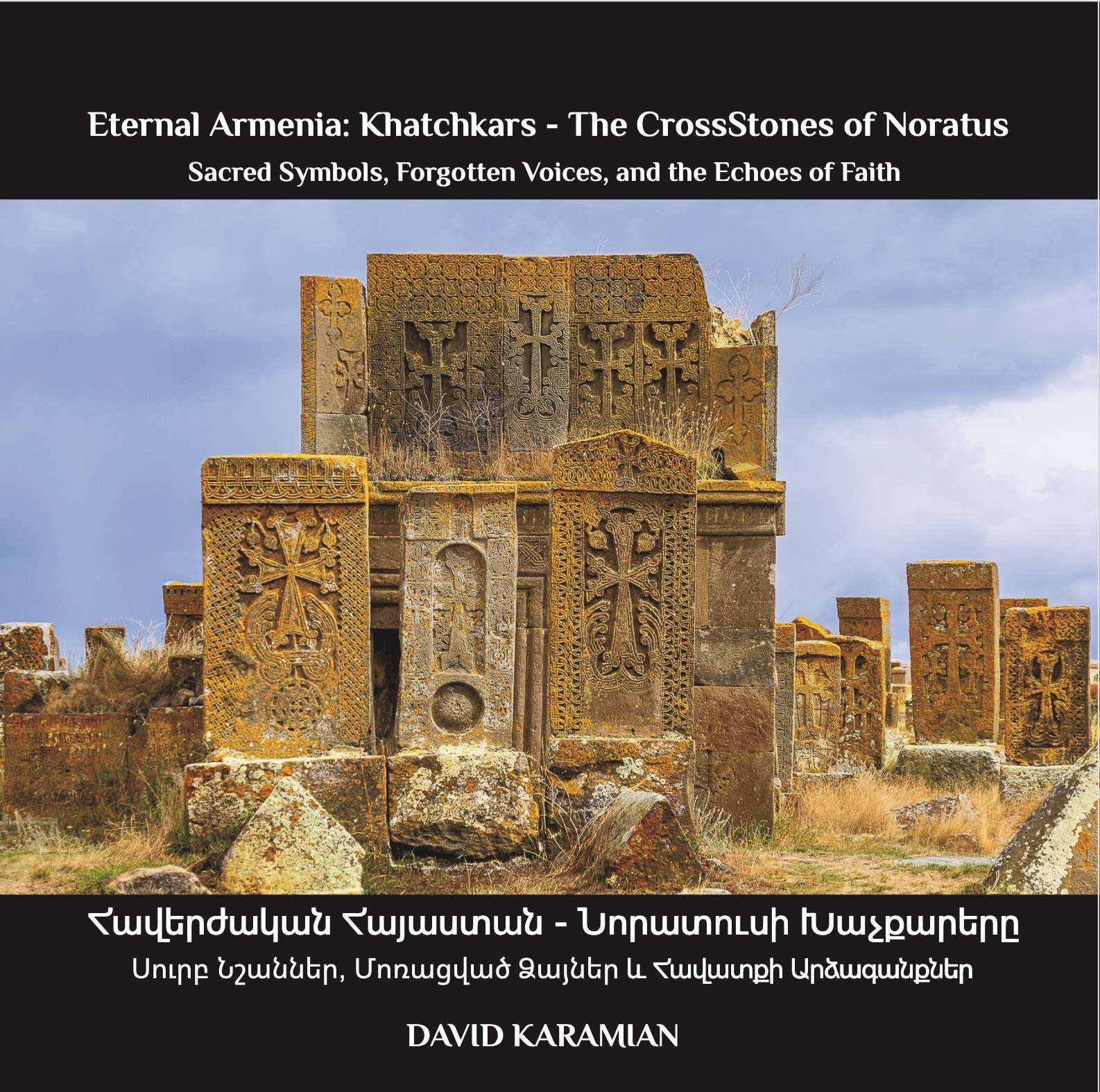
FRESNO, Calif. — In celebration of Armenian Cultural Heritage Month, the Armenian Museum of Fresno will welcome photographer and author David Karamian on Friday, October 9, from 11 a.m. to 4 p.m. to present his latest publication, Eternal Armenia: Khatchkars — The Cross Stones of Noratus: Sacred Symbols, Forgotten Voices, and the Echoes of the Faith.
Nearly three years in the making, Karamian’s book is a photographic and cultural study of the historic cemetery of Noratus, near Lake Sevan in Armenia, home to the world’s largest surviving collection of Armenian khatchkars. The 264-page, large-format bilingual English-Armenian volume features nearly 200 photographs documenting individual khatchkars, carved grave monuments and the landscape in which these centuries-old stones have endured.
Khatchkars, which literally means “cross-stones,” are among the most distinctive expressions of Armenian Christian faith, art and cultural identity. Traditionally carved from stone, they feature an ornate cross surrounded by intricate geometric, botanical and symbolic designs. They have served as memorials, places of worship and sacred markers commemorating people and significant events.
More than 50,000 khatchkars survive in Armenia, and according to UNESCO, no two are alike. In 2010, the art, symbolism and craftsmanship of Armenian khatchkars was inscribed on UNESCO’s Representative List of the Intangible Cultural Heritage of Humanity.
Karamian’s book goes beyond documenting their extraordinary artistry. Through photography and historical research, Eternal Armenia explores the development of Christianity in Armenia, the origins and evolution of the khatchkar tradition, the symbolism carved into the stones and the master artisans who created them.The project also focuses on the importance of cultural preservation. The ancient cemetery of Noratus represents generations of Armenian faith and memory preserved in stone. Karamian’s photographs capture not only the monuments themselves, but also inscriptions, weathered stones and the landscape they have inhabited for centuries.
Through his work, Karamian seeks to bring greater awareness to this extraordinary Armenian cultural and Christian heritage and help preserve its story for future generations.
The presentation is part of the Armenian Museum of Fresno’s celebration of Armenian Cultural Heritage Month throughout October and its yearlong 25th anniversary celebration.
Karamian will be at the Museum from 11 a.m. to 4 p.m. to meet visitors and discuss Eternal Armenia: Khatchkars — The Cross Stones of Noratus. Copies of the book will be available. Later at 7:00 PM David will be the guest speaker at Fresno State Armenian Studies Program lecture series.
Meet David and Leisurely Interact with Him
Friday, October 9, 11:00 AM – 4:00 PM
at The Armenian Museum of Fresno
DAVID KARAMIAN
Varoujan Der Simonian, AMF: David, thank you for taking the time to be interviewed. Tell us about yourself, what attracted you to photography? Do you recall the first time that you held a camera? How did you feel? And when did you start taking serious photos and publishing photo albums?
David Karamian: Photography has been part of my life for many years. I have always been drawn primarily to architecture, monuments, and nature. They allow me to take my time—to study the light, details, and different perspectives. Photographing people is different; it requires trust and a much more personal and sensitive approach.
My serious photographic work in Armenia began with my first visit in 2005. Over many trips, I documented monasteries, churches, landscapes, and monuments without initially thinking they would become books.
That changed after the 2020 Artsakh war. I began to understand that photographs are not simply images of beautiful places; they can also become historical records. That realization eventually led to Armenia – The Lone Stone, followed by A Traveler’s Guide and now Eternal Armenia.
AMF: This is the second such album that I know of. What first drew you to Noratus and made you feel that it deserved an entire book of its own?
DK: My journey to Noratus actually began with a single khatchkar. I came across the story of a magnificent Armenian khatchkar associated with the Louvre, and that awakened my curiosity about the tradition and eventually led me to Noratus in 2023.
Nothing prepared me for standing among hundreds of these stones. Even more surprising was discovering how little known Noratus is, even among Armenians in Armenia and the diaspora.
I realized that a place of this importance could not be represented by a few photographs in another book. It deserved a book of its own.
AMF: For readers who may never have heard of Noratus, what is this place, and why is it so important to Armenian history and culture?
DK: Noratus is an ancient village near Lake Sevan and home to the largest surviving field of Armenian khatchkars. Hundreds remain there, spanning centuries of Armenian history.
But Noratus is more than a cemetery. It is an open-air record of Armenian faith, craftsmanship, symbolism, family life, and cultural memory.
This project also gave me an opportunity to understand my own Christian heritage more deeply. I began seeing the symbols almost as an alphabet. The artisans shared a common visual vocabulary, but each used it differently to create an individual expression in stone.
“If this book helps more Armenians discover Noratus, brings it into museums and universities beyond Armenia, and contributes in some way toward its eventual consideration for UNESCO World Heritage recognition, then these three years will have accomplished something beyond making a book.” – David Karamian
AMF: One of the central purposes of Eternal Armenia is preservation through documentation and greater visibility. Why do you believe photographing and documenting Noratus is so important today? DK: In 2015, I traveled through Artsakh with my son Armen and photographed its churches, monasteries, khatchkars, and landscapes. Some of those photographs appeared in Armenia – The Lone Stone. I never imagined that one day some of them could become records of what we once had.
Since Azerbaijan took control of Artsakh, Armenian cultural sites have been destroyed, damaged, or altered, while the Armenian identity of some monuments has been challenged. That changed the meaning of documentation for me.
My objective with Eternal Armenia is therefore not only preservation through photography, but visibility. I want Noratus brought to the attention of the Armenian government and Foreign Ministry for consideration toward UNESCO World Heritage recognition. I also want it seen by museums, universities, cultural institutions, and organizations concerned with preserving world heritage.
We should not wait until something is lost before deciding it was important.
AMF: You spent nearly three years photographing, researching, writing, and designing this book. What did you discover about Noratus during that process that you did not understand when you began?
DK: Initially, I saw an extraordinary collection of khatchkars. Over time, I began seeing individual works of art and individual voices.
I noticed how different artisans used similar symbols in completely different ways. At the same time, researching the stones led me much deeper into Armenian Christianity and the spiritual ideas behind the art form.
What began as a photographic project became an education. I went there wanting to photograph the stones; I ended up trying to understand what they were saying.
AMF: Most people think of a khatchkar simply as an Armenian cross carved in stone. What did you learn about the symbols, patterns, human figures, animals, and other imagery carved into these stones?
DK: The cross is central, but it is only the beginning. Around it you find rosettes, vines, trees of life, geometric forms, animals, human figures, tools, and scenes from everyday life.
I began thinking of these symbols as an alphabet. Give several writers the same alphabet and they will not write the same story. These artisans were doing something similar in stone.
The khatchkar is therefore more than a religious monument. It is a distinctly Armenian art form combining faith, sculpture, geometry, symbolism, and memory.
Cover of the Album
AMF: In the book, you often try to “read” individual khatchkars and interpret what their artisans may have been communicating. Why was this important to you? DK: I wanted readers to slow down and really look.
The stone biographies are not claims that I know exactly what an artisan was thinking eight hundred years ago. They are invitations to observe the symbols, composition, craftsmanship, and personality of each stone.
Writing them was one of the most demanding parts of the book. Eventually, my question changed from “What am I looking at?” to “What might this stone be trying to tell me?”
AMF: The book introduces some of the master artisans who created khatchkars centuries ago. What did you learn about these craftsmen and the individuality of their work?
DK: I cannot stop thinking about the challenge these artisans faced. Look at a work by Master Poghos—patterns more intricate than lace, except they are carved into stone.
How did he begin? How many ideas and iterations came before the final composition? Eight hundred years ago there was no computer, no undo button—only a hammer, a chisel, and a stone that did not forgive mistakes.
Behind every great khatchkar was a human being with extraordinary imagination, patience, skill, and faith. Centuries later, we are still looking at what once existed in his mind.
AMF: There is also a very personal and human side to your experience at Noratus—including the people you met there. How did those encounters affect the way you saw the cemetery and ultimately the book?
DK: I keep thinking about Siranush, an elderly villager who, with her simple, broken English, became for me the human face of one of Armenia’s most extraordinary places.
On my first visit, she called me through the gate and began introducing me to the cemetery. Her warmth reminded me of my grandmother. On my last visit, she simply asked me to come back again.
That stayed with me. Behind centuries of monumental history was one elderly village woman quietly welcoming the world through the gate.
Armenia – The Lone Sone by David Karamian
AMF: The destruction of Julfa and the vulnerability of Armenian cultural heritage in Artsakh appear later in the book. One of them is an image of Aram Vruyr overlooking the khatchkars of Julfa taken in the early 1900s. How did those losses reinforce your belief that documentation itself can become a form of preservation?
DK: Julfa may be the strongest argument for documentation. Thousands of Armenian khatchkars once stood there. Today the cemetery is gone, and relatively little photographic documentation remains to show the world what existed.
That makes the historic photograph of Aram Vruyr overlooking that vast field especially haunting. The photograph survived. The landscape he photographed did not.
I now look at my own photographs from Artsakh differently. If Julfa could be destroyed, and Armenian cemeteries and monuments in Artsakh can be destroyed or altered today, we cannot assume that cultural heritage will survive simply because it has been there for centuries.
Documentation cannot physically protect a monument. But it creates evidence, memory, and visibility—and makes erasure much more difficult.
AMF: Your work combines photography, history, art, symbolism, and personal reflection. What do you hope Armenian readers experience when turning the pages—and what do you hope non-Armenian readers take away from it?
DK: For Armenian readers, I hope the first reaction is discovery. It still surprises me how many Armenians, both in Armenia and the diaspora, know very little about Noratus.
For non-Armenian readers, I want the book to open a larger door. Armenian architecture and khatchkars are not only part of Armenian history; they are part of the larger story of human creativity.
That is why I want Eternal Armenia to reach museums, universities, libraries, cultural institutions, and preservation organizations around the world.
The message is simple: This is part of humanity’s cultural inheritance. Know that it exists.
AMF: Having been to Noratus several times, I appreciate what you have accomplished. After spending three years returning to Noratus and working so closely with these stones, what does Noratus mean to you personally today?
DK: I arrived at Noratus as a photographer. Somewhere during those three years, curiosity became responsibility.
Julfa is always in the back of my mind, as are the monuments I photographed in Artsakh. I no longer take the survival of cultural heritage for granted.
I cannot determine what happens to these stones in another hundred years. What I can do is document what exists today, tell its story, and help bring Noratus greater national and international visibility.
If this book helps more Armenians discover Noratus, brings it into museums and universities beyond Armenia, and contributes in some way toward its eventual consideration for UNESCO World Heritage recognition, then these three years will have accomplished something beyond making a book.
The stones have survived for centuries. Our responsibility is to make sure the world knows they are there.
EVENT DETAILS
David Karamian Presents
Eternal Armenia: Khatchkars — The Cross Stones of Noratus: Sacred Symbols, Forgotten Voices, and the Echoes of the Faith
Friday, October 9, 2026
11 a.m.–4 p.m.
Armenian Museum of Fresno
550 E. Shaw Ave., UC Center
Fresno, CA 93710
Admission is free and open to the public.
For more information, contact the Armenian Museum of Fresno at (559) 224-1001 or info@armof.org.
UPCOMING EVENTS
SAVE THE DATE: A special evening, Remembering The Art and Life of Robin Armen Dolarian will be held on Friday, October 23, from 5 to 8 pm at the Armenian Museum of Fresno – 550 E. Shaw Ave. Fresno, CA 93710.
“I WANT TO MAKE ART THAT SHOWS I’M ALIVE TODAY.”
– Robin Armen Dolarian.
Join us in celebrating 25th Anniversary of the Armenian Museum of Fresno with these and additional cultural art performances, exhibits and presentations planned throughout the year – a very special year to experience Armenian art and culture in Fresno.
About the Armenian Museum of Fresno
Founded in 2001, the mission of the Armenian Museum of Fresno is to enhance the rich, ethnic, and multicultural makeup of Fresno. The Museum is dedicated to collecting, preserving Armenian culture, heritage, and history in Central California and promoting through exhibits, events, research, and educational programs. The museum serves as a cultural hub for the community, offering visitors a deeper understanding of the rich Armenian legacy and its global impact.
The AMF is located at the University of California Center at 550 E. Shaw Avenue in Fresno, across from Fashion Fair mall. The ADA-compliant facility is open Monday through Friday, 10 a.m. to 6 p.m. and easily accessible through the public transportation system.
ZARTONK Gallery is located at Historic Helm Building 1107 Fulton St. Downtown Fresno, 93721. Visit us first Thursday of each month 5-8pm during ArtHop nights.
AMF is funded in part by the citizens of the City of Fresno, Measure P, Expended Access to Arts and Culture (EAAC) initiative.
Admission is free and open to the public.