
Armenia’s drone industry is growing and looking to international partnerships
By Nicholas Castillo
Civilnet
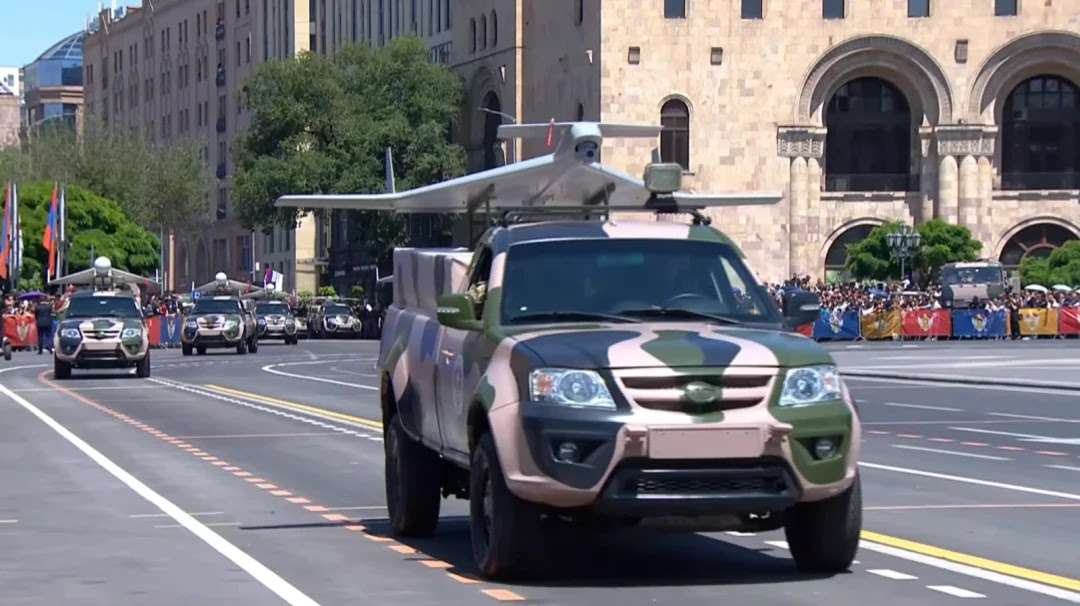
During Armenia’s May 28 Republic Day military parade, Yerevan was eager to show off new and domestically produced military technology. A section was devoted to Armenia’s newly established Unmanned Aerial Vehicle (UAV) Forces and a fleet of drones, with the announcer relaying to viewers that many had been made in Armenia.
“Since 2022, the Government of the Republic of Armenia has invested around 170 billion drams ($465 million) in the military-industrial complex, and today we have results we can be proud of,” Prime Minister Nikol Pashinyan declared during his May 28 remarks.
Recent years have seen the use of military drones drastically expand in Ukraine and across the Middle East. In Armenia, many appear to be betting on their relevance for Yerevan’s security.
In early June, Yerevan hosted the RISE Silicon Mountains expo, allowing dozens of Armenian drone and military technology manufacturers to put their newest models on display for the public. CivilNet profiles this growing industry and investigates its potential role in Armenian security.
Davaro Defense: A Leader in Armenia’s Homegrown Drone Sector
Armenia has technically maintained military drones since at least 2011. But, it would be years until Armenian researchers and officials began to devote serious attention to UAVs’ military potential
Yet, while the 2020 Nagorno-Karabakh war caused drone warfare to break through into global headlines and underscored their importance for Yerevan, much of Armenia’s domestic drone sector has its origins in the years prior to the conflict.
The producer of six of the thirteen domestically built drone models displayed during the May 28 military parade, Davaro Defense, appears to be the largest UAV defense manufacturer in Armenia. According to Minister of High Tech Mkhitar Hayrapetyan, the company employs roughly 300 people.
At the RISE expo, Davaro’s systems likewise took on a prominent role, being heavily featured at the entranceway to the exhibition hall.

Founded in 2007 and originally an electronics retailer, the company premiered its first UAV model in 2016 before securing its first research and development (R&D) contract in 2019.
Per Davaro’s webpage, their loitering munitions (another term for kamikaze drones) were used in active combat in 2020, possibly a reference to the second Nagorno-Karabakh war or the July 2020 Tavush skirmishes in which Armenian officials confirmed the use of drones by Yerevan.
Davaro’s catalogue of products includes ten reusable combat UAVs, two reconnaissance UAVs, and two models of small first-person kamikaze drones. They also produce a ground control station, explosive payloads, and military software.
Among unmanned aerial vehicles, the company also displayed its fleet of unmanned ground vehicles (UAGs) at the Rise expo. These systems are yet to be described in detail on Davaro’s website, with the exception of one unmanned turret.
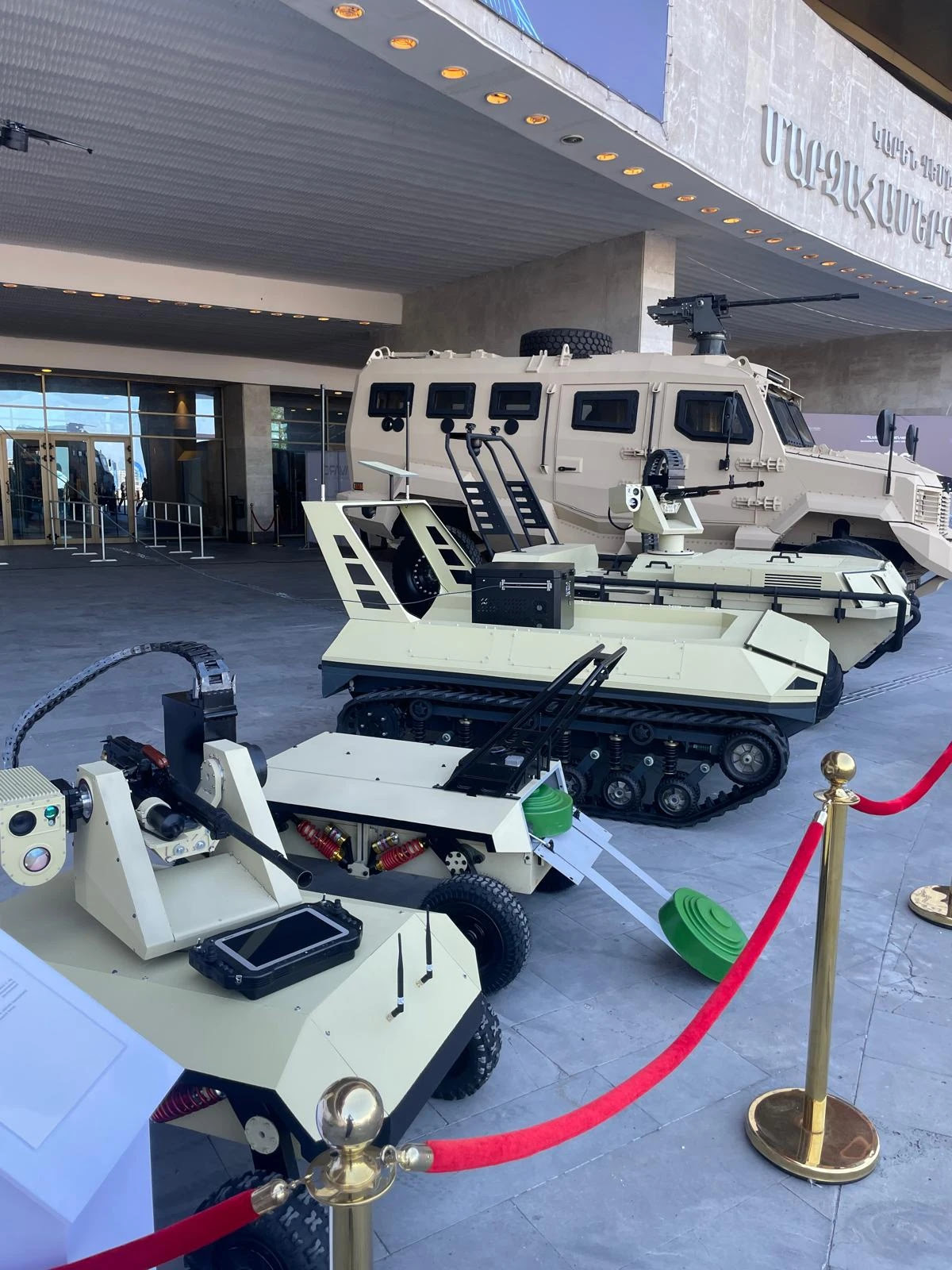
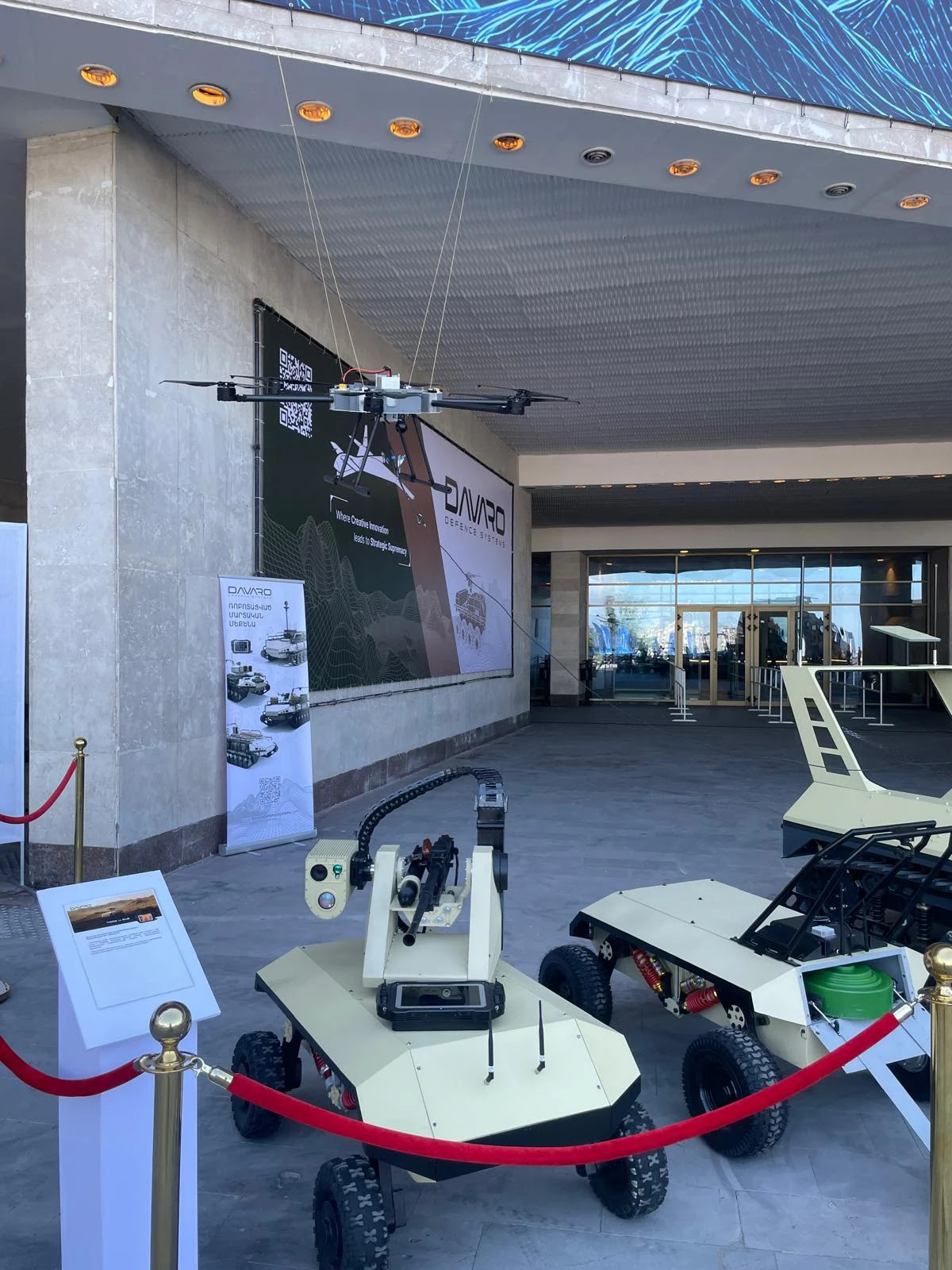
Davaro’s UGVs displayed at the RISE expo.
Davaro’s expo booth also included a model of an interceptor drone labeled as a “Rocket Drone” designed to “destroy conventional enemy drones flying at low altitudes.” This product too is yet to feature on the company’s webpage, but a post on Davaro’s Facebook describes it as an “RD-1 anti-drone system.” Such systems have taken on high demand in recent months, with several deals by Ukraine to provide drone air defense to states affected by the U.S.-Israel-Iran conflict.

CivilNet reached out to Davaro for comment, but was unable to secure an interview by press time.
Locator CJSC: Armenia’s Civilian Sector Looks to Drone Tech
Also founded in 2007, Locator CJSC developed an initial expertise in civilian digital engineering systems used in vehicles, water systems, and weather tracking.
By 2014, however, Locator was already experimenting with unmanned turret weapons, a kind of weapons system that has only recently entered the battlefield in Ukraine.
“Our ministry of defense didn’t want to take it,” Nerses Nersisyan, an engineer at Locator, told CivilNet, explaining that the technology had been too novel at the time to garner interest.
While the vast majority of the company’s work remains civilian, Locator has designed an AI-powered self-guided bomb they call the GML, and the “Matilda-A” series drones, capable of delivering Locator’s in-house payload and other ordnance. These products were likewise featured at the recent expo in Yerevan.
Both systems are autonomous, with the GBL bomb equipped with cameras to locate targets. Neither requires Wi-Fi, GPS, radio, or constant contact with human operators, who are primarily involved in selecting targets before the drone’s mission.
Locator also collaborates with UAVLab, another defense technology company based in Armenia. While Locator can provide guided munitions, UAVLab focuses on drones that can help deliver them.

Per its webpage, UAVLab currently produces five separate aerial drones, several of which featured during the May military parade.
International Partners for Armenian Drones?
When U.S. Vice President JD Vance visited Armenia in February 2026, U.S. drones were among the trip’s most tangible deliverables. Meeting with Prime Minister Nikol Pashinyan, Vance announced that the U.S. had green-lit the sale of American V-BAT reconnaissance drones to Yerevan – although the new technology was notably absent during the parade on Republic Square.
Several of the larger UAVs displayed during the parade were Chinese CH-4B drones. No previous reporting had announced any drone purchases from China, although Armenia and China announced a strategic partnership in August 2025.
However, when it comes to international cooperation, Armenian drone manufacturers appear more likely to look to Europe and India than China or the United States.
“We’ve had interest from Greece, France, India,” Locator representatives told CivilNet.
A video posted to Davaro’s Facebook page claims the company is in joint production talks with France and in purchasing talks with seven countries. The video also states that the company has begun to “implement foreign system designs and production, and some samples are already being supplied to Armenia.”
Other posts on Davaro’s Facebook appear to show the company demonstrating its UGVs to a group of Indian military officials.
A Davaro representative confirmed to CivilNet the company was working to create international partnerships, but did not name any specific country or firm.
A number of Armenia’s leading defense manufacturers took part in the Paris 2026 EUROSATORY exhibition in June. The forum was also attended by Armenia’s Minister of High-Tech Industry, Mkhitar Hayrapetyan and Minister of Defense Suren Papikyan.
The French exhibition concluded with an industrial partnership agreement between Armenian military tech company BooTech and Thales Group, a global arms company founded in France. It is the first agreement of its kind between French and Armenian military technology firms. According to the official Armenian announcement, “Thales will share its manufacturing expertise, while BooTech will contribute its integration and networking capabilities.”

“This collaboration supports European security in light of Armenia’s growing rapprochement with the alliance,” said BooTech’s Senior Vice President for Europe.
BooTech is not a drone manufacturer, instead focused on electronic battlefield management systems. However, BooTech CEO Ashot Ghukasyan told CivilNet they work to integrate their systems into Armenian UAVs.
“There is a strategic partnership between Armenia and France,” said Ghukasyan when asked about the Armenian defense sector’s orientation toward Paris. “France is one of the world’s major producers and exporters of defence technologies, with a highly developed defence industry.”
Ghukasyan described the agreement with Thales group as a “strategic partnership, which means long-term engagement and collaboration on joint projects in Armenia and potentially abroad.”
“Cooperation and partnerships with companies from the United States and India are also developing progressively,” he added.
For their part, Locator first premiered their military technology internationally in May 2025, at a trade show in Athens and took part in the recent expo in Paris. The company has long term ambitions to integrate production more with potential European partners, for example receiving an export license to provide their software to French companies.
As for Ukraine, a current global hub of drone innovation, Locator and other companies so far seem to be hesitant to get involved with potential partners directly involved in an active conflict.
“We don’t sell to Ukraine, we don’t sell to Russia,” Locator’s CEO said when asked if the company had partners in Ukraine. “We don’t go [into the] conflict directly.”
Is it Time to Scale Up?
Recent years have seen Armenian officials speak of defense export ambitions and increased spending on domestic defense industrial capacity. In January, Armenia’s Minister of Defense announced that Yerevan would spend $400 million on investments in domestic defense industry development over the coming two years.
As far back as 2022, Armenia’s Vice Speaker of Parliament Hakob Arshakyan stated“there are several production lines in Armenia, including serial production of unmanned aerial vehicles.”
“At the moment, [Locator] is more R&D than manufacturing,” Locator’s Nersisyan told CivilNet.
The company, however, is now looking toward commercial profitability, new licensing possibilities, and production.
At present capacity, Locator told CivilNet they could produce up to ten bombs per day depending on the contract, but company representatives said it could drastically scale up over time if a larger order was placed.
On its webpage, Davaro says it committed to continuous production in 2024.
While the Republic Day parade showed that Yerevan is ready to demonstrate its growing drone capacity, official statistics on Yerevan’s current drone arsenal are not available and it remains unclear just how many drones it is currently able to produce.
Experts often argue that the capacity to scale up production and maintain supply chains are key aspects of the sector’s overall combat effectiveness, separate questions from whether or not Armenian firms can produce a number of cutting edge systems. Ukraine and Russia now both produce millions of small and large drones in a given year.
For Yerevan, such high numbers may not be within the bounds of Armenia’s security needs or realistic capabilities. But questions of production, scale, and supply chains will likely be as critical in years to come as the quality of any single defense innovation.