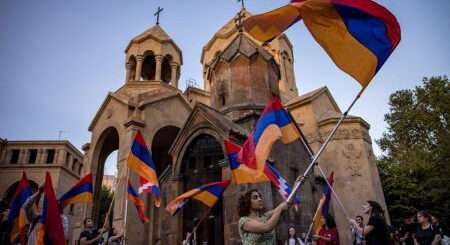
Armenia’s widening prosecution of political opponents, and what it means for the country’s EU ambitions
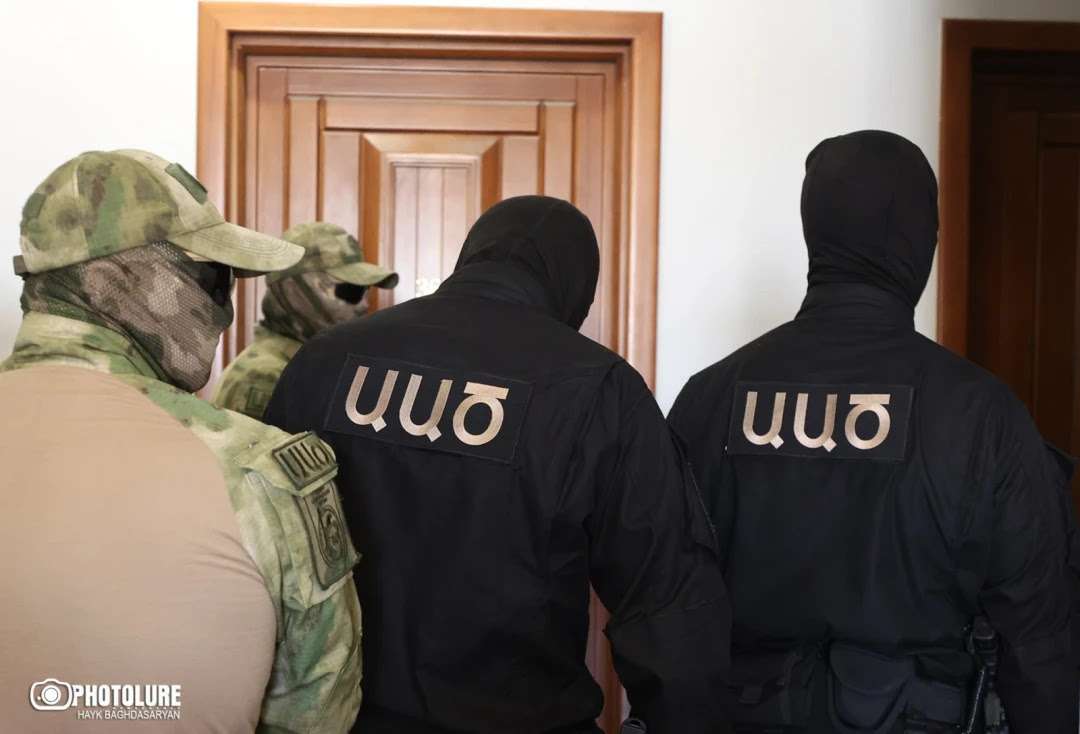
National Security Service officers at the residence of Member of Parliament Levon Kocharyan in Yerevan, Armenia, August 25, 2026.
Hrair Balian*
Civilnet
In the eleven weeks since Armenia’s 7 June 2026 parliamentary election, the government of Prime Minister Nikol Pashinyan has arrested or charged a former president, summoned a second former president, jailed the eldest son of the first, nationalized the country’s largest private company, and detained a prominent civic figure for two months before releasing him without any restriction at all. It has done all this while telling parliament, within the same week, that Armenia intends to file a formal application to join the European Union, despite the country’s distant prospects of membership.
The coincidence of timing is not new. As documented in a July 2026 article highlighting a disturbing pattern, Armenian authorities have offered a specific legal rationale for nearly every case brought against a government critic since May 2025 — tax evasion, money laundering, vote-buying, preparation of terrorism, abuse of power — but taken together, the cases display the structural markers international human rights bodies treat as hallmarks of selective, politically inflected prosecution rather than ordinary law enforcement: timing that tracks the political calendar, prolonged detention without individualized justification, speech-based charges under broad statutes, and enforcement concentrated almost entirely on one side of the political spectrum. The last two months have added a former president, a second former president, and fresh legal questions of their own — including, in the Kocharyan case, a serious question of whether Armenia is prosecuting the same defendant twice for the same underlying conduct.
Two former presidents, one weekend
On 24 August, opposition MP Levon Kocharyan accused Pashinyan on the floor of the National Assembly of pressuring courts and prosecutors, telling him a prime minister should not publicly decide who gets imprisoned or stripped of property. Pashinyan responded by demanding to know how Levon’s family had become millionaires and declaring, on camera, that the Kocharyan family would have to return its property “piece by piece” to the state as his personal “political mission.” The next morning, Armenia’s Anti-Corruption Committee arrested Levon’s father, former president Robert Kocharyan (1998–2008), along with his elder son Sedrak and four associates, after raiding dozens of addresses. The Prosecutor General’s Office charged the elder Kocharyan with three counts of abuse of official power, two counts of large-scale bribery, and four counts of large-scale money laundering, alleging that as president he removed valuable state property — including Defense Ministry land — from public ownership at below-market prices and later moved a resulting stake in the Toyota Yerevan dealership to Sedrak through what investigators call fictitious transactions. Investigators say they have frozen roughly 144 billion drams and more than three dozen properties tied to the family. Kocharyan, hospitalized briefly with high blood pressure during the arrest, days before turning 72, was ordered into pre-trial detention on 27 August; Sedrak was arrested a day earlier. Kocharyan’s office called the case “another attack” on the family.
The same case swept in a second former president. On 25 August, prosecutors also opened criminal proceedings against Serzh Sargsyan — Kocharyan’s prime minister from 2007 to 2008 and Armenia’s president from 2008 to 2018 — on charges of abuse of official power or authority, along with nine other defendants including former Yerevan mayor Gagik Beglaryan and businessman Samvel Mayrapetyan. Sargsyan told reporters outside the Anti-Corruption Committee that he did not yet know what he had been charged with. The government maintains the proceedings are ordinary anti-corruption enforcement.
A defendant prosecutors keep re-charging
What makes the new case harder to read as routine is Kocharyan’s own prosecutorial history, which is essentially a record of the state’s earlier attempts, during Pashinyan’s first year of premiership, to convict him for conduct arising from the same presidency repeatedly failing on legal, not factual, grounds. Kocharyan was first arrested in 2018 and charged with overthrowing the constitutional order in connection with the killing of ten people during the suppression of post-election protests on 1–2 March 2008. In March 2021, Armenia’s Constitutional Court ruled the relevant charge unconstitutional, and the Yerevan Court of General Jurisdiction dropped the case. A separate bribery, fraud, and money-laundering case against him — over the Kocharyan family’s purchase of Yerevan’s Congress Hotel — was dismissed because the statute of limitations had expired. In November 2024, prosecutors reclassified the same March 2008 conduct as ordinary abuse of power and revived the case; that retrial was itself still contested on statute-of-limitations grounds as recently as June 2026, when a court ordered co-defendant and former Minister of Defense Seyran Ohanyan detained after the Court of Cassation sent the case back for a new trial. Then, on 17 June 2026 — ten days after the election — the Central Election Commission stripped Kocharyan’s parliamentary immunity a third time, over what his lawyer described as a 2004 transaction predating any involvement by Kocharyan or his family and already time-barred. It is against this backdrop that the August 2026 property charges arrived — and, tellingly, the Prosecutor General’s Office felt compelled to issue a public statement on 27 August specifically denying that the statute of limitations on the new charges had expired, responding to claims already circulating that it had.
None of this proves the August 2026 property allegations are identical to any earlier dismissed charge; the Defense Ministry land sale and the Toyota Yerevan shares are, on the public record, a distinct set of facts from the 2008 crackdown or the Congress Hotel purchase. But the pattern across all of them is the same, and it is the pattern Article 68 of the Armenian Constitution and Article 14(7) of the ICCPR exist to guard against: a state repeatedly re-charging the same person for conduct tied to the same period in office, on a rotating set of legal theories, after earlier versions of the case have been dismissed on constitutional or limitations grounds rather than on the facts. Each new filing resets the clock and the headline, even where the underlying institutional posture — the government’s determination to see Kocharyan answer for his presidency in some courtroom — has not changed since 2018.
The template: Karapetyan and Electric Networks of Armenia
The Kocharyan case follows a template set by Samvel Karapetyan, the Tashir Group owner and Strong Armenia leader, arrested on 18 June 2025, hours after voicing support for the Armenian Apostolic Church in its standoff with Pashinyan. The Prime Minister announced the nationalization of Karapetyan’s Electric Networks of Armenia (ENA) the same day. An emergency arbitrator at the Stockholm Chamber of Commerce ordered Armenia to suspend the process on 24 July 2025; Armenian authorities proceeded regardless, and the government’s own international legal-affairs representative was dismissed after publicly stating the ruling was binding. Karapetyan spent more than six months in pre-trial detention — including one documented sequence in which he was returned to a detention facility via hospital just seventeen days after being granted house arrest — before the nationalization was formalized through Article 60 of the Constitution’s “overriding public interest” clause, still without a disclosed compensation figure. He was still under house arrest when he led Strong Armenia into the June 2026 election.
Chalabyan, and the volume problem
Not every case ends in conviction, and one from the same window illustrates the point. Avetik Chalabyan — a former McKinsey senior partner and coordinator of the opposition HayaQve civic initiative — was arrested on 24 June 2026 and accused of conspiring with foreign officials to pressure Armenian citizens abroad into voting for Strong Armenia. He spent almost two months in pre-trial detention before a judge, who, at the first substantive hearing on 21 August, declined to impose any restrictions and released him outright. It was Chalabyan’s second run-in with the Pashinyan government: he was jailed in 2022 on charges of paying students to join anti-government protests, a case the Council of Europe’s parliamentary assembly and the U.S. State Department cited as problematic at the time, and his eventual conviction was overturned on appeal. Chalabyan’s release is worth weighing against the broader pattern of persecuting government opponents: Strong Armenia representatives told OSCE/ODIHR’s election observers that more than 250 of the party’s members or supporters had been arrested or detained over the election cycle, a figure ODIHR could not independently verify because the authorities would not provide an official count. A judiciary capable of releasing a defendant outright in one case is not incapable of independence in general — but a volume of detentions in the hundreds, concentrated on one party, is difficult to reconcile with the individualized, case-specific necessity that Article 9(3) of the ICCPR and Article 5(3) of the European Convention on Human Rights require of every single detention, one Chalabyan-style release notwithstanding.
What the standards require, and where Armenia is falling short
Armenia’s own Constitution largely mirrors the international standard, at least on paper. Article 27 permits deprivation of liberty only on enumerated, individualized grounds — chiefly a reasonable suspicion of a specific offense — and requires a court to authorize continued confinement within 72 hours or release the person immediately; Article 63 guarantees a fair and public hearing within a reasonable time before an independent and impartial court; Article 66 guarantees the presumption of innocence until a final judgment; Article 60 permits deprivation of ownership only through judicial procedure and, for takings pursued in the name of an overriding public interest, only in exceptional cases with prior and equivalent compensation; Article 68 bars trying anyone twice for the same act; and Article 29 bars discrimination in the exercise of rights on the basis of political or other opinion. Article 96 separately shields sitting deputies from prosecution or arrest without the National Assembly’s consent — a provision tested, though not formally breached, when MP Levon Kocharyan’s home was searched without his own arrest.
The ICCPR’s Article 9(3) and the UN Human Rights Committee’s General Comment No. 35 add the operative gloss on Armenia’s own liberty clause: detention pending trial must be the exception rather than the rule, may be ordered only where necessary to prevent flight, interference with evidence, or recurrence of an offense, must rest on an individualized assessment repeated at each extension rather than a one-time finding, and must be for the shortest period reasonably possible, with release conditioned on guarantees to appear rather than mere restatement of the original suspicion. The European Convention on Human Rights, through the European Court of Human Rights’ four-ground framework under Article 5(3), requires that each successive extension supply fresh and case-specific reasons; the Court has repeatedly found violations where domestic courts recycled the same formulaic language across extension after extension, precisely the pattern seen in the sequential two-month detention orders issued for Strong Armenia candidates and, now, for Sedrak Kocharyan and his father. That same Merabishvili line of case law is the authority behind Article 18 ECHR’s prohibition on using a lawful power — arrest, asset freeze, license revocation — for the actual, if undisclosed, purpose of neutralizing a political rival; the Court there found Georgia’s detention of a former prime minister unlawful in substance even though the formal legal basis was sound, because the predominant purpose was to remove him from politics. The same test, applied to Karapetyan’s arrest on the day nationalization was announced, or to Kocharyan’s prosecution opening the day after Pashinyan personally declared the family’s assets forfeit on television, is not one Armenia currently has any independent body positioned to apply.
On property, the architecture is layered similarly. Article 1 of Protocol No. 1 to the ECHR requires that any interference with possessions be lawful, pursue a legitimate aim, and strike a fair balance — a balance the European Court of Human Rights has found absent where compensation is indefinitely deferred or where the domestic procedure supplies no genuine opportunity to contest valuation. Article 17 of the EU Charter of Fundamental Rights, which will bind Armenia’s conduct as a matter of accession-track scrutiny well before it binds Armenia as a matter of law, sharpens this further by requiring compensation paid “in good time” rather than promised indefinitely — a standard the still-undisclosed ENA valuation, more than a year after the license revocation that preceded it, does not obviously meet. For asset freezes specifically — as opposed to final confiscation — the Council of Europe’s asset-recovery framework and EU Directive 2024/1260 permit provisional restraint only where it is temporary, proportionate to a demonstrated risk of dissipation, and subject to periodic judicial re-examination; an open-ended freeze on 144 billion drams and three dozen properties, announced by the Prime Minister as a foregone conclusion before any court had ruled, sits uneasily with a framework built around provisional and reviewable measures rather than pre-judged ones. And Article 47 of the EU Charter and Article 6(1) ECHR’s guarantee of an independent tribunal function, in this context, as the precondition for all of the above: every other safeguard — individualized necessity, fresh grounds on each extension, a genuine compensation hearing, a body capable of applying Article 18’s ulterior-purpose test — presupposes a court insulated enough from the executive to actually enforce it against the executive.
That is precisely the precondition the EU’s own monitoring has found wanting. The EU’s 2025 Annual Report on Human Rights and Democracy, covering Armenia, found a continued lack of full judicial independence alongside the extensive use of pre-trial detention and the risk that criminal law was being turned against dissent. ODIHR’s election observation mission reached the same conclusion in its own language, describing a perception of selective justice arising from the concentration of criminal cases on one side of the political spectrum. The Council of Europe’s Venice Commission has separately articulated the broader diagnostic that both bodies are, in effect, applying here: judicial independence is not established by constitutional text or by the existence of appellate remedies, but by whether courts in politically sensitive cases in practice reach outcomes the executive did not announce first. On the record assembled here — the Prime Minister declaring nationalization before any court ruled on Karapetyan, declaring the Kocharyan family’s assets forfeit before any court ruled on Kocharyan, and prosecutors re-charging the same defendant on a rotating theory after each previous version of the case collapsed on legal rather than factual grounds — Armenia’s courts have not yet been shown, case by case, to meet that diagnostic test.
The Brussels problem
Pashinyan’s 24 August announcement that Armenia would soon apply for EU membership — made one day before Kocharyan’s arrest — is not incidental to any of this. The Copenhagen criteria require a candidate state to have achieved institutional stability guaranteeing democracy, the rule of law, human rights, and respect for minorities before accession talks can even open, and the EU’s post-2013 accession methodology places judiciary and fundamental rights — Cluster 1’s Chapter 23 and 24 — first on the negotiating table and last to close, precisely so that judicial independence and depoliticized prosecution are demonstrated over years rather than promised once. That sequencing is itself a lesson Brussels drew from earlier accessions — Bulgaria and Romania chief among them — where rule-of-law gaps persisted after membership because they had not been tested during it; the Western Balkan candidacies and Georgia’s own suspended process since 2024 show the same conditionality now being applied prospectively, with Georgia’s bid effectively frozen over precisely the kind of concentrated action against opposition and civil society this report documents in Armenia. The EU’s own 2025 report on Armenia already contains, in its own words, precisely the findings this record substantiates: extensive pre-trial detention, incomplete judicial independence, and a risk that criminal law is being turned against dissent. A pattern of arrests and confiscations concentrated on the leadership of Armenia’s two largest opposition forces — whatever the individual merits of each case, which only Armenian courts can ultimately settle — is the specific fact pattern Chapters 23 and 24 exist to catch. Yerevan will not be able to file that pattern away as a domestic matter once the accession file is open.
None of the cases surveyed here has been finally adjudicated, and Armenian officials have offered specific factual allegations in each one. But the volume, the timing, the repeated re-charging of the same defendants, and the disputes over whether the underlying conduct is even still prosecutable are not, at this point, isolated incidents. They are a pattern — and on Armenia’s own constitutional terms as much as the EU’s, the burden now sits with the government to show, case by case, that the pattern is not what it resembles.
* * *
* Hrair Balian, JD, DoJ (Honoris Causa), has served in leadership positions with the UN as Director of the SG’s High Representative Office in Ivory Coast (2006-2008), the OSCE/ODIHR as Head of Elections (1998-2003), and NGOs, including with the Carter Center as Director of Conflict Resolution (2008-2022) and the International Crisis Group as Director of its Bosnia and Herzegovina office (1996-1998). During a 35-year career in public service, he has worked on conflict resolution, elections and human rights in the Balkans, Eastern Europe, Caucasus, Central Asia, Middle East and Africa. Balian has taught conflict resolution, negotiations, and mediation at the Emory University School of Law (2008-2018). Book publication – Anatomy of Peacemaking: Nagorno-Karabakh Conflict & Missed Opportunities (Springer Nature / Palgrave Macmillan, February 2016); Armenian translation (Newmag, April 2026).