Armin Wegner and the Burden of Witness
“At the end of the day, what my father did could have been done by anyone else.
Why were such people so few?”
—Michele Wegner
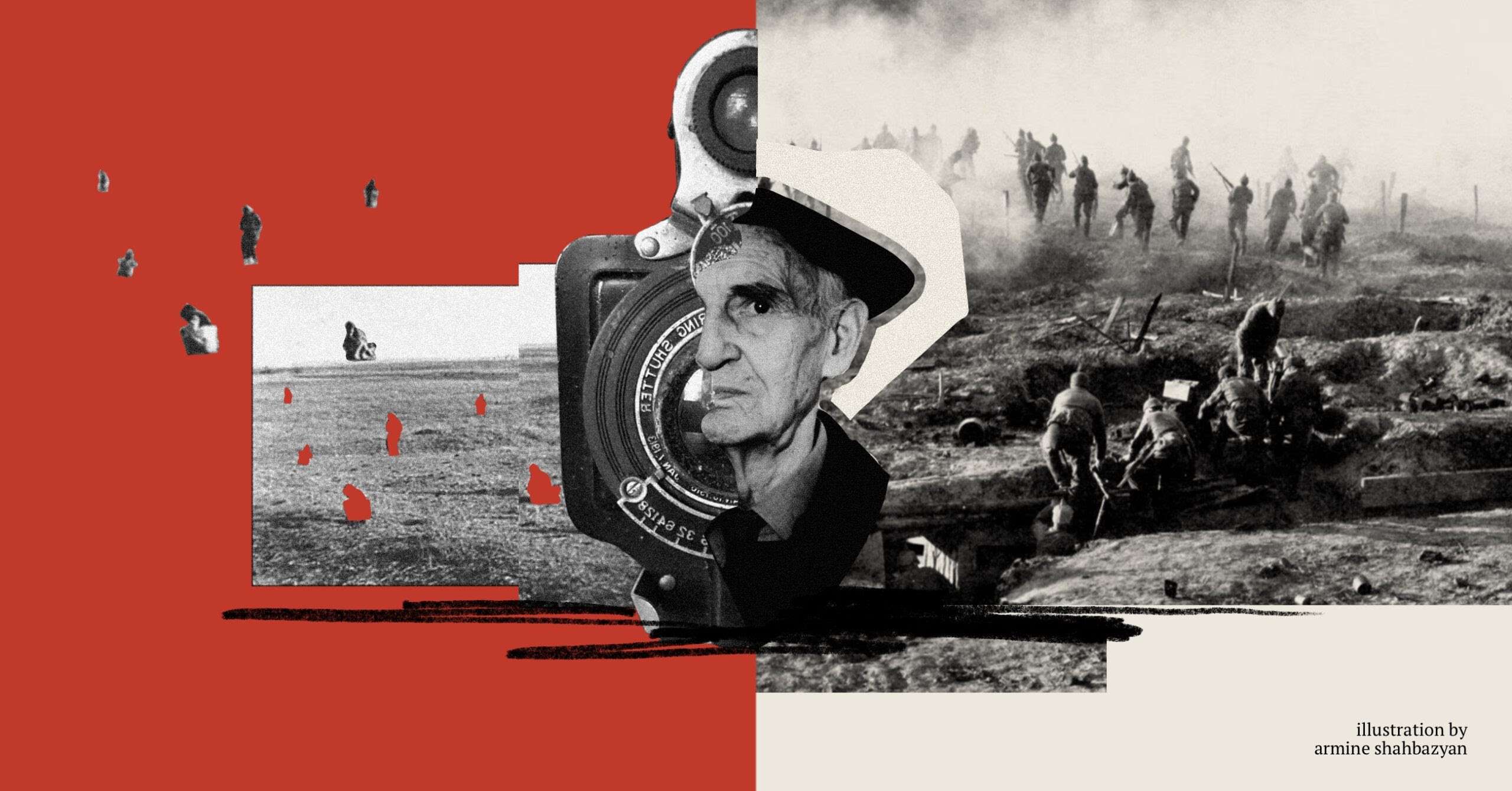
Michele Wegner, who prefers to go by Mischa, is the son of Armin Wegner, a German soldier, medic and writer, and one of the key eyewitnesses of the Armenian Genocide. Through his photographs, Armin Wegner documented the atrocities unfolding in the Ottoman Empire, leaving behind a rare and enduring visual record of immense historical significance. He is remembered as a Righteous Among the Nations, not only for Armenians, but also for Jews.
In a conversation with Mischa Wegner, I sought to uncover lesser-known dimensions of his father’s life and legacy, to whom the Armenians remain deeply indebted for his courage, moral clarity and interest he took in the fate of the nation.
Q: What brought your father to the Ottoman Empire during the Armenian Genocide?
MW: We are talking about the years of World War I. Before being transferred to the Ottoman Empire, my father had already fought in the war at the German-Russian front in Poland in the German military health service, where he was awarded a medal for saving lives. At some point he wanted to serve elsewhere; he was a poet and writer and was strongly drawn to Asia. Thanks to his mother, who had connections among German generals, he was sent to Constantinople where he joined the German troops. The troops were attached to the Ottoman Army.
Following the movement of the troops along the way from Constantinople to Aleppo, my father witnessed the death marches of the Armenians in every detail. He was struck by what he saw. He took notes about the atrocities, took photographs, and wrote letters to his mother, with whom he had a strong bond, describing what he witnessed.
The German authorities controlled the mail and found out about those letters. As a result, my father was sent back to Germany. Actually, before he went back, they thought he had died in a hospital in Constantinople along with the general of his detachment. But my father survived and returned to Germany, where he started to raise awareness about the Armenian Genocide.
Q: Why did a soldier have a camera during World War I? And how did your father make sure the photographs were transported from Ottoman Turkey safely?
MW: My father was a writer. Before World War I, he was already known as a writer and poet and was in contact with important literary figures in Germany. He lived in the vibrant, creative Berlin of those years. He was also an avid traveler. For instance, he journeyed from Germany all the way to Messina, Sicily, to witness the aftermath of the catastrophic 1908 earthquake. After 1922, he traveled to North Africa, the Red Sea, Persia, and beyond, always carrying a camera to capture moments. So the fact that he had a camera with him was not unusual, even though cameras at the time were bulky and difficult to carry—nothing like what we have today.
He managed to take those photographs and later bring them safely to Germany, hiding them on his person. Otherwise, they would not have survived. The Turks never came into possession of them.
But more important than that is the question: why did my father take those photographs? Why did he begin writing? In a book about photographs documenting genocides, the author says that the only images that truly speak are those taken by Armin. I agree, the photographs are powerful, they are real. His was the eye of a writer, of a poet, not of a photographer.
At the end of the day, what my father did could have been done by anyone. Why were such people so few?
There were those who saved lives, and that is one thing, because they usually did not endanger their own lives. But there were others—those who documented what was happening, leaving testimony for humanity. That is different. I try to explain it like this: you know there is a room, but you don’t know what’s inside. You meet someone who has been there and ask, “What’s in that room?”
“The room? Yes, I opened the door and looked inside.”
You don’t say, “I opened the door and saw inside.” To see is simply to see; to look is to participate.
There were hundreds of thousands of German soldiers along the route from Constantinople to Aleppo who did nothing and saw nothing. Which means they saw, but they did not look. My father looked. And by looking, he gave humanity the memory of something very important.
He confronted the German authorities over the atrocities. He also wrote a letter to U.S. President Woodrow Wilson, urging him to designate a territory for the Armenians. Later, in Berlin, my father testified at the trial of Soghomon Tehlirian, the man who assassinated Talaat Pasha, providing a detailed account of what he had witnessed in the Ottoman Empire. I believe his testimony was crucial, as Tehlirian was ultimately acquitted.
Half a century later, my father began receiving letters asking him to tell the story of this crime for the 50th anniversary of the Genocide. He took the initiative, but unfortunately no media outlets were interested—it was not widely known at the time. The only publication that printed his letter on the Armenian Genocide was the Swiss newspaper Die Weltwoche.
Q: In 1933, Armin Wegner wrote a letter to Adolf Hitler denouncing the persecution of Jews in Germany, as a result of which he was arrested by the Gestapo and imprisoned. Why do you think he wrote that letter?
MW: Those were the early days of the Nazi boycott of Jewish businesses, around Easter 1933. My father’s first wife was of Jewish origin, so their daughter, my half-sister, was partly Jewish.
Up until then, Jews in Germany were simply considered Germans. During World War I, many German Jews fought as Germans. There was no distinction.
Then one day, my half-sister came home from school and told her parents that she had been bullied. Her classmates told her, “You are a Jewish child.” My father was furious. I believe the letter he later wrote was an expression of his indignation at everything that was unfolding at the time, and at Hitler’s insane doctrine.
Note: The price Armin Wegner paid for writing that letter was imprisonment, torture, and exile. He managed to flee to England and later to Italy, where he lived until his death in 1978.
Q: Armin Wegner visited the Soviet Union, including Soviet Armenia. Did he ever talk to you about the journey or what he witnessed during the Genocide?
MW: My father never spoke to me about any of these things. The greatest gift he gave me was a carefree childhood. There was no sense of oppression or control as I was growing up. He lived his life, immersed in his work and writing; I lived mine.
At home, we spoke very little—he never learned Italian well, and I didn’t speak German. But he did speak to me once, on his deathbed. He was bedridden, asleep most of the time. When I visited him, he said, “Listen, afterwards, will you take care of my work?” I said yes, though deep down I felt a sense of guilt—how can you make such a big promise? But in the end, that promise turned out to be true.
Q: For decades, you have been tirelessly raising awareness about the Armenian Genocide and disseminating the crucial testimony of your father. How did you get involved in this work?
MW: It all started in 1995, when I met Pietro Kuciukian at the exhibition Precarious Refuge in Milan. The exhibition was dedicated to the Germans who fled Nazi Germany and settled in Italy. He saw me and asked whether I was Armin Wegner’s son. I replied affirmatively. He asked about my father’s photos. Sometime later he inaugurated a major exhibition in Milan dedicated to the Armenian Genocide – more than 4 million Italians visited it – and I was invited to speak at the opening. I headed to the opening quite carefree, only to find out while speaking that I somehow was too emotional and on the verge of bursting into tears. Speaking at that exhibition, I realized I had a lot to say. Invitations to conferences and exhibitions started pouring in, I participated in countless events. The most important one took place in Padua in 2000 and was organized by Gabriele Nissim of Gariwo.
Note: In April 1996, Mischa Wegner, together with Pietro Kiciukian, brought the ashes of his father Armin Wegner to Tsitsernakaberd, Yerevan.
For several years after the first exhibition, I constantly faced the problem of being suffocated by emotion when speaking about the Armenian Genocide. I think I finally realized what it is that made me cry back then. I have a problem: I do not have roots – and the Armenians also have this problem. You are born in a place, you have a family, relatives, your unique experiences. The life you lived there includes an environment, a landscape, traditions, and that’s where you belong. You can go anywhere in the world but you have that, you belong somewhere.
I do not have that sense of belonging, having grown up with a German father and a Russian-Polish mother in Positano, where I spoke the Neapolitan dialect and absorbed Neapolitan wisdom. Up until today, I still don’t truly know the landscape and places where my family history is rooted. I haven’t gotten to know the customs, the many relatives scattered all around Europe. So, think of a person who is up in the air and can’t touch the ground. This is what makes me a relative of the Armenian people.
Q: In 2023, more than 100 years after 1915, Armenians were yet again uprooted and had to flee their homes, this time in Nagorno-Karabakh. How do you feel about these events taking into account the experience and testimony of your father?
MW: It is a tragedy. It is one of the many terrible things that took and are taking place. The world is in flames.
Wherever you look, there is someone who is destroying the other, thinking that he is better and has more rights. There are people who are being annihilated because someone thinks that they should be annihilated.
What is Netanyahu doing with Gaza? What’s happening in Iran, Lebanon, and a lot of other places in the world – it is incredible how they keep killing, killing and killing, as if it was nothing. The problem is that I do not see any clear way out of this cycle of violence. Many people unconditionally believe what they see in their phones. They don’t know how to tell a lie from the truth and believe the most incredible things. I think we should switch off those phones more often rather than handing them to little children.
Coming back to the Armenians, the extraordinary thing about Armenia is that it is an ancient people with a 2,000-year-old culture, one language, one religion. And this helped the Armenians survive. But how many other ethnic groups and peoples will manage to survive, if they don’t have such a strong tradition? This is something we must acknowledge.
Editor’s Note: This interview was conducted in Italian and translated into English by the author.