Artsakh Center Stage at International Religious Freedom Summit
— Religious Freedom Advocates Spotlight Artsakh’s Right of Return, Armenia’s Security, and the Release of Armenian Hostages ahead of VP Vance’s Visit to the South Caucasus
WASHINGTON, DC – The Armenian National Committee of America (ANCA) welcomed the powerful global spotlight on Artsakh (Nagorno Karabakh) at this week’s International Religious Freedom Summit – the world’s premier global gathering of faith leaders – echoing calls by a broad array of stakeholders to hold Azerbaijan accountable, protect Christian holy sites, return Armenian refugees to Artsakh, free Armenian hostages held in Baku, and release Armenian Apostolic bishops and lay leaders unjustly jailed in Yerevan.
Held days before Vice President JD Vance’s planned February 9th visit to Armenia and Azerbaijan, the summit featured a panel co-sponsored by the Armenian Bar Association and the Diocese of the Armenian Apostolic Church Eastern U.S. titled “The Law of Conscience – Ensuring Safe Return and Property Restoration for Religious Communities.”
Forcibly Displaced Armenian Delivers Powerful Testimony on Right of Return
Nina Shaverdyan, a 25-year-old displaced Armenian from Artsakh, currently studying at Columbia University, delivered powerful testimony about growing up through repeated wars. “When I was 16, I went to school on a beautiful spring day, and then went home crying because a war started in Nagorno-Karabakh,” she told the summit.
“When I was 20, another war started. That time, my classmates, the guys from our street with whom we used to play as kids, my friends, parts of my family, 5,000 Armenian soldiers and civilians were killed,” she recounted.
She described Azerbaijan’s September 2023 genocidal assault. “When I was 23, Azerbaijan attacked my country. Imagine a 10 million country attacking us, 100,000 people, in a small territory, who have been deprived of food and everything else for 10 months, and they won the war.”
The ethnic cleansing resulted in total loss. “We lost every single thing that we owned, our houses, our churches, our cultural monuments, our religious heritage, everything around which our identity and lives were built around,” she said.
Shaverdyan spoke about explaining this loss to future generations. “I want to have children, and instead of thinking about nice things, I always think, how am I going to explain to them what happened to their mother’s homeland? They will ask me, mom, what did you do to make this not happen? And I don’t really have answers for them yet.”
Despite the trauma, she emphasized her generation’s unwavering commitment to return. “There has never been a day where we didn’t want to go back home. There has never been a day where the home hasn’t left us,” she stated. “Now, when it’s all fresh, just two years has passed from the ethnic cleansing of my people in Nagorno-Karabakh, we have time, we have the opportunity to work and work hard to execute the right to return our people to our homeland. I think the next step after recognizing the reality and naming everything by their right names is to finally start working on the legal level to ensure our right to return with guarantees for security.”
Moderator Tamar Purut of the Diocese of the Armenian Apostolic Church of America Eastern U.S. opened the panel by emphasizing that sacred spaces anchor entire communities. “When religious persecution occurs, it does not only harm individuals — it disrupts the spiritual and communal foundations of entire peoples,” she stated.
She stressed the need to move beyond punishment toward restoration. “Systemic religious persecution creates harm that is communal and enduring. Responding to that harm requires approaches rooted not only in law, but in conscience — approaches that honor truth, dignity, and the possibility of restoration.”
Purut noted the personal nature of the panel’s themes. “As an Armenian myself, with familial roots that remain in Turkey, the themes of this panel are not abstract to me. More than anything, it reminds me of the importance of listening: listening with care, with conscience, and with respect for lived experiences that so often carry truths law and policy alone cannot fully capture.”
Experts Urge Accountability and Documentation
The panel also featured Dr. Tugba Erdemir, coordinator of the Anti-Defamation League’s Task Force on Middle East Minorities, and Knox Thames, former Special Advisor for Religious Minorities at the U.S. State Department and currently at Pepperdine University.
Dr. Erdemir offered a message of hope. “I see hope in restoration. And we see a lot of destruction, it’s true. But as an archaeologist, I can tell that nothing is truly destroyed and erased. There are remnants of it that we can always identify,” she stated.
Thames warned that allowing violence without consequences sends a dangerous message. “Accountability is a powerful teaching tool. When, be it a government, or be it non-state actors in a community, if they can get away with violence without any consequence, that teaches them we can do more of it,” he told the summit. “At the same time, when people are held accountable for the violence they conduct against people or places, or when a government faces some type of consequence, that also teaches.”
He called on the United States to use its considerable leverage with Azerbaijan. “If we don’t want to see future instances of this – there need to be consequences. This gets back to this community urging the United States and other governments to be very clear with Baku about what’s right and what’s wrong, and if they decide to continue their ways to think about, well, this relationship needs to change, and what are the levers of influence that we have at our disposal, which are considerable.”
Thames also stressed documenting destruction before it becomes irreversible. “Gathering the pictures, the videos, so that you see the before and after. How can the community start documenting the sacred places, the sacred items, as well as the intangible heritage? What were the traditions, the songs, the memories, writing them down? So it’s not just completely lost.”
“For the 5th year, the Armenian Bar Association was honored to co-sponsor with the Diocese of the Armenian Apostolic Church Eastern US as supporting partners at the IRF Summit 2026,” stated Claire Kedeshian of the Armenian Bar Association. “This year, we were thrilled to have Nina Shaverdyan, a forcibly displaced refugee from Artsakh, speak with firsthand passion about her traumatic experiences and hopes for her, her family, her friends, and the Artsakh community’s future.”
Attorney Highlights Armenia’s Christian Heritage Under Threat
Armenian attorney Aram Vardevanyan, who represents persecuted clergy and advocates in the MerDzevov movement, emphasized Armenia’s foundational Christian identity. “I have to mention that in the year 301, Armenia adopted Christianity as its state religion, thus making us the first Christian nation. The Armenian Apostolic Holy Church has safeguarded our religious, cultural, national identity throughout centuries,” he stated.
He detailed the recent devastation. “We have witnessed difficulties these last few years. The 44 days of war in Artsakh, also known as Nagorno Karabakh. Also, later on, the forced displacement of 120,000 Armenians from their ancestral homes.”
Vardevanyan described ongoing destruction and detentions. “As of now, as we speak, centuries-old churches and monasteries have been vandalized, denying Christian Armenians the chance to visit places of worship, places which housed sainted relics. As we speak, we have 19 Christian Armenians as political prisoners, as captives in Azerbaijan.”
He also condemned the Armenian government’s persecution of church leaders. Four bishops remain detained while six others have been indicted and banned from travel. Vardevanyan noted that the Armenian Apostolic Church’s most prominent benefactor, Samvel Karapetyan, was jailed for defending the church. “These examples show that the Armenian government weaponized its power against our Holy Church,” stated Vardevanyan.
Imprisoned Archbishop Appeals to Summit, Vice President Vance
The summit coincided with a Christian Solidarity International (CSI) visit to Armenia, where the organization met with His Holiness Karekin II, Catholicos of All Armenians, and visited Archbishop Bagrat Galstanyan, imprisoned since June following the Armenian government’s crackdown on the Armenian Church and opposition activists.
Archbishop Galstanyan sent letters from Yerevan Kentron Prison to both the IRF Summit and Vice President Vance. He explained Armenia’s historical vulnerability: “The Republic of Armenia was created as a secure homeland for the victims of the Armenian Genocide and their descendants. But the dictator of Azerbaijan – who calls Armenia ‘Western Azerbaijan’ – seeks to turn Armenia into a vassal state, unable to protect the Armenian nation and its interests.”
He outlined the regional dynamics. “Azerbaijan is supported in this effort by Turkey, which is building a zone of influence stretching from the borders of Israel to the Caspian Sea. A crucial part of this project is to rob the Armenian Apostolic Church of its ability to speak with an independent voice in society.”
The Archbishop demanded concrete action. “I urge the Summit to put three requests to Vice President Vance, as he prepares to visit Armenia and Azerbaijan: To make it clear to the president of Azerbaijan and the prime minister of Armenia that the United States will not accept the continued persecution of the Armenian Apostolic Church; to tell both leaders to release their political prisoners – especially the 20 Armenians held hostage in Baku, and the four clergymen and supporters of the church imprisoned in Armenia; and to include the Mother See of Holy Etchmiadzin as a dialogue partner in the Armenia-Azerbaijan peace process.”
In his letter to Vice President Vance, Archbishop Galstanyan warned: “There can be no peace between Armenia and Azerbaijan if the Armenian nation ceases to exist. If the Armenian church is successfully neutralized, nothing less than that will be at stake.”
Christian Solidarity International President John Eibner, who led the delegation along with Swiss parliamentarian Erich Vontobel, stated at a press conference in Yerevan that “the Armenian Apostolic Church has been steadfast in defending the rights of the 150,000 Armenian Christians ethnically cleansed from their homeland in Nagorno Karabakh/Artsakh. As a result, the Church is now under attack by Turkey, Azerbaijan, and the Armenian government itself.”
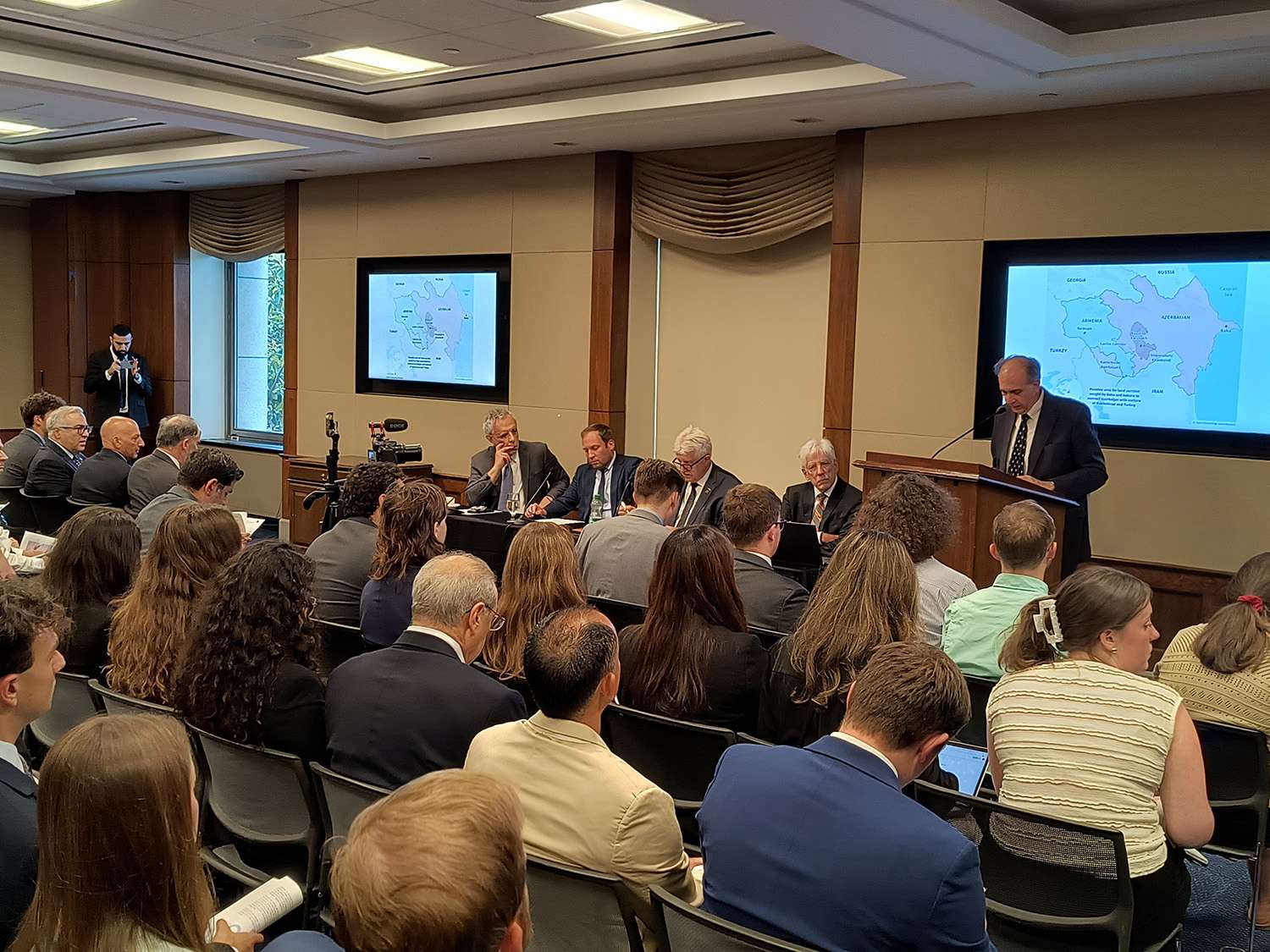
Both Eibner and Vontobel participated in a standing-room-only Capitol Hill briefing on the Artsakh right of return last June, moderated by ANCA Policy Director Alex Galitsky, drawing over 200 Congressional staffers, human rights advocates, and policy professionals.
Vontobel, whose motion mandating the Swiss government to hold a peace forum between Azerbaijan and representatives of displaced Artsakh Armenians was approved by Switzerland’s parliament in March 2025, declared: “In Armenia, one hears at the highest level, that the case of Nagorno Karabakh is closed. We see it differently. The case of Nagorno Karabakh is not closed yet. As long as the displaced people have not returned to their homes, the case cannot and must not be closed.”
ANCA Urges Continued Focus on Artsakh Ahead of VP Vance Visit
“The International Religious Freedom Summit provided a critical platform to keep Artsakh front and center in the days before Vice President Vance’s visit to the region,” stated ANCA Executive Director Aram Hamparian. “The displaced Armenian Christians of Artsakh have every right to return safely to their ancestral homeland. The 20 Armenian hostages held by Azerbaijan must be freed immediately. And the Armenian Apostolic Church, which has safeguarded the Armenian nation for 1,700 years, must be protected from persecution both from Baku and from Yerevan. These are not just religious freedom issues – they are matters of survival for the world’s first Christian nation.”
Summit Continues with Capitol Hill Advocacy Day
The summit continues on February 4th with Capitol Hill Advocacy Day, featuring a House Foreign Affairs Committee hearing on “Defending Religious Freedom Around the World.” The hearing will be led by the Subcommittee on Africa, chaired by Rep. Chris Smith (R-NJ), and the Subcommittee on the Western Hemisphere, chaired by Rep. Maria Salazar (R-FL).
The International Religious Freedom Summit brings together a coalition of over 90 organizations representing more than 30 faith traditions for an annual two-day event in Washington, D.C. The summit is co-chaired by Ambassador Sam Brownback, who served as Ambassador at Large for International Religious Freedom from 2018-2021, and Dr. Katrina Lantos Swett, President of the Lantos Foundation for Human Rights and former Chair of the United States Commission on International Religious Freedom (USCIRF).
The Armenian advocacy presence included the Armenian Bar Association’s Task Force and volunteers from universities, coordinated by Diocese of the Armenian Church of America Eastern U.S. volunteer delegate Tamar Purut and His Eminence Archbishop Dr. Vicken Aykazian, Ecumenical Director and Diocesan Legate of the Diocese of the Armenian Church of America Eastern U.S. Advocates distributed “aghi bilt” cookie molds made in Armenia, honor St. Sarkis Day, celebrated on January 31st.