Attorney Files Complaint at European Court for Artsakh Captives Rights Protection
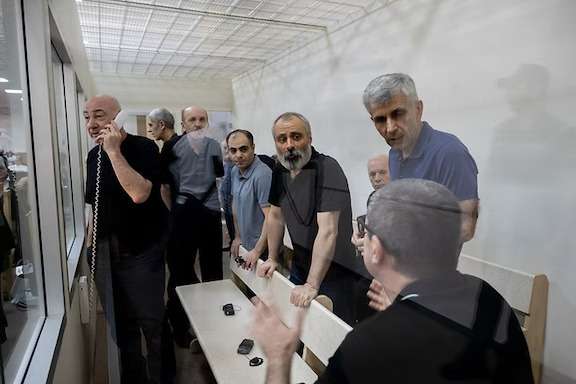
Artsakh leaders in a Baku court during their sham trial
A complaint has been filed at the European Court of Human Rights by attorney Siranush Sahakyan concerning the violations of the rights of 15 Artsakh Armenians currently being held captive in Baku.
Sahakyan, who is the attorney representing the rights of Artsakh Armenians at ECHR and is also a member of the International and Comparative Law Center, filed the complaint on August 21.
The center reported that the complaint filed concerned former Artsakh presidents Bako Sahakyan, Arkadi Ghukasyan, and Arayik Harutyunyan; former Artsakh Parliament Speaker Davit Ishkhanyan; former Artsakh foregn minister Davit Babayan; Major General and former senior military commander Davit Manukyan; Lieutenant General; and former Artsakh defense minister Levon Mnatsakanyan. The complaint also concerns Madat Babayan, Garik Martirosyan, Levon Balayan, Davit Allahverdyan, Vasili Beglaryan, Erik Ghazaryan, Gurgen Stepanyan, and Melikset Pashayan.
All the men were put on a sham trial in Baku and were sentenced to lengthy prison sentences ranging from 20 years to life imprisonment.
The complaint raises the issue of the incompatibility of the “trials” conducted by Azerbaijan against the 15 Armenians with the right to a fair trial guaranteed by Article 6 of the Convention.
“The ‘trials’ conducted before the Baku Military Court were fictitious and predetermined in nature, lacking the fundamental guarantee of an independent and impartial examination. At the same time, the Military Court did not have the requisite jurisdiction to hear cases concerning civilians and render judicial acts,” said the International and Comparative Law Center.
The complaint further raises concerns over the presumption of innocence, noting that senior Azerbaijani officials, including President Ilham Aliyev, publicly labeled the defendants “terrorists,” “war criminals” and “separatists” before verdicts were issued.
The application also documents serious restrictions on the defendants’ ability to prepare their defense. Much of the 422-volume, approximately 105,000-page case file, was reportedly unavailable in adequate translation, while requests for sufficient time, access to documents and effective communication between defendants and lawyers were denied or delayed.
According to the complaint, the prisoners and their lawyers were also denied full certified copies of the verdicts, further restricting their ability to appeal effectively. Azerbaijan’s Court of Appeal nevertheless upheld the sentences on August 6.
The filing also invokes Article 7 of the Convention, maintaining that participation in military operations or carrying weapons cannot in itself be treated as terrorism or other criminal conduct without proof of specific individual offences and personal responsibility.
The organizations involved say a future ECHR ruling could call into question the legality of the Baku proceedings and establish at the international judicial level that the prosecutions failed to meet fundamental human rights standards.
A possible judgment of the ECHR may have both legal and political consequences. At the international judicial level, it will call into question the legality and legal value of the trial conducted and the “judgment” rendered as a result thereof, giving rise to an immediate obligation to eliminate the consequences of the violations of law.
The international judicial recognition of politically motivated persecutions substantially neutralizes Azerbaijan’s attempt to confer legal credibility to its own official narrative concerning the conflict through sham domestic judicial proceedings. In that case, the “judgment” will lose its significance as a document reflecting Azerbaijan’s unilateral historical and political interpretation of the conflict, limiting the use of that “judgment” on international political and diplomatic platforms.
The complaint was filed within the framework of public activities, in cooperation with the International and Comparative Law Center, and the Armenian Legal Center for Justice and Human Rights.