Avetik Isahakyan and China: When the Poetry of the Armenian Poet and Chinese Culture Met, Becoming a Bridge Between Two Civilizations
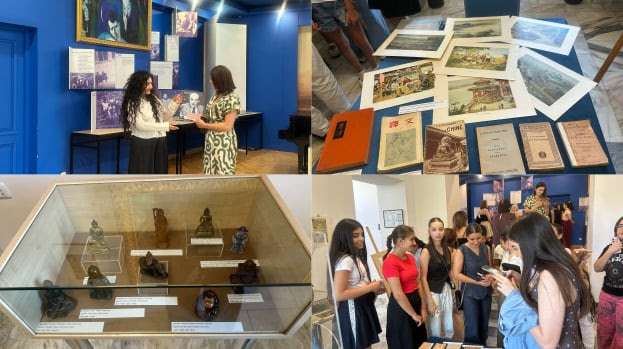
The exhibition “Avetik Isahakyan and China: The Meeting of Civilizations through Works of Art” opened at the Avetik Isahakyan House-Museum in Yerevan presents this topic in its entirety for the first time. Chinese figurines, books, maps, letters and other archival materials belonging to the poet are exhibited here, which allow us to talk about Isahakyan’s interests, as well as the cultural dialog between Armenia and China, from a new perspective.
“I pointed out those figurines and told the museum staff that they were extremely important specimens. Then they told me that the director of the museum, Armenuhi Avetisyan, wanted to see me,” Ani Margaryan tells NEWS.am STYLE.
After that meeting, a small but very interesting research journey began. Ani was also directed to the house-museums of Yeghishe Charents, Martiros Saryan, and Hovhannes Tumanyan. New materials were appearing one after another.
“Little by little, materials were being collected, and I realized that this was indeed the topic of the article.”
Later, participating online from China at a conference dedicated to Isahakyan’s 150th anniversary, Margaryan presented her study. The idea also interested Armenuhi Avetisyan, the director of the Isahakyan House-Museum, and the research gradually turned into a lecture and exhibition.
“Armenuhi Avetisyan and the museum staff brought this important exhibition to life with the greatest dedication and effort, and I am extremely happy and proud of this cooperation,” says Ani.
Isahakyan’s Chinese world in figurines
One of the most interesting parts of the exhibition is the collection of small-scale Chinese sculptures belonging to Isahakyan. The images of the Taoist god of longevity, the Buddha of abundance and prosperity, and the Bodhisattva Manjushri are made of soapstone, terracotta, and gilded bronze.
However, the value of these objects is not only artistic or collectible. They tell the story of Isahakyan’s interest in the philosophical and spiritual world of the East.
“These figurines were an inspiration for Isahakyan, an embodiment of philosophy, an idea, and he immediately understood that we should communicate directly with China,” says Ani Margaryan.
This observation is one of the key ideas of the exhibition. Isahakyan was not simply an interested observer of Chinese culture. His interest, and that of other Armenian intellectuals, formed a cultural bridge, on the other side of which was China.
Charents’ gift: about the common spiritual search of two great writers
The soapstone statuette of Laozi has a special story among the exhibits. The Taoist sage is depicted sitting on an ox with a scroll in his hand. The image is connected with the well-known legend about Laozi, according to which, having left worldly life, he moves to the West and leaves his descendants the “Daodetzi”.
In the summer of 1937, Yeghishe Charents, who was deeply interested in the philosophical thought of the East, presented this statuette from his collection to Isahakyan. On the pedestal, he left his handwritten dedication: “To Dear Avetik, from Charents. 24/VI 1937”.
Here, Chinese culture becomes not only the subject of interest for Isahakyan and Charents, but also a part of their intellectual dialog.
In recent years, Charents’ interest in the East has been particularly deepening. He spoke of his desire to study “Nirvana” and kept various objects of Eastern origin in his office. In this context, the Laozi statuette can be perceived as a material symbol of the common spiritual quest of the two great Armenian writers.
When Interest Turns into Cultural Diplomacy
Isahakyan’s connection with China, however, is not limited to Chinese art objects.
In the 1950s, this connection already takes on a more systematic nature, being included in a wider framework of Armenian-Chinese cultural exchanges. The Soviet-Chinese Friendship Society also played an important role in those years.
In August 1955, Isahakyan received a letter from the famous Chinese translator and cultural delegate Ge Baoquan. He addressed the Armenian poet with the title of “Master”, told about the process of translating Isahakyan’s works into Chinese and proposes to publish a complete collection in China.
In the same year, the journal “World Literature” publishes several of Isahakyan’s poems in Chinese.
These facts are especially important for one reason: they show that the connection between Isahakyan and China was two-way. If Chinese figurines came to Isahakyan’s world, then his poetry made its way to the Chinese reader.
Thus, cultural exchange took place not only at the state or official level, but also through literature, art, translation, and personal interest.