Azerbaijan accuses Turkey of “plotting a coup” “The hijab” ignites resentment
Tensions are escalating between Turkey and Azerbaijan over the headscarf ban in schools, amid mutual criticism and accusations of interference in internal affairs, while Erdogan’s absence from a summit in Baku raises questions about the future of relations between the two allied countries.
Al-akhbar.com
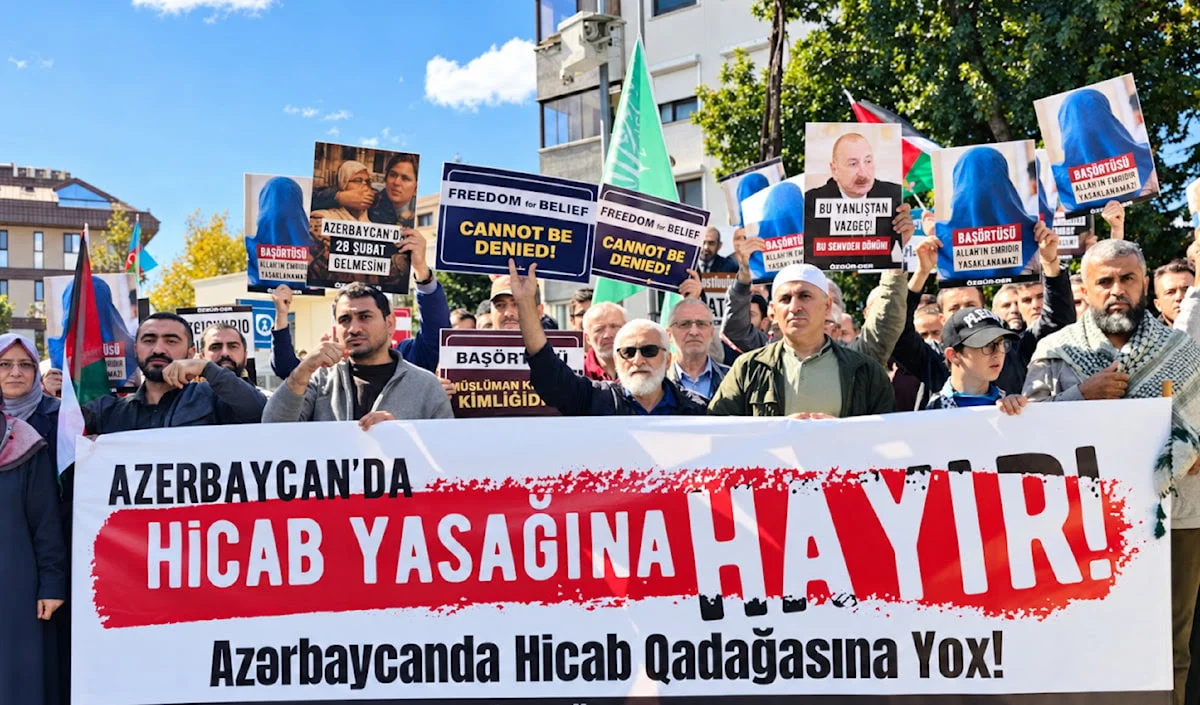
A march in Istanbul to protest restrictions on wearing headscarves in Azerbaijani schools (from the web)
The repercussions of the headscarf ban crisis in Azerbaijan continue to unfold both domestically and internationally, particularly along the Turkey-Azerbaijan axis, where the issue has transcended the religious and social spheres and now threatens political relations between the two allied nations. On September 21, Baku announced the implementation of a headscarf ban in public schools, citing the principle of secular education. However, this measure was met with widespread reactions in Turkey, especially within the ruling Justice and Development Party (AKP), whose senior officials issued statements criticizing the ban and demanding that the Azerbaijani government rescind the decision. In response, and in what appeared to be a direct message to Turkish President Recep Tayyip Erdoğan, Azerbaijani President Ilham Aliyev advised the AKP to refrain from interfering in his country’s internal affairs and to focus on Türkiye’s own.
Although Baku had objected two years ago to statements by Erdoğan in which he said he would enter Jerusalem, just as he had previously entered Nagorno-Karabakh and Libya, considering this a belittling of the Azerbaijani army’s role and denying any fundamental Turkish role in Baku’s victories over Yerevan in 2020 and 2023, this is the first time Erdoğan has been criticized in this manner over the headscarf issue. As a result of this criticism, the Turkish president refrained from traveling to Azerbaijan to attend the Conference on Interaction and Confidence-Building Measures in Asia (CICA) summit last Thursday, instead sending his Foreign Minister, Hakan Fidan.
However, the signs of tension did not stop there; last Saturday, the Azerbaijani website Kavkazinfo, which is close to the authorities, published a report accusing Fidan of holding a secret meeting with the Turkish Youth Aid Foundation (GYF), licensed by the Baku authorities, and issuing various directives to it. The report, titled “Behind the Scenes of Hakan Fidan’s Meeting with the Youth Aid Foundation,” stated that this organization is linked to Turkish intelligence and is used, along with other institutions such as the Turkish Cooperation and Coordination Agency (TİKA), the Humanitarian Relief Foundation (İHH), and the Mahmud Aziz Khodaei Foundation, to “interfere in Azerbaijan’s internal affairs, build a network of pro-Turkish elements, conduct intelligence operations, and incite unrest within the country.” It added that these meetings “plan coups and recruit agents.”
Azerbaijan accuses Türkiye of seeking to incite unrest within its borders and plotting a coup against Aliyev.
Following the publication of the report, Ankara, through its embassy in Baku, quickly issued a statement rejecting these “allegations” entirely, describing them as “baseless fabrications” and “an act of media disinformation aimed at harming Turkish-Azerbaijani relations.” The embassy clarified that Fidan had taken photos, as usual, with individuals, some of whom belonged to a legally recognized organization, but that he “did not hold secret meetings or issue directives.” It also denied the report’s claim that the ruling New Azerbaijan Party had sent a letter to the Turkish parliament criticizing Ankara’s interference in Azerbaijani affairs. For his part, Fidan acknowledged differences of opinion with Baku but stressed that “such issues should be addressed through dialogue between the two countries.” Meanwhile, a congratulatory message from Erdoğan to Aliyev on the occasion of Azerbaijan’s Independence Day—which fell on Sunday—was noted, in which he addressed Aliyev as “my friend and brother, Ilham Aliyev.” We are together in sorrow and in joy.
However, despite the Turkish embassy’s clarifications, Azerbaijani attacks on Turkey did not cease. The same website, Kavkaz Info, published an article by Aslan Valiyev, stating that “Turkey has transformed into a religious state and cannot lecture Azerbaijan.” The writer launched an attack on the Justice and Development Party’s rule, arguing that “in the last twenty-five years, Turkey has not only seen itself as the heir to the Ottoman Empire but also as the historical and spiritual guardian of the lands that once belonged to it.” The writer asserted that “those who hold power in Turkey today are religious currents with a sectarian mentality,” adding that “this mentality is hostile and works to distort the image of Atatürk within Turkey, the very man who revived Turkey and gave it its strength.” He continued, “Azerbaijan will not become like the model that some in Turkey want, those who seek to appoint themselves as our preachers on dress codes.”
In contrast, Turkish writer Murat Yetkin argued that the scenario presented by Kavkaz Info contradicted the natural course of events, recalling that his country was not pleased when the Azerbaijani representative did not leave the UN hall during Israeli Prime Minister Benjamin Netanyahu’s speech, but remained silent. He pointed out that “on the 30th of this month, a summit of leaders of Turkic-speaking countries will be held in Ankara. Given that it is unlikely Aliyev will not attend the summit, it will be an important opportunity for both presidents to try to overcome these tensions, from which Israel primarily benefits.”