Baccarat vs Blackjack for Readers Who Want the Rules to Make Sense
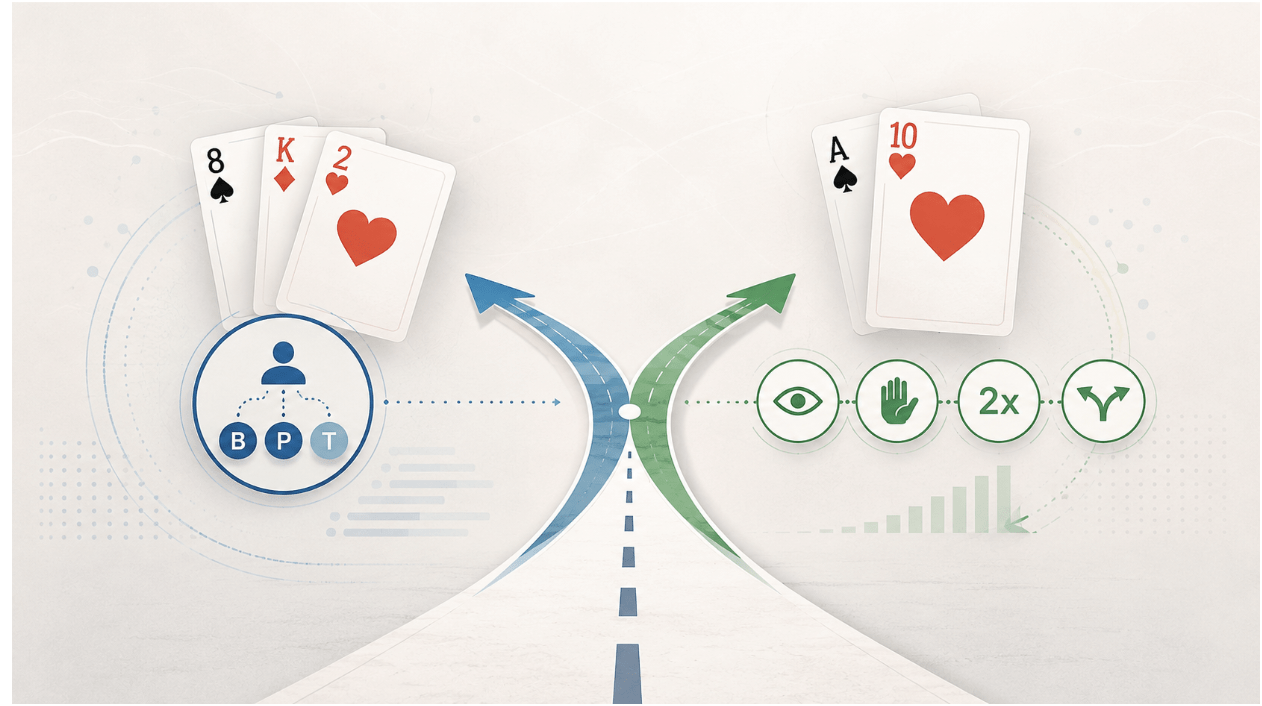
https://drive.google.com/file/d/1iC9r0yPCWXr-NrBNrfXeNzJWc2a0Or-Y/view?usp=sharing
Image source: Original article graphic created by the author
ALT text: Forked card game decision path
Baccarat and blackjack are often grouped together because both are compact card games with quick rounds and similar table energy. Look closer, though, and they ask for different kinds of attention. Baccarat gives the player one main choice before the hand resolves. Blackjack asks multiple questions during the round. That difference explains most surface-level comparisons.
A comparison starts with mental load, not preference. Fewer live choices make a round feel steadier. Branching choices mean each new card can change the right response. An open-access Frontiers review on information overload is a useful frame for reading card games without turning the topic into raw math.
The First Split Is Choice Volume

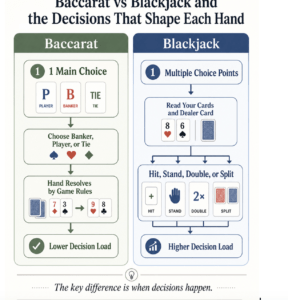
https://drive.google.com/file/d/1qZ_4cUezFk_DKJUzIxx-ocKlKPfpaOJa/view?usp=sharing
Image source: Bespoke visual created by the author for this article
ALT text: Baccarat blackjack decision flow infographic
Once the rules are clear, the next question is what the player actually controls. This table game guide on baccarat vs blackjack house edge helps make this clear. In baccarat, the standard round centers on choosing the banker, player, or tie, after which the dealing rules decide how the game proceeds. In blackjack, the player may hit, stand, double, or split, and may choose to hit multiple times, depending on what cards they receive.
It’s also worth noting that there is no fixed optimal value that the player should stop at in blackjack. The optimal stopping point depends on whether the dealer is showing a weak card or a strong card, and whether your cards form a soft or hard total. Baccarat is simpler and has a more compressed choice structure. Blackjack requires a lot more mental effort to play well.
A lot of table-game learning starts before anyone opens a full guide. It starts with a social post, a quick question in a chat, or someone asking why baccarat and blackjack are often compared. Cafe Casino’s Instagram post inviting players to its Discord reflects that casual entry point: a community space built around updates and live conversation.
**PLEASE EMBED THIS LINK**
https://www.instagram.com/p/DVyXfzWlLbw/
Why Baccarat Feels Easier to Read
Baccarat is often called simple because the player’s role is narrow. The goal is to be closest to 9, but the player is not steering the hand after the first selection. The dealing process follows set rules, at a table or online. That gives baccarat a smooth rhythm for players looking for something easy to understand and low pressure.
The banker and player choices are the main comparison points. In many standard explanations, banker carries the lowest house edge among the usual choices, with player close behind. Tie sits apart because its house edge is much higher. Knowing this helps, but that isn’t the main appeal of baccarat for most people. Its strong point is often considered to be its simplicity.
Baccarat rounds can feel easier to track because the player is not pausing to interpret every card. The interest comes from anticipation and pattern, not from solving a new decision after each deal. For someone comparing baccarat and blackjack, that is the cleanest starting point.
Why Blackjack Keeps Changing Shape
Blackjack looks simple at first: get closer to 21 than the dealer without going over. The difficulty is that the best response depends on context. A hard 16 does not feel like a soft 16. A dealer 6 does not require the same decisions as a dealer 10. A pair opens a different path from two unrelated cards with the same total.
Blackjack is more active. The hand is not only counted; it is interpreted. Each time a player hits, a new card is shown and they are faced with the opportunity to hit again or stand where they are. Small rule details can also matter. Deck count, whether the dealer hits or stands on soft 17, whether doubling after a split is allowed, and whether blackjack pays 3:2 or 6:5 can all change the discussion.
None of that means blackjack is better or baccarat is less interesting. Blackjack simply spreads the player’s attention across the hand. The round creates small turning points, and each one asks for a response. For decision-minded readers, that is the appeal.
The Cleaner Comparison
The least useful version of baccarat vs blackjack tries to crown a winner. The better version asks which play style better suits what someone is looking for. Baccarat is a compressed-choice game. Blackjack is a continuing-choice game. One puts the player’s role before the hand unfolds. The other keeps the player involved.
A reader does not need to memorize every percentage to understand the split. They only need to notice where the decisions happen. In baccarat, the decision arrives early. In blackjack, it keeps returning. That difference shapes pace, attention, and learning, and it also matches how people rely on mental shortcuts when complex choices need to be made, as described in PLOS One’s work on effort reduction in decision-making.