Balyan or Kadehciyan? A Debate on the Surp Asdvadzadzin Cathedral in Antep
As a result of my intensive two-year research, I wrote my master’s thesis on the Surp Asdvadzadzin Cathedral in Antep at the Berlin University of Technology. As part of this study, we also published an extensive interview in Agos on the story of the Surp Asdvadzadzin Cathedral, spanning from before its construction to the present day, under the title “Surp Asdvadzadzin in Antep: A cathedral, prison, and mosque” in December 2023.
The reason I bring this up is because, at the event held at Yesayan Salon in recent weeks, the Surp Asdvadzadzin Cathedral was presented as “a magnificent example of Balyan architecture in Anatolia.” Furthermore, I believe that the statement I read in “Anadolu Kültür”’s post-earthquake assessment report—that ‘’This building, […] designed by Sarkis Balyan on a much larger scale, includes an attempt to implement a three-level gallery.”’—needs to be re-examined. Indeed, when I read in Elmon Hançer’s latest interview with Agos that the building’s plan was enlarged by 1.5 times by Sarkis Balyan, I felt the need to open this issue up for discussion.

The gallery, photo by the author
1. To what extent was Sarkis Balyan involved in the design and construction of Surp Asdvadzadzin Cathedral?
The main source for the historical information about the church in the report is the Houshamadyan book “Badmutyun Antebi Hayots” ( History of the Armenians of Aintab), edited by Kevork A. Sarafian. The report states that a delegation from Antep went to Istanbul to obtain Sarkis Balyan’s approval to enlarge the church 1.5 times.However, the aforementioned source writes that the delegation went to Istanbul not only to get approval for enlarging the plan but also to inform that they no longer wished to bring in an architect from outside. Yet, it is not clear from this source whether this meeting actually took place or whether Balyan approved this enlargement. In this regard, it is important to look at the text written by Bishop Papken in the Gochnag journal in 1917:
«The plan of the famous architect, in accordance with Patriarch Nerses’s desire, would have given the people of Aintab a church at a relatively low cost. However, by enlarging it by one and a half times—and doing so without consulting Sarkis Bey again—both the concern and expense of the construction multiplied, and the built church lost its proportional resonance or acoustic quality. As a result, the sermon delivered in front of the church’s altar and chancel is not heard well from a distance.»
This information indicates that the plan was not enlarged by Sarkis Balyan and that his role in the final formation of the church was limited. Although the art historical evaluations in the report are valuable, from an architectural perspective, since we do not have Sarkis Balyan’s drawings, it is not possible for us to compare the differences between the original plan and the final structure either.
2. Was the three-story galleried church application tried for the first time in Anatolia by Sarkis Balyan?

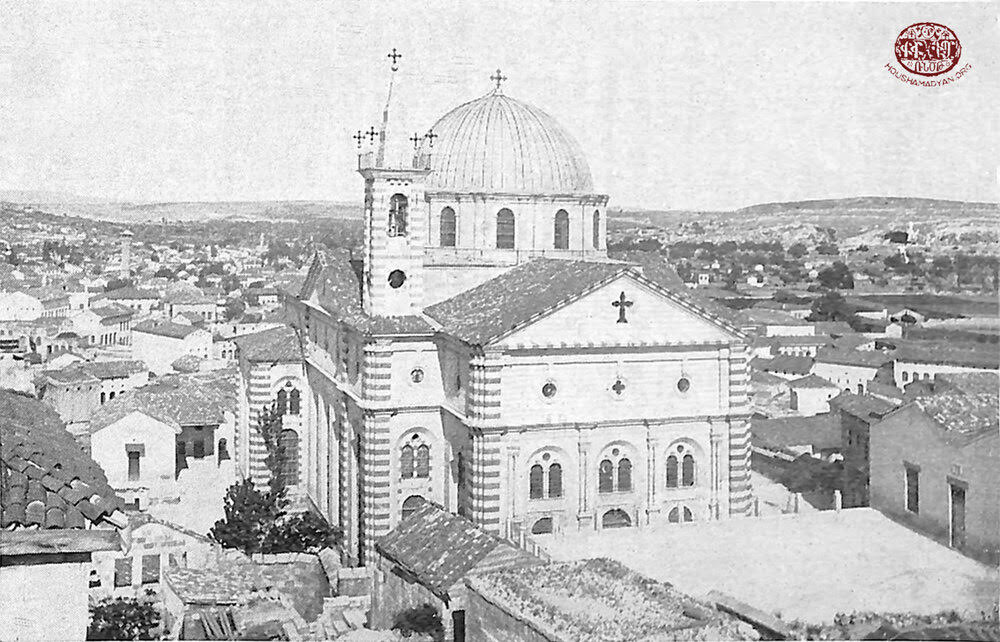
Detail from a panorama of Anteb, with construction of the Cathedral visible (source: Houshamadyan.org).
The report suggests that Sarkis Balyan attempted to design a church with a three-level gallery and that such a gallery was implemented for the first time. However, since the church’s plan is not available, it cannot be said that Balyan’s low-cost design actually included a three-level gallery. That said, considering that the plan is thought to have been enlarged by one and a half times by the Antep-based Sarkis Usta Kadehciyan and Nigohos Ağa Nazeretyan, it can be argued that this increase in height may have made a three-story gallery possible.
Moreover, the Surp Asdvadzadzin Church in Antep was not the first three-story galleried church in this region. During my thesis research, I encountered this claim in many places, and I even expressed that this was the case in an interview I gave to Agos. In my subsequent research, I saw that the Surp Hovhannes Church, built in Kilis before Antep and destroyed by bombing in the 1920s, was constructed with three galleries by Agop Kalfa from Istanbul. The people of Antep may have wanted a three-story gallery just like the one in Kilis and likely thought that working with an architect from Istanbul would be prestigious from the start.

Nigoghos Agha Nazaretian (source: Houshamadyan.org)
3. The Architect of the Surp Asdvadzadzin Cathedral in Antep
In the Houshamadyan book, there is a section dedicated to Sarkis Usta Kadehciyan under the heading ‘The Architect of the Armenian Church of Antep.’ This section states that he served as the ‘Chief Municipal Architect’ for many years, trained many masters, and that many buildings in Antep were his work. Among the buildings specified in the book are the Armenian Catholic Church in the Hayik neighborhood, the second Protestant church, and the Hotel Hacı Ömer Han. We need to better understand which roles Sarkis Usta held in the construction of these buildings.
He was illiterate. During that period, the Governor of Aleppo visited the construction of the Surp Asdvadzadzin Cathedral and wished to meet the master responsible for the church’s construction. He was surprised to learn that Sarkis Usta Kadehciyan had no formal education. This information shows us that Sarkis Usta Kadehciyan learned his profession through practical observation and application.

Mahdesi Sarkis Usda Kadehciyan (Source: Houshamadyan.org)
I believe that to understand the 19th-century *Kawar* (province) churches, we must examine not only Surp Asdvadzadzin but also other Tanzimat-era churches built in the same period, even those that were demolished or bombed. I would also like to announce here that, together with Parrhesia, we will soon be organizing a seminar where we will comparatively examine 19th-century Kawar churches through the lens of the Surp Asdvadzadzin Cathedral.