Bipartisan Congressional Gathering Demands Justice for Century of Genocide at Capitol Hill Commemoration
— Lawmakers Issue Unified Call for Release of Armenian Hostages, Artsakh Right of Return, and Sanctions Against Aliyev and Erdogan
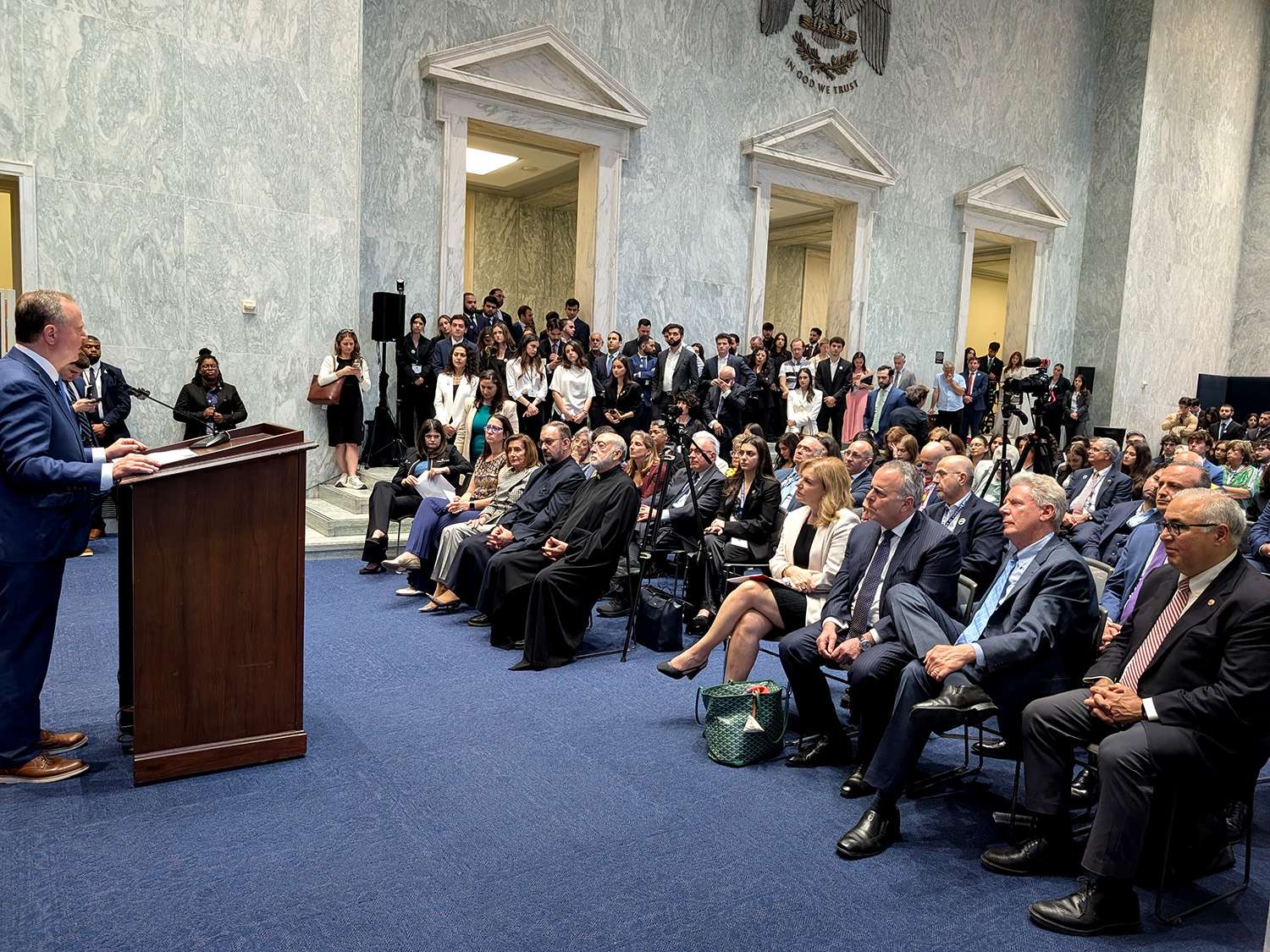
WASHINGTON, DC – A bipartisan gathering of Congressional leaders joined Armenian Americans and allies from across the country on April 15th for the annual Capitol Hill commemoration of the Armenian Genocide, issuing unified calls for the immediate release of Armenian hostages, the right of return for Artsakh Armenians, and sanctions against the Aliyev and Erdogan regimes for genocidal crimes spanning from 1915 to 2023, reported the Armenian National Committee of America (ANCA).
The solemn commemoration, co-hosted by the ANCA and the Armenian Assembly of America, in cooperation with the Congressional Armenian Caucus, is the latest in a decades-long tradition of annual Capitol Hill observances dating back to the first such gathering in 1965, which marked the 50th anniversary of the Genocide. This year’s program came as Turkey and Azerbaijan’s genocidal crimes against the Armenian nation — from 1915 to 2023 — remain unaddressed and ongoing. Armenian prisoners of war and civilian captives, including Artsakh leaders, continue to languish in Azerbaijani detention. More than 150,000 Artsakh Armenians remain forcibly displaced from their homes. And Azerbaijan continues to occupy sovereign Armenian territory while pressing demands designed to foreclose any prospect of justice, accountability, or return.
The ANCA live-streamed the event on its Facebook, Twitter, and YouTube channels.
“The Armenian Genocide – from 1915 until today – was, from the start – and remains still: A crime, not a conflict,” stated ANCA Executive Director Aram Hamparian. “Our current challenges: Existential (genocidal), not transactional. Our focus: Firmly on the threat horizon – fundamentally on our future, not our past.”
Hamparian rejected what he called the false peace now being imposed upon Armenia — one that “locks in the fruits of Azerbaijan’s genocidal gains, locks down Armenia’s losses – of soil, security, and sovereignty, and forever locks out Artsakh refugees from their homes – blocking their right to return to – and live freely upon – their indigenous homeland.”
“A false peace – absent accountability – that (in a word) normalizes Azerbaijan’s genocide of Artsakh,” Hamparian warned. “Worse still, that rewards this crime. That aids, abets, and emboldens its perpetrators. That punishes its victims. And sets the stage for future attacks — aggression aimed at finishing the genocidal work started more than a century ago by Abdul Hamid, Talaat Pasha, and Kemal Ataturk. This we cannot abide. This we will stand against with all our strength.”
Dr. Robert Krikorian, the evening’s emcee and a former senior U.S. Department of State official with more than two decades of firsthand Armenia policy experience, drew a direct line from Turkey’s unrepentant Genocide denial to Azerbaijan’s assault on Artsakh. “An unrepentant Turkey orchestrated and led the Azerbaijani assault on Artsakh in 2020,” Krikorian said. “And Azerbaijan has been faithful to this idea by committing genocide against the Armenian people of Artsakh in 2023 in full view of an indifferent world.” He closed on a note of determined resolve: “Yes, Armenia stands alone in the world… except for us, the descendants of survivors of the Armenian Genocide. We will continue to support Armenian statehood, to support the democratic aspirations of the people of Artsakh to live freely on their land, and to pursue the just cause of Armenian Genocide Recognition. We will not forget.”
Kerkonian: Perpetrators Must Be Confronted, Not Appeased
Keynote speaker Karnig Kerkonian, Esq. delivered a sweeping address anchoring the proceedings in the lived reality of genocide as a continuous and unfinished process. Beginning with the story of his 12-year-old grandfather sewing leather water pouches in Aintab as Armenian deportees streamed past in 1915 — “It never occurred to us that we would be next,” his grandfather would reflect a lifetime later — Kerkonian built to a prosecutorial indictment of the present moment, tracing a direct line from the Hamidian massacres of the 1880s through the Artsakh genocide in 2023.
“We are not here simply commemorating the past,” Kerkonian said. “We’re here commemorating 1915 as we’re standing inside the ongoing genocidal process against the Armenian people.”
Kerkonian warned specifically against the Trump Route for International Peace and Prosperity (TRIPP), arguing it functions not as an economic opportunity but as a mechanism to circumvent Armenian sovereignty — “the end run,” he called it, “the act of appeasement” that allows Azerbaijan to avoid acknowledging Armenia’s de facto statehood. He placed the right of return for Artsakh Armenians at the center of the strategic struggle: “Advocating for the right of return of the Artsakh Armenians is not merely a mechanism to secure a fundamental human right. It is an essential mechanism to obstruct the ongoing relentless march made possible by every previous act of appeasement.”
He closed with an unsparing call to historical responsibility: “Even if you do not see the return of the Artsakh Armenians in your lifetime, you are still responsible for it. Even if justice is deferred, you are not excused. Even if the world pretends not to see, you are still called to bear witness.”
Pelosi: Honor Their Memory Not Only by Remembrance, But Resolve
Speaker Emerita Nancy Pelosi (D-CA) reflected on decades of Armenian-American advocacy that made the passage of the historic 2019 Armenian Genocide Resolution possible, crediting the community’s outside mobilization as the decisive force behind its passage. Recalling her very first day in Congress — when Turkish government placed a thick volume on her desk about the history of the Ottoman Empire in an early attempt to advance their denial narrative — Pelosi described a community that has spent decades fighting back against that well-funded campaign, overcoming presidential phone calls to committee members urging a no vote and years of institutional resistance to bring the truth to the House floor. “There’s nothing more eloquent to a member of Congress than the voice of his or her constituent,” she said. “Your voices were heard by members of Congress, and that’s why we were able to pass the Armenian Genocide Resolution.” She closed with a charge to the room: “May we honor the memory of those victims, not only by remembrance, but resolve.”
Congressional Leaders Demand Action
Among the legislators offering remarks were Senator Adam Schiff (D-CA), Congressional Armenian Caucus Co-Chairs Rep. Frank Pallone (D-NJ), Gus Bilirakis (R-FL), and Rep. David Valadao (R-CA), Vice-Chair Brad Sherman (D-CA), and Representatives Gabe Amo (D-RI), Sanford Bishop (D-GA), Judy Chu (D-CA), Jim Costa (D-CA), Vince Fong (R-CA), Laura Friedman (D-CA), George Latimer (D-NY), Mike Lawler (R-NY), Mike Levin (D-CA), Seth Magaziner (D-RI), Jim McGovern (D-MA), Dave Min (D-CA), Delia Catalina Ramirez (D-IL), Luz Rivas (D-CA), Haley Stevens (D-MI), and Dina Titus (D-NV).
Hostage Release and Prisoner Accountability
The demand for Azerbaijan’s immediate release of Armenian hostages ran through the evening’s congressional remarks like a thread, with members from both parties making clear that no peace process can be considered credible while Armenian prisoners of war and civilian captives — including Artsakh’s elected leaders — remain in Azerbaijani detention.
Senator Adam Schiff (D-CA), who was among key leaders of the Armenian Genocide Resolution in the House to its historic 2019 passage, opened on a note of alarm, calling out the current administration’s retreat from that hard-won recognition and demanding accountability beyond the peace agreement signed at the White House last summer — an agreement, he noted, that “does not even mention the prisoners of war that Azerbaijan continues to hold.” With regard to the Armenian Genocide recognition, “Some in the current administration are sadly retreating from that important progress, and we must push back against that retreat,” Schiff said.
Where Schiff sounded the alarm on diplomatic backsliding, Rep. Mike Lawler (R-NY) drove home the moral stakes with blunt precision: “Peace without accountability is not peace. It is permission.” Lawler called for the immediate release of Armenian prisoners and full enforcement of Section 907, warning that failure to act risks “repeating the very failures that made past atrocities possible.”
Rep. Judy Chu (D-CA) brought firsthand witness to the chamber’s proceedings. Having visited Artsakh in person over direct Azerbaijani threats — and subsequently banned from entering Azerbaijan, a distinction she called “a badge of honor” — Chu was unequivocal: “I will never give up demanding that the political prisoners of Armenia be returned from Azerbaijan.”
Rep. Vince Fong (R-CA) grounded the hostage issue in its broader strategic context, calling the unlawful detention of Artsakh’s leaders not merely a human rights violation but “a barrier to lasting peace” — and reaffirming his co-sponsorship of the Armenia Security Partnership Act (H.R.6840) as the legislative vehicle for accountability.
Rep. Haley Stevens (D-MI), made the connection between prisoner release and U.S. military assistance explicit: “U.S. military assistance should not, cannot flow to Azerbaijan while they continue to hold Armenian prisoners, occupy Armenian territory, and deny the right of return.”
Artsakh Right of Return
If the hostage demand was the evening’s most urgent call, the right of return for Artsakh’s more than 150,000 displaced Armenians was its moral center — with members pressing for international guarantees that go beyond any peace agreement currently on the table.
Rep. Seth Magaziner (D-RI) set the frame, reaffirming his co-sponsorship of the Armenia Security Partnership Act (H.R.6840) and placing the right of return at the heart of the Caucus’s legislative agenda: “We have to continue to remain vigilant and do everything we can to ensure that Armenian sovereignty and freedom is respected.”
Rep. Gabe Amo (D-RI), matched words with action — reporting that on the very morning of the commemoration he had pressed the State Department in committee on the absence of foreign commercial service officers at the U.S. Embassy in Armenia, and highlighting his leadership of a committee-passed amendment requiring the State Department to actively press for the protection of Armenian heritage sites, release of prisoners, and safe return of refugees. “Justice, security, dignity for the Armenian people are not optional,” Amo said. “They’re essential.”
Rep. George Latimer (D-NY) widened the lens, speaking to the bipartisan breadth of the gathering and the shared sense of purpose that unites members who do not share Armenian heritage: “We don’t share your heritage, but we share your sense of purpose for the future.”
Armenia Security Partnership Act (H.R.6840)
With the Armenia Security Partnership Act drawing broad bipartisan support throughout the evening’s proceedings, members pressed for its passage as the essential legislative vehicle to strengthen Armenia’s deterrence and hold Azerbaijan accountable for continued aggression.
Rep. Frank Pallone (D-NJ), co-chair and founding member of the Congressional Armenian Caucus, traced the legislation’s origins to Speaker Pelosi’s 2022 congressional delegation to Armenia — a visit that made clear, in his words, that a strong Armenia “both militarily and economically, is probably the most important thing that we can do as the United States government.” He pledged the Caucus’s continued engagement regardless of which administration holds power: “Those goals are bipartisan. And those goals will continue regardless of which government is in charge in Armenia or in the United States.”
Rep. David Valadao (R-CA), Armenian Caucus co-chair, underscored the stakes of impunity from the other side of the aisle, warning that the world’s failure to hold perpetrators accountable creates conditions for future atrocities: “When the world fails to acknowledge and hold perpetrators accountable, it creates opportunities for atrocities to happen again.” Valadao reaffirmed his co-sponsorship of both the Armenia Security Partnership Act and the Armenian Genocide Education Act.
Rep. Brad Sherman (D-CA), vice chair of the Armenian Caucus, sharpened the argument, calling genocide denial “the last step of a genocide — and the first step in the next genocide,” pointing directly to the Trump administration’s deletion of a post recognizing the Armenian Genocide — “No, the error was the deletion” — and issuing a clear strategic warning: “What Azerbaijan did to Artsakh, they would do to Armenia if Armenia was defenseless. Only strengthening Armenia, as we should have done with Ukraine, can prevent the next war of acquisition and conquest.”
Rep. Mike Levin (D-CA) closed the section on a note of moral clarity, calling out leaders who refuse to name what happened as genocide and making the connection between recognition and security explicit: “Refusing to call out atrocities or set the historical record right is a shameful moral failure, and it does nothing to advance the cause of peace or security. It does the exact opposite.”
Azerbaijan Sanctions and Global Magnitsky
Members pressed for enforcement of existing U.S. accountability tools — from the Global Magnitsky Act to the Azerbaijan Sanctions Review Act — making clear that diplomatic engagement with Baku must be paired with real consequences for war crimes and human rights abuses.
Rep. Jim McGovern (D-MA), author of the Global Magnitsky Act and representative from Worcester — home to the oldest Armenian community in America — anchored the section in the legislation he wrote: “It is important that we maintain vigilance with regard to Azerbaijan and its war crimes, but that we demand accountability. And that is what the Global Magnitsky Act is all about.”
Rep. Dina Titus (D-NV) built on that demand, highlighting the Azerbaijan Sanctions Review Act she introduced — targeting 53 Azerbaijani officials for State Department review and sanctioning — and noting a quieter but significant victory she had already secured: successfully pressing the Library of Congress to formally adopt the term “genocide” in its catalog. “Even if the Congress couldn’t pass it for a while,” she said, “we got the Library of Congress to make that distinction.”
Rep. Jim Costa (D-CA) reflected on a lifetime of friendship with Armenian families in Fresno and called the community’s continued advocacy the engine behind every legislative advance, citing his support for the Azerbaijan Sanctions Review Act, H.R.5369, and the Armenian Genocide Education Act: “Your efforts are critical.”
Rep. Sanford Bishop (D-GA), citing Galatians 6:9 — “Let us not become weary in doing good” — closed the section with a charge rooted in 34 years of congressional engagement with Armenian Americans: “Yours is a righteous cause, and Congress cannot just be a bystander to history.”
Armenian Genocide Education Act (H.R.2585)
Members across both parties returned again and again to education as the foundation of prevention — pressing for passage of the Armenian Genocide Education Act and for a curriculum that ensures future generations understand not just what happened, but why it must never happen again.
Rep. Laura Friedman (D-CA), whose district encompasses the largest Armenian-American community outside of Armenia, framed education not as a matter of historical record alone but as active protection for Armenia’s future: “All of that is not just about remembering the past, but protecting Armenia and Armenians’ future.”
Rep. Gus Bilirakis (R-FL) brought the Greek-Armenian solidarity that has long defined the Caucus’s bipartisan character, noting that the Hellenic and Armenian Caucuses “work side by side” as a “natural fit” — and reaffirming his Republican co-sponsorship of the 2019 Genocide Resolution in the face of significant pressure: “People got a lot of pressure, but we stood by our faith.”
Rep. Luz Rivas (D-CA), whose San Fernando Valley district is home to the third-largest Armenian-American congressional constituency in the country, pressed for passage of the Armenian Genocide Education Act as the essential tool for prevention: “If we fail to recognize what happened 111 years ago or why these tragedies transpired in the way that they did, we will not be able to prevent future atrocities from happening.”
Rep. Delia Catalina Ramirez (D-IL) pledged that Armenian Americans in Illinois’ 3rd Congressional District would see action, not statements: “I want you to know that you are seen and valued, and we have work to do here in the halls of Congress.”
Rep. Dave Min (D-CA) closed with a warning drawn from history and aimed squarely at the present, drawing a cautionary parallel between the Ottoman Empire’s nationalist scapegoating of Armenians and today’s global rise of extremism and hyper-nationalism: “Those who cannot remember history are condemned to repeat it.”
Community Leaders and Clergy
Armenian Assembly of America Co-Chair Taline Yacoubian addressed the inseparability of memory and present-day responsibility, warning that cultural erasure and forced displacement are deliberate tools of ongoing destruction. “When cultural sites are erased, it is not only stones that are lost. It is the visible record of a people,” she said. “Peace is necessary, but it must be durable.”
Congressional Armenian Staff Association executive member Aren Sanikian spoke to the power of Armenian Americans working within the halls of democracy itself. “My family’s story is the Armenian story. From Adana, Erzurum, and Moush to Fresno, our roots were torn from the earth and replanted again and again by people who refused to disappear. That is the inheritance I carry into these halls every single day.”
Maryland State Delegate Dr. Lorig Charkoudian — whose grandparents survived the Genocide and fled from Marash and Aintab, the very cities referenced in Kerkonian’s keynote — connected personal testimony to present duty: “It is our duty to have love and courage and resilience and determination that is as strong so that we can face the current genocidal tendencies, the current ethnic cleansing, the current threat to our people. In their honor, in their name, and in their love, we will continue.”
The program’s invocation was offered by Rev. Father Hovsep Karapetyan, who opened the evening with a prayer for “renewed commitment to justice, peace, and defense of human dignity.” Rev. Father Sarkis Aktavoukian of Soorp Khatch Armenian Church closed the program, calling on God to “spare others from tyranny and persecution” and giving thanks to the United States for being a refuge for the Armenian people. The program garnered broad support from Greater Washington DC community groups and Armenian American advocates from across the U.S., including the perennial participation of youth from the Homenetmen Armenian General Athletic Union and Scouts and Armenian Youth Federation (AYF).
Armenian Americans can visit anca.org/action to send messages to their Representatives to support ANCA’s ongoing advocacy on behalf of Armenia’s security, the release of Armenian hostages, and the right of return for Artsakh’s displaced population.