Pope wraps up Türkiye visit as he reaches out to Orthodox community
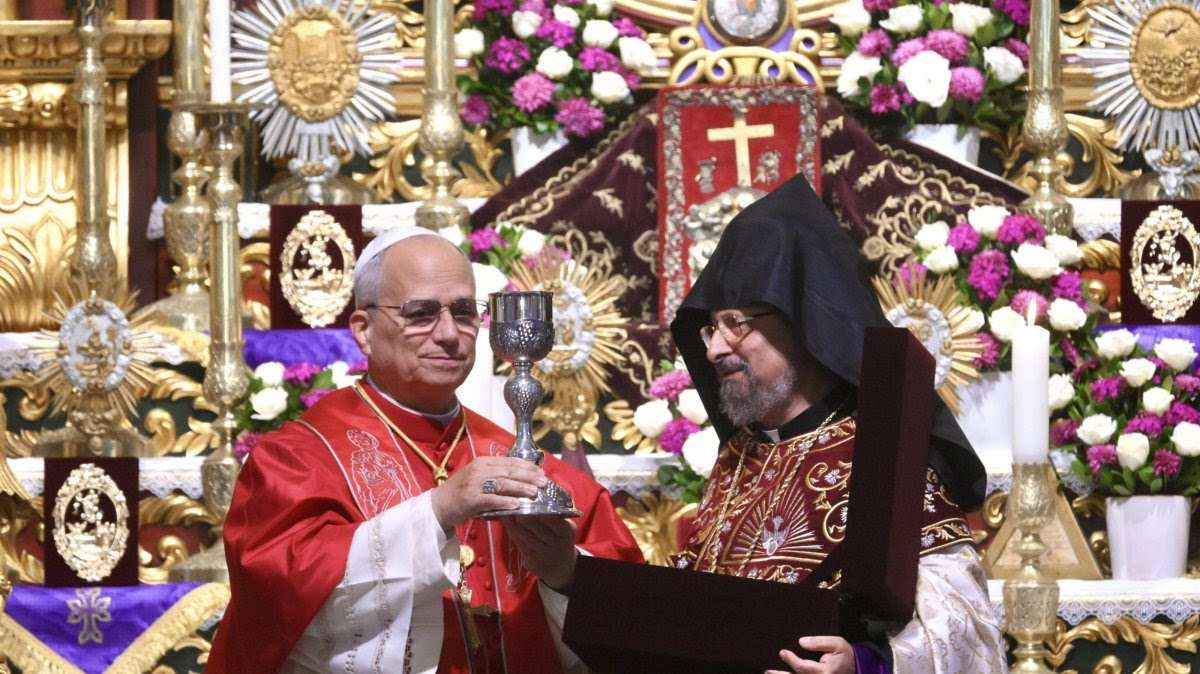
Pope Leo XIV was set to leave for Lebanon on Sunday, the last day of his visit to Türkiye where he underlined unity in talks with Armenian and Fener Greek Orthodox patriarchs.
Pope Leo XIV’s first trip to Türkiye ended on Sunday after four days. The pontiff, who received warm welcome by Türkiye’s Christian community, was set to depart for Lebanon with a message of peace for the crisis-mired nation.
On the last day of his visit, his first trip overseas since being elected leader of the world’s 1.4 billion Catholics, Leo participated in several Sunday services in another demonstration of his desire for greater unity among different branches of the Church.
At the Armenian Cathedral, Leo had words of encouragement for the largest of Türkiye’s Christian communities that counts some 50,000 members, thanking God “for the courageous Christian witness of the Armenian people throughout history, often amid tragic circumstances.”
It was an apparent nod to mass deaths of Armenians during the Ottoman rule between 1915 and 1916. Türkiye rejects the term of genocide for mass deaths, something that soured the relations with Armenia.
“The Armenian people do not forget the popes who raised their voice in our times of suffering, who stood with Christian communities in danger and who upheld truth when the world hesitated,” Armenian Patriarch Sahak Mashalian said. And he prayed Leo’s influence would help ensure the safety of “vulnerable Christian communities” in the Middle East, saying: “May the good Lord make you an angel of peace in those bleeding lands to herald glad tidings of enduring peace among war-worn peoples.”
Pope Francis did not visit any Armenian sites during his visit to Türkiye in 2014, but on his way to the airport before departing, he made an unscripted stop at a hospital where the ailing Armenian Patriarch Mesrob II was being treated. A year later, Francis drew Ankara’s ire by referring to the deaths of Armenians during the Ottoman era as “the first genocide of the 20th century.” He later visited Armenia, where he again used the term genocide.
Leo’s visit comes as Türkiye and Armenia appear to be moving closer toward a normalization of their ties and the pontiff’s visit is likely to lend support to those efforts, said Richard Giragosian, the founding director of the Regional Studies Center based in Yerevan, Armenia.
“More than just the symbolic importance of bringing the Vatican closer to the Armenian Church in terms of the eastern religion outreach, (the visit) is also, in some ways, promoting Armenia-Turkish normalization,” Giragosian told AP.
Türkiye and Armenia have no formal diplomatic ties and their border has remained closed since the 1990s. In 2021, the countries agreed to work toward normalization, appointing special envoys to explore steps toward reconciliation and reopening the frontier. Those talks have progressed in parallel with efforts to ease tensions between Armenia and Azerbaijan, a close Turkish ally. Türkiye supported Azerbaijan during its 2020 conflict with Armenia for control of the Armenian-occupied Karabakh region. Armenian Prime Minister Nikol Pashinyan visited Türkiye in June for talks with President Erdoğan. He later told a group of Turkish journalists in Yerevan that pursuing international recognition of the genocide is not among his government’s priorities, while emphasizing the genocide is an “indisputable fact” for Armenians.
The American pope then went to take part in a divine liturgy, the Orthodox equivalent of mass, at the Patriarchal Church of St. George, its glittering interior echoing with chants and ancient liturgy, the air filled with incense.
But before all his public duties, Leo met privately with a bereaved father whose 14-year-old Italian Turkish son died in February after being stabbed at a market in Istanbul.
“Today I cried, but I cried tears of joy, I came for Mattia Ahmet,” Italian chef Andrea Minguzzi said of his son in remarks to reporters afterwards, thanking the pope for meeting him and “fulfilling one of the greatest dreams of my life.”
“I wrote a letter two weeks ago and he received us today. I asked him for his support for our mission of peace and brotherhood. He is praying. This may be the best thing for us,” he said, fighting back tears.
Leo was to have lunch with Patriarch Bartholomew I, the leader of the world’s Orthodox Christians, a day after they signed a joint declaration pledging to take “new and courageous steps on the path towards unity.”
Despite doctrinal differences that led to the Great Schism of 1054 that divided Christians between the Roman Catholic Church in the West and the Eastern Orthodox Church, the two sides maintain dialogue and hold joint celebrations.
Pope Leo, the fifth pontiff to visit Türkiye, after Paul VI in 1967, John Paul II in 1979, Benedict XVI in 2006 and Francis in 2014, began his trip by holding talks with President Recep Tayyip Erdoğan.
Then he travelled to Iznik for a celebration marking 1,700 years since the First Council of Nicaea, one of the early Church’s most important gatherings.
In Istanbul on Saturday, thousands of worshippers braved heavy rain to celebrate mass with him, with many travelling across Türkiye to join the multilingual service that left participants and observers deeply moved by its beautiful and haunting choral interludes.
The six-day two-nation trip is the first major international test for the first pope from the United States, who was elected head of the Catholic Church in May and whose understated style contrasts with that of his charismatic and impulsive predecessor, Francis.
Although Leo’s visit drew little attention in Türkiye, a Muslim-majority nation of 86 million whose Christian community numbers only around 100,000, it is eagerly awaited in Lebanon, a religiously diverse country of 5.8 million inhabitants.
Since 2019, Lebanon has been ravaged by crises, including an economic collapse, a devastating port blast in Beirut in 2020 and the recent war with Israel.
Speaking to Daily Sabah on Friday, a professor at Istanbul Sabahattin Zaim University, Özcan Hıdır, described the pope’s visit as theo-political and stated: “The most important aim of the visit is not theological but rather theo-political. Accordingly, through his multifaceted diplomacy concerning both the Western and Islamic worlds, the pope wishes to deliver a message from Türkiye saying ‘We can cross the threshold of peace together,’ since Türkiye is one of the most crucial actors in resolving chaos-ridden areas such as the Gaza crisis, Syria and the Russia-Ukraine war.”
Welcomed by high-ranking Turkish officials, Pope Leo XVI and Erdoğan held a meeting in Ankara on Thursday at the Presidential Complex. The two leaders discussed Türkiye-Vatican relations as well as current regional and global issues, particularly focusing on the genocide in Gaza and efforts to ensure stability in the Middle East.
“Izmit holds a ‘privileged’ position for Vatican-papal visits. The three-day visit to Türkiye, which is rarely seen in diplomacy, is on the occasion of the 1,700th anniversary of the First Council of Nicaea, regarded as a “unifying platform” where the theological backbone of Christianity was shaped,” Hıdır said.
The 1,700th anniversary of the Council of Nicaea is considered a milestone in the Church’s history. Convened in A.D. 325 by Emperor Constantine, the council gathered leaders from across the Roman Empire and produced the Nicene Creed, which is a declaration of the faith in one God in three persons: the Father, the Son and the Holy Spirit. The creed still remains a foundation of Christian doctrine today.
Moreover, Bekir Zakir Çoban, a professor from Izmir Ege University, pointed out the significance of Pope Leo’s Türkiye trip and the diplomatic ties between Türkiye-Vatican. “He is the head of a significant community in the world and carries certain titles, such as being the representative of Jesus, the successor of Peter. This is a religious title. But at the same time, he is welcomed with official protocol, because he is also a head of state with whom Türkiye has had diplomatic relations since 1960,” he noted and added, “The fact that the current pope, Leo XIV, is making his first visit to Türkiye is also meaningful. This increases the importance of the messages he will give here, both religiously and politically, especially underlining Türkiye’s position in the region. From a religious perspective, these are the lands where Christianity was born, shaped and formed.”
After meeting the pope, President Erdoğan said they discussed bilateral relations as well as “current issues that concern the collective conscience of humanity,” including forced migration, poverty, injustice, climate change and ongoing conflicts around the world. He called the visit “a very important step” that reinforces common ground between the two sides and expressed hope that their meeting would bring “benefit to all humanity.”
Esma Çakır, a senior journalist based in Rome, also noted that, “The developments in the Middle East and Ukraine – which directly concern Christians – are among the pope’s priorities. Türkiye, with its geographical and historical significance, offers him a remarkable opportunity to deliver a message of peace.”
Emphasizing Türkiye’s key role in regional tensions and global crisis, she described Türkiye and the Vatican as “responsible humanitarian actors” on the international stage, asserting: “Türkiye and the Vatican both support a two-state solution in the Palestinian question. Pope Francis, who passed away in April, enabled the Vatican’s recognition of Palestine as a state in 2015. Pope Leo XIV uses a more cautious tone compared to his Argentine predecessor. He frequently expressed his deep sorrow over what has been happening in Gaza and called for immediate humanitarian aid for civilians, as well as a cease-fire and peace.”
“Türkiye’s role as an important actor within the Islamic world and the Vatican’s choice of Türkiye for this visit signals not conflict or division based on faith, but a pursuit of mutual understanding and dialogue,” she also noted.
Referring to his upcoming engagements in Türkiye and Lebanon, Pope Leo reiterated his intention to stress the importance of peace for everyone in the world. He also called on all people to unite in pursuing peace, noting that despite differences in religion and beliefs, humanity is fundamentally connected, and he hopes to contribute to efforts promoting peace and global unity.
In this respect, Hıdır stated that Türkiye’s growing impact in the region and “the fact that the Patriarch of Jerusalem delivered to President Erdoğan the ’emanname’ (letter of protection) that Caliph Omar gave to Christians in Jerusalem during the conquest is meaningful. This will bring about a diplomatic shift in the world from geo-politics to theo-politics, or what can be called religious-cultural diplomacy, revealing the growing importance of theo-politics.”
Regarding the Catholic and Orthodox Church’s meeting, comments such as “the churches are uniting” would not be accurate, Çoban noted, stressing that: “This is a courtesy meeting. It is also important for the peace message to be given together. With reference to the Council of Nicaea, the pope previously described it as one of the most fundamental elements that united Christians. Indeed, it is. It can almost be said that the Council of Nicaea is the only point where all Christians united. However, as I mentioned, the issue of the churches uniting is not possible because these churches are completely different in cultural, religious and ritual aspects.”
“Despite lacking military or economic power, the Vatican positions itself as a strong soft power actor in international relations through its moral authority, historical legacy and religious influence,” Çakır indicated.