Catholicos Karekin II claims ‘persecution and repression’ of Armenian Apostolic Church
Tensions renewed with the country’s Prime Minister after election landslide
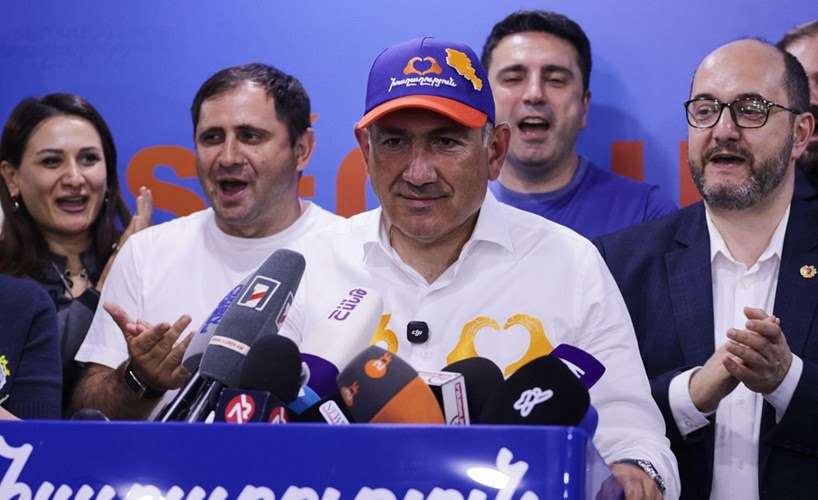
The Prime Minister of Armenia, Nikol Pashinyan, speaks at his party HQ on Monday
The Armenian Apostolic Church is facing renewed tensions with the country’s Prime Minister, Nikol Pashinyan, after his governing party won an election landslide on pledges to curb the Church’s traditional influence.
“I made my choice, praying that God will keep the Armenian state unshaken,” Catholicos Karekin II said after voting in Sunday’s nationwide ballot. “I also voted so that God’s love and mercy may be with us, building a strong, secure, and prosperous country.”
Pashinyan’s Civic Contract Party won almost 50 per cent of the votes, far ahead of its three main opposition rivals, which won 37 per cent between them.
Speaking on Monday, Pashinyan said that his government’s main tasks would now include instigating the 2025 peace agreement, which was brokered by the United States to put an end to the 35-year conflict with neighboring Azerbaijan; and pursuing closer ties with the European Union.
Church leaders have accused the liberal government of conceding too much under the deal, while government officials have retaliated by arresting supporters of Karekin II and backing dissident bishops who are calling for his resignation.
Earlier this year, the Conference of European Churches voiced concern about the growing tension between Church and government and urged Pashinyan to ensure “transparency and proportionality” in the run-up to Sunday’s election.
On Monday, however, election observers from the Organization of Security and Co-operation in Europe said that the election had been marred by vote-buying as well as “provocative rhetoric, disinformation, and ongoing international pressure”.
In a message last week, the Catholicos had said that his Church remained the “steadfast guardian” of Armenia’s “spiritual heritage and historical memory”, but warned that its “centuries-old canonical order” was being distorted by “persecution and repression”.
On Monday, a Russian Foreign Ministry spokeswoman, Maria Zakharova, accused Western countries of interfering in the election.
The EU’s High Representative for Foreign Affairs and Security Policy, Kaja Kallas, welcomed the results as showing that Armenians had “chosen a European future”.