
Chronology of Turkey’s Long War Against its Minorities (1941-2007) — By Harut Sassounian
The third and last part of my article presents some of these persecutions from 1941 to 2007, as documented by Turkish historian Ayse Hur:
— December 15, 1941: The Turkish authorities refused to allow the overcrowded Struma ship, carrying 769 Romanian Jews from Constantza fleeing Nazi persecution, to disembark in Istanbul on the way to Palestine. After enduring illness, starvation, and death for 2.5 months, the Struma was towed 23 miles offshore, without engines, fuel, food, water, or medicine. It was torpedoed and sunk by an unidentified submarine on February 24, 1942. Only a single passenger survived.
— November 11, 1942: Prime Minister Şükrü Saracoğlu’s government imposed on the minority populations the notorious “Wealth Tax,” one of the most egregious examples of economic persecution. 87% of the taxpayers were non-Muslims. Armenian merchants were taxed at 232% of their capital, Jewish merchants at 179%, Greek merchants at 156%, while Muslim-Turkish merchants were taxed at only 4.94%. Those unable to pay their taxes were sent to forced-labor camps in the country’s interior. During the “Wealth Tax Tragedy,” which lasted until March 1944, families lost their homes, businesses, and in some cases their lives. The law was eventually repealed, but the damage was permanent.
— 1946: For the first time, non-Muslim university graduates were allowed to serve in the military as reserve officers. However, since that time, not a single non-Muslim has been elevated to the rank of commander in the Turkish Armed Forces.
— 1946: The ruling political party issued a chilling internal report: “We must take serious measures, especially against the Greeks in Istanbul…. Not a single Greek should remain in this city by 1953, the 500th anniversary of the Ottoman conquest of Istanbul.” According to the report, “Anatolia should also be cleansed of non-Muslims.”
— 1948: When Jews attempted to emigrate to the new State of Israel and Armenians to Soviet Armenia, the Turkish government and its loyal press — which had done everything for years to drive them away — began publishing articles that portrayed those who wanted to emigrate as “traitors.”
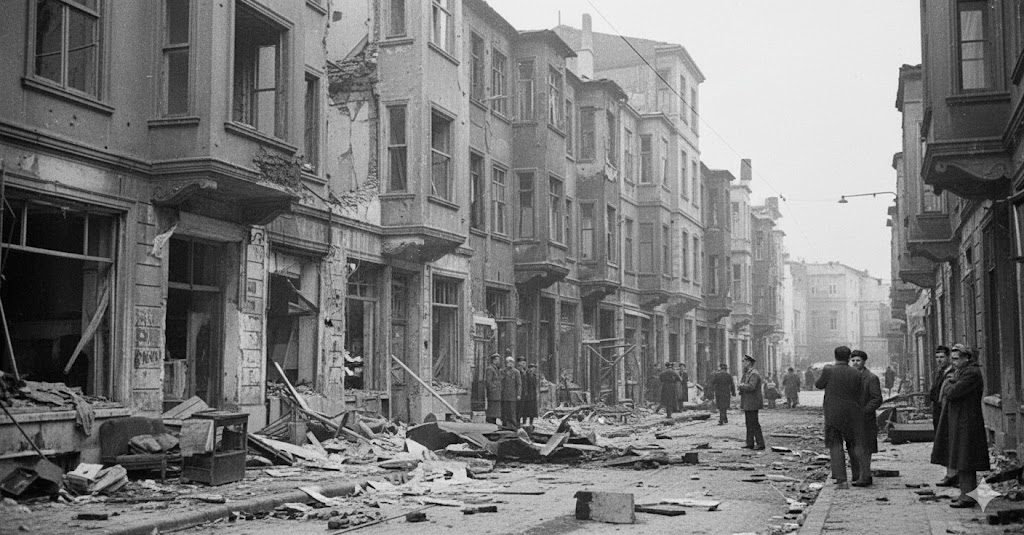
— September 6-7, 1955: A large-scale, state-orchestrated pogrom unfolded, primarily targeting the Greek population of Istanbul. However, the events spread to other cities, such as Izmir, Adana, and Trabzon. Armenians and Jews were also attacked. According to some sources, three people were killed, according to others 11, approximately 300 people were injured, and hundreds of women were raped. According to official figures, more than 5,300 buildings were attacked, while unofficial figures put the number close to 7,000. Estimates of the damage ranged from 150 million to one billion liras.
— 1964: As tensions escalated with Greece, Turkey unilaterally annulled the “Friendship Treaty” signed in 1930 between Turkish President Kemal Atatürk and Greek Prime Minister Eleftherios Venizelos. Tens of thousands of Greek citizens, born and raised in Turkey, were forcibly expelled. They were allowed to take with them only one suitcase and a very small sum of money. With the departure of Turkish citizens of Greek origin, the Greek community was brought to the verge of extinction.
— 1974: By a decision of Turkey’s Supreme Court regarding a lawsuit between the Board of Directors of the Balıklı Greek Hospital Foundation in Istanbul and the State Treasury, non-Muslim citizens in Turkey were officially classified as “non-Turks.”
— 1984: The Phanar Greek Orthodox Patriarchate requested permission to close the Heybeliada Theological Seminary, stating that it could not cover its expenses. However, the Turkish government, which had been doing everything in its power to close the school until then, rejected this request, arguing that it was not possible to close it down under the Lausanne Treaty, other bilateral agreements, and the “principle of reciprocity.” Today, despite having no students, the school’s Turkish administrator, who was appointed by the Ministry of National Education, reports for work every day. The Patriarchate continues to incur expenses to keep the school open.
— 1985 and 1990: The Yazidis, who worship the Peacock Angel, were driven from their homes and forced to migrate en masse to Western countries because they refused to become village guards against the PKK.
— The 2000s: One of the central topics of the National Security Council meetings was “combating missionary activity.”
— November 15, 2003: Two Turkish Islamist terrorists carried out suicide attacks on the Beth Israel Synagogue in Şişli and the Neve Shalom Synagogue in Galata, killing 25 people, including the attackers, and injuring more than 300.
— February 5, 2006: Father Andrea Santoro of the Santa Maria Catholic Church in Trabzon was stabbed to death by a 16-year-old Turkish boy.
— January 19, 2007: Hrant Dink, the editor-in-chief of Agos Armenian newspaper, was assassinated.
— April 18, 2007: In Malatya, seven Turkish nationalist youths raided the Zirve Publishing House, which published works related to Christianity, and brutally murdered three office workers.
The decades‑long record of discrimination, dispossession, and violence against Turkey’s minorities is not a collection of isolated incidents but a sustained state policy that reshaped the country’s demographic and cultural landscape. Armenians, Greeks, Jews, Assyrians, and Yazidis — communities rooted in Anatolia for millennia — were pushed to the margins through laws, intimidation, and outright brutality. Their numbers dwindled not by accident, but by design.