Either Pashinyan was deceived, or he is deceiving us
By Vahe Sarukhanyan
Hetq
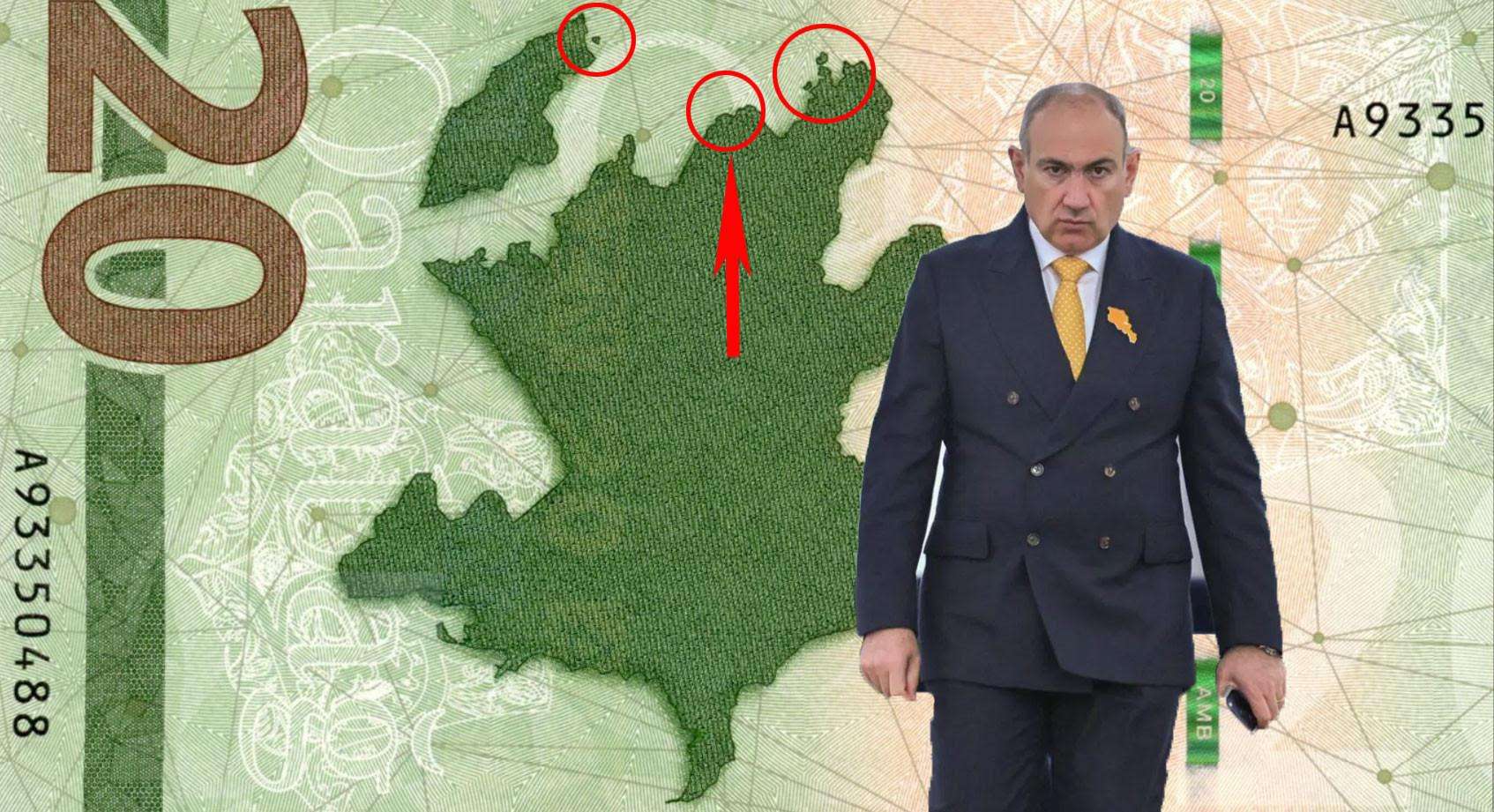
“Artsvashen is recorded as an enclave on the maps of the Azerbaijani currency and passport. And that is a very important nuance. This is a very important nuance, and I think we should also demonstrate the same mirror approach in order to demonstrate an accurate attitude towards the maps corresponding to the Alma-Ata Declaration, because this stems from those agreements and the text of the initialed agreement, which we not only signed, but was also approved by the citizens of Armenia through actual elections,” Prime Minister Nikol Pashinyan stated at a meeting with journalists on July 9 and added, “but I am sure that this nuance in Armenia… I, for example, learned about it just a month ago or a month and a half ago, that, for example, on the Azerbaijani dram, where the map of Azerbaijan is expressed, Artsvashen is separately marked in a different color, as a territory that does not belong to Azerbaijan. The same is expressed in passports with the same expression. That is, de jure does not belong. Now I don’t know, I assume that people even live there, perhaps I don’t have very clear information. But this is a fact that is very significant, including when developing our policies and attitudes and positions.”
This statement by Pashinyan is manipulative, as it presents half the truth.
The fact is that on all copies of the Azerbaijani banknote, the manat, printed after 2020, Artsvashen is presented not as an enclave (an exclave of Armenia), but as part of the territory of Azerbaijan.
After the collapse of the USSR, Azerbaijan has issued coins (gyapik – from the Russian word kopek) and banknotes (manat – from the Russian word moneta) several times.
The Azerbaijani manat entered circulation in 1992, and from January 1, 1994 it became the only legal tender in the territory of Azerbaijan, since the Soviet ruble was withdrawn from circulation. In parallel with the manat, its small coin, the gyapyk (1 manat is equal to 100 gyapyk), was introduced into circulation, which was issued in the form of a coin.
The first samples of the gyapyk – coins with a value of 5, 10, 20 and 50 gyapyk – were issued in 1992-1993. They did not have a map of Azerbaijan on them.
The samples of the second issue of the gyapyk have been in circulation since January 2006 and are used to this day. Coins with a value of 1, 3, 5, 10, 20 and 50 gyapyk were issued. Their obverse depicts a map of Azerbaijan, on which, however, the enclaves formed on the territory of Azerbaijan and Armenia during the Soviet years are not distinguished. In other words, Artsvashen is not separated from the territory of Azerbaijan, and Tigranashen, Verin Voskepar and Sofulu-Barkhudarlu from the territory of Armenia.
As for the Azerbaijani manat, the first samples were issued in 1992-2001. (Banknotes in denominations of 1, 5, 10, 50, 100, 250, 500, 1,000, 10,000 and 50,000 manats were in circulation). They, like the banknotes of the first issue, did not have a map.
Since 2005, banknotes of a new design have been in circulation, which are used to this day. All of them have a map of Azerbaijan on their reverse.
Moreover, in 2005-2018 In the printed samples (1, 5, 10, 20, 50, 100, 200 manat banknotes), enclaves are visible on the maps. More specifically, Artsvashen is separated from the territory of Azerbaijan, Verin Voskepar and Sofulu-Barkhudarlu from the territory of Armenia, and Tigranashen is presented as part of Armenia (not separated).
Pashinyan referred to these samples in his statement on the 9th of the month, but he either deliberately hid from journalists and the public, or due to ignorance did not raise the fact that Artsvashen is presented as part of Azerbaijan on the banknotes with an updated design in 2020 and thereafter.
Thus, in the specimens printed in 2020 and thereafter (banknotes in denominations of 1, 5, 10, 20, 50 and 100 manats), to which the 500 manat note was also added (printed in 2021, with the inscription “Karabakh is Azerbaijan” on the obverse and reverse), not only has Artsvashen been merged with the territory of Azerbaijan and does not appear as an enclave, but also, unlike previous specimens, Tigranashen has been separated as an enclave within the territory of Armenia, and Verin Voskepar and Sofulu-Barkhudarlu in almost all specimens (except for the 20 manat note printed in 2021) are presented not as an enclave within Armenia, but as a territory with a land connection with Azerbaijan. Pashinyan’s statement regarding the Azerbaijani passport is correct. Since 2013, Azerbaijan has been using biometric passports, in which the enclaves are visible on the maps presented.
As for the maps present in other Azerbaijani documents, it is worth noting that the enclaves are separated on the map presented in identification cards (ID), but not on old and new driver’s licenses.
Thus, Nikol Pashinyan, speaking about the separation of Artsvashen on Azerbaijani currency and passports, manipulated reality by declaring that “on the Azerbaijani dram, where the map of Azerbaijan is expressed, Artsvashen is marked separately in a different color as a territory that does not belong to Azerbaijan.” Without specifying that this is exclusively about samples printed in 2005-2018, Pashinyan made a misleading statement, intentionally or due to ignorance, not only not showing Artsvashen after 2020, but also Verin Voskepar and Sofulu-Barkhudarlu are presented distortedly, having a common connection with Azerbaijan, which, naturally, is at the expense of the territory of Armenia.
“For example, I only found out about it a month ago or a month and a half ago,” Pashinyan stated, which shows that either he was deceived by reporting half the truth, and he still does not know the full truth, or he knows, but is deliberately distorting reality. Regardless of everything, the information Pashinyan spread to journalists on July 9 is “fake.”
It is another question what purpose is hidden in making such a statement at the highest level. Regarding the “mirror-like approach” mentioned by Pashinyan, it is worth noting that there are no maps in RA passports and on the dram, and the outline of RA presented on the driver’s license does not include enclaves.
Pashinyan was probably hinting at new biometric passports, which will be available to citizens from the fall of this year. In the design of these new passports presented in April, we see the only exclave of Armenia, Artsvashen, on the other hand, there are no enclaves on the territory of Armenia.
After the Prime Minister’s announcement on July 9, it can be expected that the map of Armenia in the new biometric passports will be changed, and the Azerbaijani enclaves formed on the territory of Armenia during the Soviet years will be highlighted on it, the legal basis for the emergence of which the same Pashinyan has previously questioned. It can be expected that after making such an announcement, the Prime Minister will also demonstrate a “mirror approach” to his badge in the form of a map of Armenia, on which no enclaves are currently visible.