Erdoğan claims “no genocides, massacres, or colonialism” in Turkish history: What the historical record and archives prove
|
By the Hellenic Canadian Research Institute
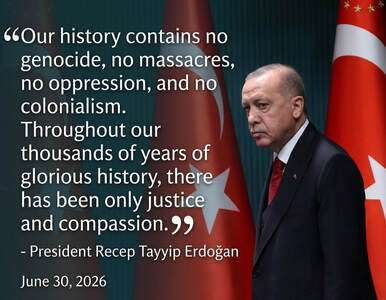
When Turkish President Recep Tayyip Erdoğan spoke at a political gathering on June 30, 2026, his words were not merely a defense of contemporary foreign policy, but a sweeping attempt to rewrite centuries of geopolitical reality. Addressing international critics in a video shared by Clash Report on X, Erdoğan declared:
This absolutist invocation of a spotless past represents a foundational tenet of modern Turkish state-directed historiography. By filtering the multi-ethnic, often violent transitions of the late Ottoman Empire and the early Turkish Republic through a singular lens of absolute benevolence, such rhetoric seeks to completely insulate the state from historical accountability. In this narrative, state actions are universally framed as acts of defensive preservation, justice, or paternal compassion, while the catastrophic losses suffered by minority populations are dismissed as wartime collateral damage or foreign-instigated fabrications.
However, historical truth cannot be legislated by state decrees or obscured by contemporary political posturing. Decades of painstaking, multi-archival research by international and Turkish historians, extensive diplomatic records from wartime observers, and the foundational frameworks of international law present a starkly different, deeply troubling reality. The transition from the multi-faith Ottoman Empire to the homogenous, modern Turkish nation-state was not achieved through peaceful cohabitation, but through the deliberate, state-sanctioned destruction of the empire’s diverse cultural mosaic. From the reprisal massacres and scorched-earth campaigns against the Greeks in the 1820s to the industrial-scale genocides of World War I, and extending to modern campaigns of settler colonialism and minority suppression, the historical record reveals a persistent pattern of systemic violence, forced assimilation, and territorial expansion. To evaluate President Erdoğan’s claim of an untarnished history, one must look beyond political rhetoric and examine the extensive historical record. The following list in Part I is non-exhaustive and barely scratches the surface of Turkey’s history. Part I: The Historical Record of Mass Atrocities The Late Ottoman Period Massacres and Genocides (1821 to early 1923) The claim that Turkish history contains “only justice and compassion” is directly contradicted by the final chapters of the modern Turkish Republic’s predecessor, the Ottoman Empire. To suppress internal dissent, the empire routinely implemented total warfare against regional independence movements, civilian annihilation, and targeted atrocities against indigenous minority populations. This list does not focus on the war crimes, massacres, murders, and destruction caused by the Turks as they conquered and colonized during their rise and expansion which spanned centuries:
Early Republican-Era State Violence (late 1923 to 1938) The transition of the Ottoman Empire to a secular republic in 1923 did not halt internal mass atrocities. The early state apparatus heavily suppressed ethnic and religious minorities to enforce a singular, homogenized national identity:
Late 20th-Century Sectarian Pogroms
Part II: Turning Turkey’s Archives Against Denial Modern genocide scholars have successfully turned Turkey’s own institutional records against state denial, utilizing official Ottoman and Turkish state archives to verify historical atrocities despite multiple waves of systemic purging. Turkish historians like Taner Akçam bypassed strict state restrictions by making definitive archival breakthroughs within the Ottoman Prime Ministerial Archives (Başbakanlık Osmanlı Arşivi). A critical component of this research involved the discovery of a decoupled cipher system hidden within a massive repository of everyday administrative telegrams. By cross-referencing public four-digit numbering cipher keys with encrypted trial records, scholars successfully verified the authenticity of absolute killing orders dispatched directly from Istanbul.[21][22] Furthermore, these archives expose a highly organized campaign of demographic engineering run directly by the Ottoman Interior Ministry. In the case of the Armenians, meticulous archival logs prove that regional governors received strict commands to ensure that relocated Armenian populations never exceeded 5% to 10% of the local Muslim population in any given area.[23] This strict preoccupation with population percentages mathematically confirms a deliberate, top-down blueprint for systemic erasure rather than the chaotic, unintended consequences of wartime relocation. The structural logistics of this erasure are further laid bare in abandoned property (Emval-i Metruke) ledger books recovered from the state archives.[24] These property liquidation records outline the organized expropriation, tracking, and reallocation of Christian assets across the empire. By explicitly mapping out how minority wealth was legally stripped and transferred, these official documents prove that the theft of property was directly engineered to build a new Turkish national economy. Crucially, the state’s archives do more than just record the mechanisms of economic theft and destruction; they also preserve a hidden history of internal resistance and administrative guilt that directly shatters the state’s monolithic denial narrative. As demonstrated by Turkish researcher and activist Tamer Çilingir at a landmark 2019 international genocide conference in Athens, Greece, secret minutes of the Turkish National Assembly from 1922 and 1923 that he brought to light serve as damning evidence of the internal fractures surrounding the destruction of the Greek population. These secret minutes highlight explicit expressions of sorrow, alarm, and profound guilt voiced by contemporary Turkish politicians regarding the horrific brutality of the massacres being committed under their watch. Most damaging to the state-sanctioned narrative, however, is the verification within the state archives of official military execution orders targeting local Turkish Muslims. Çilingir stated that these documents provide empirical, undeniable proof that some Turkish citizens frequently rejected the government’s genocidal campaigns. Instead, ordinary Muslims actively risked their lives to secretly shelter, feed, and aid Greek Orthodox Christians hiding from state forces in the mountains.[25] Part III: Refuting the “No Colonialism” Claim: Modern Settlement and Occupations Erdoğan’s claim that Turkey’s history contains “no colonialism” is flatly contradicted by the fact that both the Seljuk and Ottoman Empires were founded on systems of territorial conquest, subjugation, and long‑term colonial administration. Furthermore the modern Turkish Republic continues to orchestrate ongoing policies of military occupation, resource expropriation, demographic engineering, and state‑directed settlement projects beyond its borders: Illegal Occupation and Settler Colonialism in Northern Cyprus (1974–Present) Following its military invasion of Cyprus in 1974, Ankara established a de facto partition of the island that has now entered its sixth decade. International legal bodies and historians categorize Turkey’s ongoing presence in Cyprus as being illegal. The Turkish government implemented an aggressive campaign of demographic engineering, forcing approximately 170,000 to 200,000 indigenous Greek Cypriots from their ancestral homes in the north. To permanently alter the territory, Turkey initiated a state-sponsored population transfer, importing tens of thousands of mainland Turkish settlers in violation of the Geneva Conventions. This systematic replacement of the indigenous population has effectively transformed the northern territory into a project of settler colonialism.[26] Crucially, this systematic demographic engineering has devastated not only the displaced Greek Cypriots but has structurally eroded the autonomy of the island’s secular Turkish Cypriot population as well. As highlighted by Evangelos Savva, the Ambassador of Cyprus to the United States, before the Tom Lantos Human Rights Commission on June 30, 2026, the influx of mainland settlers has been so overwhelming that today, Turkish Cypriots have been rendered a clear demographic minority in the occupation zone, completely eclipsed by Anatolian Turkish settlers. To cement this control, Turkey enforced a comprehensive program of cultural and economic assimilation designed to integrate the occupied territory into the state fabric of the mainland. By introducing the Turkish Lira, routing all postal and communication networks exclusively through Ankara, and maintaining heavy financial oversight, Turkey has effectively forced a permanent dependency on the Turkish mainland.[27] Neo-Colonialism in Northern Syria (2016–Present) During the Syrian civil war, the Turkish military launched successive operations to occupy a 30-kilometre-deep buffer zone in northern Syria.[28] Political scientists and human rights monitors have documented this intervention as a textbook case of transformative military occupation with distinct neo-colonial patterns.[29] Central to this strategy is a systematic process of administrative and cultural erasure, wherein Turkey brought local Syrian health, education, and judicial sectors directly under the bureaucratic control of the Hatay governorate inside Turkey. Under this centralized authority, school curricula were forcefully changed to Turkish, the Turkish Lira was introduced as the primary currency, and indigenous Kurdish street names and cultural holidays were strictly banned. Military Intervention and Drone Warfare in Artsakh (Nagorno-Karabakh) (2020-2023) Turkey’s contemporary regional ambitions have heavily shaped the map of the South Caucasus, utilizing modern military force to directly alter local demographics. During the 2020 Second Nagorno-Karabakh War, Turkey provided decisive, direct military, intelligence, and logistical support to Azerbaijan. Under this framework, Turkish senior military personnel directed operational planning while advanced drones, including sophisticated Canadian drone technology[30], were deployed to obliterate Armenian defenses. The resulting military victory by Baku successfully broke a three decade stalemate, directly paving the way for the total exodus and ethnic cleansing of around 120,000 indigenous Armenians from Artsakh (Nagorno-Karabakh) in 2023. Opportunistic Bombing of Kurdish Infrastructure in Syria and Iraq (as of October 2023) The modern Turkish state’s long-standing campaign against Kurdish populations has frequently relied on capitalizing on global distractions to advance cross-border operations without international pushback. In October 2023, while the entire international community’s attention was gripped by the immediate fallout of the October 7 terror attacks in Israel and the resulting crisis in Gaza, Ankara launched an intense, devastating campaign of air and drone strikes against Kurdish regions in Syria and Iraq.[31][32] This strategic timing allowed Turkey to escalate its military footprint with minimal diplomatic friction from Western allies or regional bodies. Striking across northern Iraq and northeast Syria, the Turkish Armed Forces targeted and severely damaged vital humanitarian infrastructure, including water pumping stations, electricity plants, oil refineries, and domestic gas facilities. The resulting destruction crippled the region’s essential resource networks. Highlighting the sheer scale of the offensive, human rights organizations reported over 1,000 individual airstrikes carried out in Iraq by mid-2024.[33] Part IV: Legalized Silence — Article 301 of the Turkish Penal Code The enforceability of historical denialism within Turkey is not passive; it is legally mandated by the state’s judicial apparatus. The primary legal mechanism used to punish dissidents, journalists, and academics who attempt to discuss these historical atrocities is Article 301 of the Turkish Penal Code. Article 301 criminalizes the act of publicly “insulting the Turkish Nation, the State of the Republic of Turkey, or the Grand National Assembly of Turkey.” Anyone convicted under this law faces a prison sentence ranging from six months to two years.[34] The law has been used aggressively to target individuals who publicly use the word “genocide” or publish works detailing the massacres of minorities. Prominent intellectuals, including Nobel Laureate Orhan Pamuk, were prosecuted under this statute for mentioning the mass killings of Armenians and Kurds.[35] Similarly, peace activist Yannis Vasilis Yaylali was imprisoned for two years for simply commemorating the victims of the Armenian and Greek genocides.[36] The danger of this state-sponsored legal targeting was fully realized in the landmark case of Hrant Dink, a prominent Turkish-Armenian journalist. Dink was repeatedly prosecuted and convicted under Article 301 for his writings on the Armenian Genocide.[37] The state’s public legal campaign painted him as a traitor, creating a hostile domestic environment that ultimately culminated in his assassination by an ultranationalist in 2007. Though the law was amended in 2008 to require explicit permission from the Ministry of Justice before filing a case, it remains a powerful tool of state censorship, effectively enforcing a state-approved history through fear. Part V: The Danger of Erdogan’s Moral Superiority and Selective Moralism President Erdoğan’s speech attempted to build a shield of moral superiority by contrasting the humanitarian catastrophe in Gaza with an idealized version of Turkish history. In condemning the staggering loss of innocent life in Gaza, Erdoğan sought to position himself as a champion of universal human rights. However, true moral authority cannot exist alongside selective historical amnesia. Using today’s tragedies to hide from past wrongdoings is a common political tactic; however, it creates a dangerous contradiction that ultimately weakens the international laws he tries to invoke. This contradiction is rooted in a glaring double standard regarding state violations of international law. A government cannot legitimately weaponize the framework of international law to condemn mass atrocities, forced displacement, and resource expropriation in one geographic theater while simultaneously using domestic statutes like Article 301 to criminalize any mention of identical, state-orchestrated violations in its own past. Dismissing the heavily documented history of the Armenian, Greek, and Assyrian genocides as mere “slander” utilizes the exact same language of denialism that has historically been deployed globally to shield perpetrators of mass violence from accountability. Furthermore, asserting that Turkey’s past contains “only justice and compassion” effectively erases the generational trauma and lived experiences of the millions of indigenous minorities who were systematically uprooted from Eastern Thrace, Anatolia, the Armenian Highlands, Cyprus, and the Levant. Ultimately, human rights are, by definition, universal and indivisible. The suffering of civilians in Gaza must be condemned unequivocally on its own terms, but it cannot be used as an ideological tool to absolve any state of its own historical or contemporary crimes. Genuine moral leadership on the world stage requires an uncompromising consistency, demanding that a nation extend the same compassion and structural legal accountability it claims to champion abroad to the victims recorded within its own past. Conclusion Sweeping claims of historical perfection are the tools of political convenience, not historical reality. The transition of power across the late Ottoman Empire and the Republic of Turkey is an undeniably complex, deeply scarred legacy that requires transparency, open archival access, and the courage to face dark chapters honestly. To truly heal these systemic wounds, Turkey should implement a Truth and Reconciliation process inspired by the Canadian model. Such a framework would allow the state to confront past state-sponsored injustices through public testimony, rigorous education, and official accountability, proving that true justice and international credibility cannot be built on state-enforced silence. For Turkey, achieving genuine moral leadership on the world stage requires abandoning defensive political rhetoric and extending the same compassion it demands for victims abroad to the memory of the victims within its own historical ledger. Sources:
[1] Mellby, J. (2019, May 7). The hanging of Gregory V in Constantinople. Graphic Arts, Princeton University Library. https://graphicarts.princeton. [2] Cartledge, Y. (2024, April 15). The Chios Massacre (1822) and Chiot Emigration [Invited talk]. Festival Hellenika 2024, Adelaide, SA, Australia. https://researchnow.flinders. [3] Hellenic Army General Staff. (2024, June 22). The destruction of Psara. https://stelexi.army.gr/en/ [4] Pavlopoulos, P. (2026, March 24). The heroic exodus of Messolonghi as a timeless source of inspiration for the fulfillment of our national obligations. Hellenic Canadian Research Institute. https://www.hellenicinstitute. [5] Sharkey, H. J. (2025). Damascus, Syria, 1860: Clues and lessons from the scene of a crime. Bustan: The Middle East Book Review, 16(1), 3–15. https:// [6] Adalian, R. P. (n.d.). Hamidian massacres. Armenian National Institute. armenian-genocide.org [7] The Armenian Genocide Museum-Institute. (n.d.). Adana massacres 1909: Unknown scenes of the tragedy. genocide-museum.am [8] Greek Genocide Resource Center. (2020, July 14). Eastern Thrace: The first phase of the Greek genocide. https://www.greek-genocide. [9] Greek Genocide Resource Center. (n.d.). Greek Genocide Resource Center. https://www.greek-genocide. [10] Kafno.org. (n.d.). Kafno never ended. https://kafno.org/ [11] Bulut, U. (2026, May 16). Kafno: The Lebanese Maronite Genocide. SyriacPress. https://syriacpress.com/blog/ [12] Seyfo Center. (n.d.). The Assyrian Genocide. Seyfo Center: Assyrian Genocide Research Center. seyfocenter.com [13] Assyrian International News Agency. (n.d.). 750,000 Assyrians were killed in World War One. aina.org [14] Lemkin Institute for Genocide Prevention [@LemkinInstitute]. (2023, June 17). The @LemkinInstitute remembers the estimated 750,000 Assyrians that were murdered during the #Assyrian Genocide, Seyfo, beginning in 1915. [Post]. X. https://x.com/LemkinInstitute/ [15] Adalian, R. P. (n.d.). Encyclopedia entries on the Armenian Genocide. Armenian National Institute. https://www.armenian-genocide. [16] Hun, M. Ö. (2025, July 13). The Zilan Massacre: Anatomy of a historical turning point. Hun Academy. https://hunacademy.com/en/ [17] Omar, A. (2025, May 11). The Dersim Massacre. KGNA. https://kgna.krd/15269/ [18] de Zayas, A. (2007). The Istanbul Pogrom of 6–7 September 1955 in the light of international law. Genocide Studies and Prevention: An International Journal, 2(2), Article 4. https://digitalcommons.usf. [19] Kurdish Institute Brussels. (2014, December 19). A black mark on Turkey; Maraş Massacre. https://www.kurdishinstitute. [20] United States Commission on International Religious Freedom. (2021, July 2). Sivas Massacre and Turkey’s persecution of the Alevi community[Post]. https://www.uscirf.gov/news- [21] Akçam, T. (2006). Deportation and massacres in the cipher telegrams of the Interior Ministry in the Prime Ministerial Archive (Başbakanlık Arşivi). Genocide Studies and Prevention: An International Journal, 1(3), 305–325. https://digitalcommons.usf. [22] Agos. (2016, October 11). Akcam: The authenticity of the Naim Efendi memoirs and Talat Pasha telegrams. Armenian Weekly. https://armenianweekly.com/ [23] Carter, C. (2012, September). The crime that dare not speak its name. Origins: Current Events in Historical Perspective. https://origins.osu.edu/ [24] The Promise Armenian Institute. (n.d.). The auctioning of stolen Armenian properties: Emval-i Metruke. University of California, Los Angeles. https://www.international. [25] Livemedia. (2019, December 7). International Conference on the crime of Genocide native language 07/12/19 [Video]. YouTube. https://www.youtube.com/watch? [26] Parliamentary Assembly of the Council of Europe. (2002, November 1). Colonisation by Turkish settlers of the occupied part of Cyprus (Doc. 9799). https://assembly.coe.int/nw/ [27] Hellenic Canadian Research Institute. (2026, June 26). US congressional hearing on Erdoğan’s human rights record in Turkish-occupied Cyprus to take place before NATO Summit. https://www.hellenicinstitute. [28] Al Mayadeen English. (2022, May 20). Syria condemns Turkish statements regarding ‘safe zone’ in the north. almayadeen.net. [29] Human Rights Watch. (2024, February 29). Syria: Abuses, impunity in Turkish-occupied territories. https://www.hrw.org/news/2024/ [30] CBC News. (2020, October 6). Canada suspends arms export permits to Turkey [Video]. CBC. https://www.cbc.ca/player/ [31] Syrians for Truth and Justice. (2024, June 26). “As if an earthquake had struck”: Turkish airstrikes are killing life in northeast Syria. https://stj-sy.org/en/as-if- [32] Khoshnaw, N., Giles, C., & Smith, S. (2024, November 19). Turkish strikes in Syria cut water to one million people. BBC News. https://www.bbc.com/news/ [33] Turkish Minute. (2024, June 15). Turkey has conducted nearly 1,000 attacks in Iraqi Kurdistan in 2024: Rights group. https://turkishminute.com/ [34] Amnesty International. (2006, March). Turkey: Article 301: How the law on “denigrating Turkishness” is an insult to free expression (EUR 44/003/2006). https://www.amnesty.org/en/wp- [35] Amnesty International. (2006, January 23). Turkey: Court drops case against novelist Orhan Pamuk (EUR 44/001/2006). https://www.amnesty.org/es/wp- [36] Hellenic Canadian Research Institute. (2026, July 4). Yaylali issues urgent open letter for support ahead of August 3 asylum hearing. https://www.hellenicinstitute. [37] Amnesty International. (2007, January 19). Turkey: Turkish-Armenian journalist murdered (EUR 44/001/2007). https://www.amnesty.org/en/wp- |