The Armenian Foreign Ministry welcomed the decision. It said the EU mission will be deployed for an “initial period of two years.”
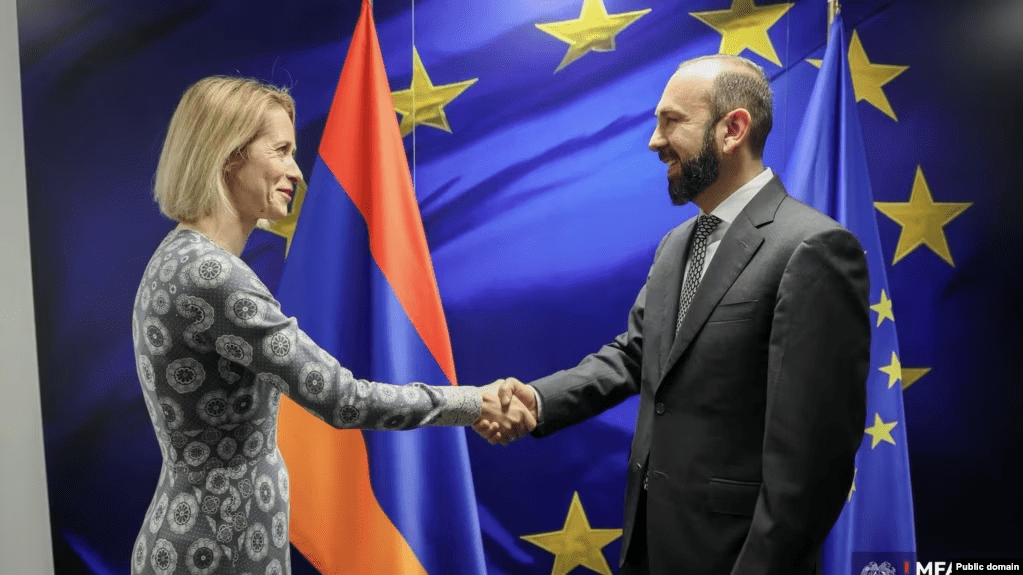
The mission was requested by Yerevan in December and recommended by EU foreign policy chief Kaja Kallas earlier this year. The ambassadors of EU member states in Brussels endorsed last week a relevant proposal submitted by Kallas.
The proposal seen by RFE/RL states that the European Union Partnership Mission in the Republic of Armenia (EUPM Armenia) “shall enhance the resilience of Armenia in the field of hybrid threats through the provision of strategic advice as well as operational level advice and support to relevant security sector agencies, in line with a whole-of-government approach and in close coordination with other like-minded actors.” This includes providing strategic advice to relevant Armenian ministries and agencies “for countering hybrid threats, notably Foreign Information Manipulation and Interference (FIMI) and cyber, as well as illicit financial flows in the electoral and political context.”
While not stated directly in the proposal approved by the ministers, it is clear Russian interference in Armenia’s June 7 parliamentary elections is the main concern for the mission. According to several EU diplomats speaking on the condition of anonymity, the EU hopes to copy what it sees as the success in the parliamentary elections in Moldova last year in which pro-Brussels forces retained power. Two Moldovan opposition parties deemed pro-Russian were disqualified from the vote.
The EU already decided last month to send a separate “hybrid rapid response team” to Yerevan for the upcoming elections. The Armenian government requested the deployment as well after implicitly alleging Russian “hybrid” threats to the integrity of the electoral process. Government officials have not publicly elaborated on those threats.
Armenia’s leading opposition groups are concerned that they too could be barred from running in the polls. Some of their leaders have claimed that Prime Minister Nikol Pashinian is seeking an EU blank check for winning reelection through fraud or foul play.
The Russian Foreign Ministry said on March 4 that the EU is gearing up for a repeat of “the Moldovan scenario” in Armenia. Russia’s President Vladimir Putin publicly warned Pashinian against disqualifying pro-Russian opposition groups when they met at the Kremlin on April 1.
Russian Deputy Foreign Minister Mikhail Galuzin met with the Armenian ambassador in Moscow, Gurgen Arsenian, on Monday. According to a Russian readout of the meeting, they discussed “some pressing issues of bilateral relations in light of the results of the recent Russian-Armenian high-level talks in Moscow.” No details of the discussion were reported.