
Exclusive Excerpt: A New Biography Traces Kim Kardashian’s Ambitions to Ancient Armenia
Vanity Fair
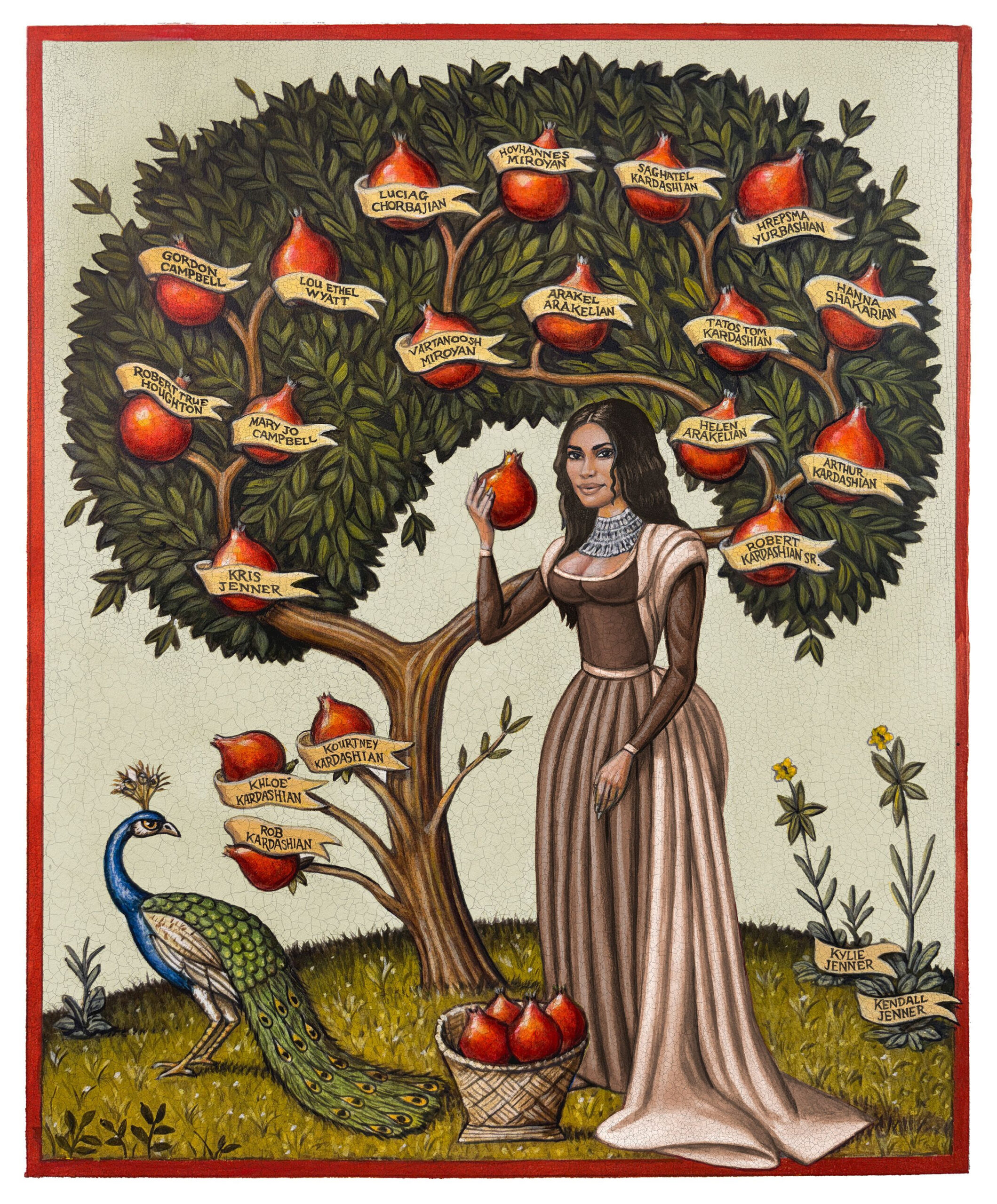
The story of the prophet is one that Robert Kardashian told his daughter over and over when she was a child. His mother’s ancestors were from historic Armenian lands in the Ottoman Empire, and his father’s from those on the Russian side of the border. Kim lights up when she talks about it: “My great-grandparents…came from Armenia, and in their village, there was a boy who couldn’t read or write, and he supposedly went into a trance and wrote two letters. The first letter he said to open but not the second letter. And so the first letter said: Everyone will be massacred; go to Los Angeles, California.… The tale has always been that the second letter can’t be opened until it’s time and that a ‘chosen’ Armenian will be drawn to open it one day.”

GENETIC MAKEUP The Kardashian family, clockwise from top left: Tom, Barbara, Robert Sr., Arthur, and Helen.
Courtesy Kim Kardashian
Watch Now:
Kim’s Armenian grandparents, Robert’s parents, were Arthur Kardashian and Haigoohi “Helen” Arakelian, both born in 1917, Arthur in Los Angeles and Helen in Oakland. It was their parents who settled in California after fleeing Armenia at the turn of the century. By leaving when they did, they managed to escape the Armenian genocide and the surrounding tumult of the First World War and the Russian Revolution. The 30-year Ottoman-Turkish campaign (1894–1924) to remove Christians from the region was the catalyst for the exodus from Armenia—and the reason why so many Armenians landed in Los Angeles. As of the 2020 census, LA held the largest Armenian American community in the United States, as well as one of the largest populations of Armenians in the world outside of Armenia.
Arthur and Helen were married in 1938, at which point his family’s meatpacking company was the largest in Southern California—dirty, hard, profitable work. He was also extraordinarily handsome. I found his draft card from 1940, when he was 22 years old. When I mentioned to Kim that I was struck by how not just handsome but beautiful he was—with Kim’s dark eyes and perfect eyebrows—she said, “He was obsessed with Cary Grant.” She laughed. “He had posters of Cary Grant in his kitchen!” (This tracks.)
But the story that has gotten lost in the mix is about Robert’s mother, Kim’s grandmother, Helen, who made Robert, and Robert begat Kim, who absorbed so much of Helen’s glamour and drive. “My mother was so, so sharp,” Robert’s brother, Tom, tells me. “She was the pusher in the family, always the dominant figure, and she pushed everything from our grades to us becoming the kind of human beings she wanted us to be. It was just her personality, and I think all the kids, but especially Kim, got a lot of that take-charge energy from my mother. And my mother was really enthralled with those girls, each one individually.” Arthur and Helen were together for 70 years. Arthur died at age 95 in 2012; Helen lived to 90, passing away in 2008 (they both lived long enough to see their grandchildren become television stars). Kim has said in many interviews, and from the very beginning of her fame, that “being Armenian is a big part of who I am,” and that her grandparents instilled in her a lot of Armenian values and culture. It is also a big part of how she looks. Kim is “not exactly white,” as some Armenians like to say, including Kim. “This is the struggle of being Armenian,” someone wrote on a Reddit thread in 2024 titled “Do Armenians identify as (white) Europeans or West Asians?” “Not white enough to be white, not Asian enough to be Asian, not middle eastern enough to be middle eastern. So I just say Armenian. But on government forms, I put white (since we are OG Caucasians).” Although Armenia is geographically located in Western Asia, Armenians generally consider themselves either Middle Eastern, or from the Caucasus or Europe.
Perhaps it’s no accident, then, that Kim’s rise to fame in the mid-2000s coincided with the arrival of what The New York Times described as the “ethnically ambiguous” generation. “We’re seeing more of a desire for the exotic, left-of-center beauty that transcends race or class,’’ said the managing editor of Teen People. It ‘‘represents the new reality of America, which includes considerable mixing,’’ she added. ‘‘It is changing the face of American beauty.’’ And the shape. As Kim’s cousin Cici put it, “Kim’s…what? Five feet two? With a body. She’s one of the first to embrace the full, real body.” Kim first visited Armenia in 2015 with Khloé and West on the 100th anniversary of the beginning of the Armenian genocide. The president was busy meeting with Pope Francis, who, on that very occasion, recognized the massacre of Armenians—and for the first time used the word genocide. So Kim got an audience with the prime minister. The trip was filmed for season 10 of Keeping Up With the Kardashians, and Kim was greeted by a teeming throng at her hotel. “We’re used to big crowds,” said Khloé, “but it’s, like, complete pandemonium outside. They’re all chanting Kim’s name.” You could hear it everywhere: Keem, Keem, Keem! One very old woman stood in front of their hotel for two days. When she finally met Kim, she grabbed both of her hands and said, You are the best girl in the world. “I would say our scariest experience was with fans in Armenia,” said Farnaz Farjam, executive producer on KUWTK. “There were so many people on the streets and you could feel the distress, like, this intense energy. It was as if some people thought she was, like, the Virgin Mary, like Kim had come to save them.” I asked Kim what that was like. “It was full-crazy mayhem,” she said. “It felt like the whole town had come out, so it was like an Evita moment, waving to everyone from the balcony.”
When Kim went back four years later with her kids and Kourtney, she had dinner with President Armen Sarkissian at the presidential palace in the capital city of Yerevan. But she was most astonished to learn, from a woman she hired in Armenia to do genealogical research and guide them around the country, that the Kardaschoff branch of the family, from the city of Gyumri, was relatively well-off. “Our family in Armenia—the Kardashians back in the 1800s—had two horse and carriages”—not unlike Robert Kardashian having two Rolls-Royces in his driveway. “And they had a pool,” said Kim. “They were like, ‘No one in Armenia ever had a swimming pool.’” She paused for a moment. “They were ballers,” she said, laughing. “Having two horse and carriages was like having two private jets. You guys were balling.” She laughed harder. “Isn’t that so funny? They told us that our ancestors weren’t just flashy—they were the flashiest. So, the flash is genetic.”
Kim is a potent mix of Armenian prophecy and American dream; magical thinking combined with an immigrant’s work ethic. On her maternal side, this blending of mysticism with commerce takes the form of a candle shop in La Jolla, exotically named the Candelabra, opened by Kris’s mother and grandmother in 1963. Kris worked in the shop as a teenager and pitched in at home in the garage alongside her mother and grandmother, hand-making their most successful innovation, Gloomchasers, or more precisely, “crushed colored glass glued onto a jar, grouted in gold, then polished and placed on teak stands with glass votive candles inside,” wrote Kris in her memoir.
Gloomchasing is key to this family’s mindset: Hopelessness, pessimism about the future, is anathema. They are resolutely un-gloomy and can’t abide it in others. The one thing you never want to be around the Kardashians is a drag. This stubborn positivity has less to do with religious faith and more to do with the belief in oneself. These are tough, independent-minded, proto-feminist businesswomen who emerged as a result of—or despite—their fly-by-night husbands. Four generations of men who either cheated, drank too much, died too young, were abusive, fell into a coma, or became addicted to nitrous oxide. It is a pattern that can feel more like a curse than a prophecy. And yet, with the men out of the way, the matrilineal line has thrived. Gloom be gone!

During World War II, when MJ was about eight years old, Lou saw an opportunity to go bigger: She took a job at a nearby Army base managing the PX, or post exchange, the kind of mini department stores you find on military bases all over the world. Before long, the Army was sending Lou around the country to open and manage PXes, so for several years, Lou and MJ moved from base to base. “I was like an Army brat,” says MJ. They eventually wound up at the mother of all military bases, the Marine Corps Recruit Depot San Diego. “It’s a big, big base,” said MJ. “All the presidents go there to meet the troops, and Lou opened a PX there, hired all the help, counted all the money, she did everything. My mom was a big deal.”
One of the people she hired to work at the exchange was James Fairbanks, “who was busting out of the Marines,” said MJ. A man being hired by a woman, let alone a woman he wound up marrying, was unheard of back then but perfectly in keeping with the dynamic already firmly established in this family—the women call the shots, especially when it comes to business. After a year of courtship, Lou married Fairbanks—MJ finally had a father—and the three of them stayed put and built a life together.
The family drive for moving product manifested in MJ from an early age. “I was very independent,” she tells me. “I think that’s a Southern thing. It came from my mom; it was passed down to me, and then Kris. I never wanted to work for anyone. I wanted to be an entrepreneur.” When she was 15, MJ took a course called Fashionality—Gloria Vanderbilt was her idol, “my inspiration for design, clothes, and everything”—and landed a job working in a department store. “I loved fashion, I loved retail,” she said. And then MJ married her high school sweetheart, Bob, the first boy she ever kissed. “He went to KAY Jewelers and bought me a ring for graduation. And I didn’t even question it. I just put it on and started planning a wedding. My mom went all out. My stepfather, with money from the GI Bill, bought us a house. I loved Bob, he was this beautiful, handsome guy, head of the football team, and I was a majorette. It was perfect, right? It should have been great. But it wasn’t. We just didn’t get along. I was too young and too independent.”
Kim’s ill-advised marriage to basketball star Kris Humphries in 2011 famously lasted only 72 days. MJ’s got her beat. “Two months,” she said, laughing. “I was in it for 60 days and then I threw a skillet at my poor husband and told him to get out.”
MJ kept the house, kept working, and before long met Robert True Houghton, Kris’s father (Khloé’s daughter, True, is named after him), when they were taking classes at the same college. He had just gotten out of the Air Force. Mary Jo was 21 when Kristen Mary was born on November 5, 1955. “He was a really handsome man,” said MJ. “You can tell by my two children that he was a good-looking guy.” I have always wondered why Kendall and Kylie Jenner, fathered by Bruce, look so much like their Kardashian sisters. Could their mother’s genes be that dominant? One day I found a picture of Houghton on the internet, and there he was, at long last—the genetic culprit. He had wide-set, almost black eyes and a dazzling smile. All the Kar-Jenn sisters look, in different ways, like their maternal grandfather.
Sadly, Houghton proved lacking in nearly every other way. For the first few years, “he was very sweet, very nice,” said MJ. But by the time Kris was seven, Mary Jo and Houghton were fighting constantly—he has been described in the tabloids as an alcoholic—and in 1962, he packed his bags and left. Kris saw him occasionally through adolescence—until he moved to Long Beach and they never saw him again. (In 1975, when Kris was 19, he died in a horrific car accident. According to a reported account by his then fiancée, Vicky Thomsen, they had gone to Mexico to get married. After a day of heavy drinking, just south of Tijuana, they decided to drive to another beach town. Houghton, behind the wheel of his Porsche, swerved head-on into a vegetable truck, was impaled by the steering column, and died in a nearby convent.)
Mary Jo’s reaction to being abandoned by an abusive alcoholic? She bought a 1956 red T-bird convertible and opened a shop, naturally. “Anytime I wanted money, I knew what to do: I could go open a store,” MJ tells me—she was Lou Ethel’s daughter, after all. Call it retail salvation. In 1963, she went into business with Lou, and the Candelabra was born. It was on Prospect Street, the oceanside shopping district in La Jolla known as “the Rodeo Drive of San Diego.” The Candelabra was a success, and eventually MJ opened another location of her own on Girard Avenue, next to John’s Waffle Shop.
MJ had opened several other businesses in San Diego: the Tuck Box, an antique shop in a shopping arcade; a bikini shop, which grew into a ladies’ fashion store, MJ Shannon’s; and a high-end children’s boutique called Los Niños. Finally, she opened Shannon & Co, a bigger children’s clothing store that became a La Jolla institution for more than 30 years. That is the store where Kim worked in the summers when she was an adolescent.
One thinks of the difference between the women on Robert’s side of the family, who enjoyed the finer things afforded by their husbands, and Kris’s side, can-do shop owners who sold the finer things: expensive children’s clothing, often worn once; fancy candles, beauty products, bathing suits bought for beach vacations, lady things. This is a world of baby shower gifts, floral scents, and special occasions. It’s about making memories and wish fulfillment—not dissimilar to the products the Kardashians sell today. None of the women on Kris’s side were generationally wealthy, but they had the hustle and social skills and looks to pull it off. And it’s not just the habit of opening shops that gave them a foot in the door to the upper class, but the social intelligence they gleaned on the shop floor. Kris absorbed these maxims at an early age: You have to remember the name and story of every woman who walks in the door; she has to believe that you have the solution to her high-class problem; you must earn her trust. To run a successful high-end boutique, you have to become a cult of personality, because women come back again and again to see you. Kris would use these life skills to one day conquer Beverly Hills society, like only a seasoned shopgirl could. And Kim, the ultimate cult of personality, would redefine what it means to be a shopgirl entirely.
This is Kris’s—and by extension, Kim’s—birthright: shopkeeping. It’s also their love language: opening businesses. This is how they show up for each other. When a child is in dire straits, hang out a shingle. It’s a matriarchal pattern that was set almost a hundred years ago: As men fell apart or died or simply ran out of steam, the women closed ranks, chose each other, and made things happen themselves.
Observing Kim’s operation, a big business that still feels like it’s being run as a family company, I was reminded of a New York Times essay from 2011 by William Deresiewicz, titled “Generation Sell,” in which he describes millennials (Kim, born in 1980, is right on the cusp) as a generation of salesmen for whom “the characteristic art form…may be the business plan.” He considers this shift “less Reaganism…than Clintonism—the heroic age of dot-com entrepreneurship that emerged during the Millennials’ childhood and youth.”
When social media came roaring into our lives, part of the reason Kim was poised to be such an early adopter, a pioneer of the form, its canniest practitioner, and arguably its biggest star, was that she had grown up watching her parents hustle through the earlier iterations of new media.

FAMILY BUSINESS Kris Jenner and Robert Kardashian with Kim’s maternal grandparents, the late matriarch Mary Jo Campbell and Harry Shannon.
Courtesy Kim Kardashian
In those pioneering days of internet 1.0, Kim discovered the potential of commerce-driven platforms like eBay, creating the account kimsaprincess in October 2002, practicing the art of the middleman, just like her father. “I had a little room where I set up a mannequin and a background and my camera, and I would photograph, like, clothes and bags and shoes to sell,” she tells me. “It was like my side hustle. And I remember one time, I said to my dad, ‘I’m obsessed with these Manolo Blahnik Timberland boots that J.Lo wore in her “Jenny From the Block” video.’ And I had a connection at Manolo; she called to tell me five pairs came in. I said to my dad, ‘I’ll sign a contract with you, but can I please, please put them on your credit card? They’re, like, $800 a pair. I will pay you back in three weeks, plus 10 percent interest.’ And he said, ‘Okay.’ And then I sold each pair on eBay for $2,500, because no one could get them. So I made that profit and became obsessed.” It is hard not to see this as the eureka moment in Kim’s young life, when it dawned on her that the internet was a near-frictionless environment for shifting product.
In 2003, Kimsaprincess became the username for Kim’s MySpace page, the social networking site that launched earlier that year, which she customized with a bright pink layout. Only four years later, on February 26, 2007, she formed Kimsaprincess Inc., filing trademarks for clothing, cosmetics, and jewelry (less than a month before the release of her sex tape). From eBay to MySpace to a billion-dollar holding company, Kimsaprincess has included her businesses KKW, SKKN by Kim, Kimoji, and the trademarks for her name and the names of her children.
That year, 2007, was also when she moved her online identity to her own website, kimkardashian.com, which she would use to build on and expand her brand, perfecting the kind of interactive engagement that would soon come to define the social media era. From the start, she referred to her site’s visitors as members, displaying the traffic counter in the footer of her homepage in an era before anyone was thinking about followers. The content included video tutorials; an advice column in which she often divulged details about her personal life on topics such as “Dating outside of your race”; product recommendations (directing customers to her store, Dash); and sponsored posts, videos that feel like an evolutionary link between her mother’s infomercials and the unboxing videos of the influencer culture to come. She even had her own version of livestreaming, which she called Channel Kim.
Kim’s first Instagram post was in February 2012: “I’ll never forget this; I was wearing a pink and white striped robe from Victoria’s Secret. My hair was in a ponytail. I always know my glam—I was sitting in front of my mirror, and we took a picture on my BlackBerry, and I posted something like “Kisses for Instagram!” Like Kris selling Stair Climbers and Zero-G Striders to helpless insomniacs in the desolate wee hours, and Robert, who figured out how to make money from the dead space before the movie started, Kim would instinctively understand the value in filling (and monetizing) people’s bored moments with some sort of minor titillation—glamscrolling, if you will. Fourteen years later, Kim had amassed 344 million followers on Instagram, consistently ranking among the top 10 most followed people in the world. (Joining her in the top 10 were her sisters Kylie and Khloé, with 381 million and 291 million followers, respectively.) Perhaps the cultural mystification over Kim’s ubiquity is seeded right here. Long before almost anyone else had figured this stuff out, Kim was building what would become a gigantic audience in a place where the cultural gatekeepers and most grown-ups just weren’t spending their time. In this way, it’s easier to understand another aspect of how Kim changed things: She is the progenitor of the bottom-up internet star, like MrBeast or Addison Rae.
Kim’s lifelong friend from Beverly Hills, Anthony Schiller, who now lives in San Francisco as cofounder and director of a venture capital firm, says to me, “Early on when Kim was becoming famous—when it was still, Oh, she’s famous for being famous, like it was all some kind of accident—I asked her, ‘Is there any kind of, like, code in this? Is there a blueprint to what you’re doing?’ And she said, ‘You know, the thing is, if you can get somebody to feel like your friend, not your fan, they will always be invested in the outcome of what you’re doing.’ Social media intersected with her life at exactly the right time because she was able to use those channels to engage people in the process: What color should I use? What font should I use? You feel like you’re contributing to the outcome of these products. That then catalyzes the sense of friendship. Who’s not going to buy a product that the customer feels like they have their thumbprint on? To my mind, that’s what separates her from everyone else who’s tried to use their celebrity or their brand equity to launch something comparable to what Kim has done.”
Kim was flattening the space between her and her followers. But there’s more to it. People in Kim’s orbit talk a lot about her uncanny ability to turn haters into followers—her peerless talent for engaging people despite their disinclination or even active dislike. As Kim’s lifelong best friend Allison Statter tells me, just as the family reality show was moving from E! to Hulu, “The subscriptions are gonna go up because they have, collectively—but especially Kimberly—a very loyal fan base and consumer. But I also think they have a very disloyal fan base and consumer, by which I mean, even the haters fucking want it.” I cannot count the number of social media posts—or friends telling me—about how much they don’t want to love SKIMS but cannot stop buying it. I had also noticed that Kim IRL was always asking for my opinion—on, say, her Met Gala costume, or the Rick Owens furniture designs for her new office—pulling me further into her world, making me feel like I was a valued participant and citizen. Nearly everyone I spoke to told me some version of this: that Kim is always asking for their take on things she’s working on or thinking about. In this way, it feels less strategic than constitutional.
At this point, the Kardashians are approaching Sesame Street and General Hospital territory, shows that have run for 50 seasons or more. Come to think of it, that’s not a bad description: Their lives are a soap opera, but they are also kind of Muppety. The longest‐running shows tend to be cartoonish, or actual cartoons—The Simpsons, South Park—because there’s affection there; the characters, no matter what they do, are beloved. During our interviews in Malibu, Kim kept coming back to their reality show; it had clearly been on her mind. “With our new show on Hulu,” said Kim, “it’s just…us. There are no producers telling us to do silly things. Keeping Up With the Kardashians is legendary. But it was just… All the stuff we did, if you think about it, wouldn’t really work today. We couldn’t go to those places. There are too many eyes on us and phones on us. Sometimes I think about that. Sometimes we want to get out of our houses! Film in a restaurant. But it’s really hard to.” She paused and got that wistful look in her eyes. “The really simple things.”
I mentioned I’d just seen a social media post by a young woman who compared the two shows and declared the new one on Hulu superior because “I’m learning what it means to be a business‐woman and to take myself more seriously.” I thought Kim would take this as a high compliment, a ringing endorsement, but she didn’t. “Sometimes I struggle with this because it’s not the most exciting thing to show all the time—our businesses and our photo shoots—but that’s our reality. We have these conversations and I say to my sisters, ‘Guys, do we still want to do this?’ It’s coming up on a renewal. Is this what we want to do? Are we willing to give of ourselves? Because some people just want the drama and the crazy. And sometimes I’m like, ‘We don’t really have the drama and craziness to give.’ Everyone has boundaries now and everyone has kids. When we were shooting in the beginning we had no children. We could pick up and move to Miami for three months. We weren’t that well known, where we could go to a restaurant and not a soul would recognize us. We struggle with that, because I only want to give the best, but I’m like, ‘This is really all we have going on right now.’ Is it boring?”
When Kim launched SKIMS, her now multibillion-dollar business, in 2019, it was, unsurprisingly, as her marriage to Kanye West started to show strain. Like Tiny, Lou, MJ, and Kris, at the first sign of trouble and heartbreak, she started a new company. The SKIMS origin story is one of problem-solving: For years Kim had been traveling with girdles, bras, pantyhose, scissors, and needle and thread, cutting up and sewing back together undergarments—Frankenstein shapewear—to suit her unique body and unusual getups, and then dyeing them with coffee and teabags to match her skin tone. SKIMS bras, bodysuits, briefs, waist cinchers, and thigh slimmers weren’t just inclusive in terms of sizing; they were available in every imaginable shade of skin color. The new venture married the style and entrepreneurship of her Armenian forebears with the shop-floor savvy of her mother’s side (giving the customer something she can’t find anywhere else). By the time Kim’s divorce from West was finalized in November 2022, SKIMS was valued at nearly $4 billion.
Those billion-dollar curves were on full display when, out of nowhere, on a random Tuesday in March 2025, a massive, 60-foot-long inflatable replica of Kim appeared in Times Square. She was in repose in a tiny blue bikini—an obvious nod to Times Square’s inflatable sex dolls of yore. Blow-up Kim was an advertisement for SKIMS’s new swimwear line (we’ve come a long way from Grandma’s bikini shop), but the sheer size felt more analogous to the Great Sphinx of Giza or a reclining Buddha. Even The New York Times, whose Kardashian coverage can be snarky at best, reported with a scholarly awe that would make the feminist cultural critic Camille Paglia proud:
While a good likeness of the original, Balloon Kim did not so much depict a person as it did a commodity, an abandoned outer shell—a product designed specifically for consumption by crowds of people.… By covering her famous face, Balloon Kim refused to return the onlookers’ gaze.…This structure was not a portrait or a sculpture of Ms. Kardashian, but rather a very faithful recreation of the workings of Ms. Kardashian’s empire, which is built on the meticulously crafted project she has made of her body—a collection of highly public, highly exposed curves and spheres, sculpted and polished to perfection…
It is the depiction of a corporate goddess. Indeed, there is something about monumental Kim—her Armenian curves eclipsing the sun—that once again taps into something ancient: an effigy in rubberized vinyl, celestially aligned at the center of commerce, surrounded by hordes of followers.
A prophecy fulfilled.
From Citizen Kim: The Woman Who Created the Future, by Jonathan Van Meter, to be published on October 27 by Viking, an imprint of Penguin Random House. Copyright © 2026 by Jonathan Van Meter.
Audio excerpted courtesy of Penguin Random House Audio from Citizen Kim by Jonathan Van Meter, read by Jonathan Van Meter. © 2026 Jonathan Van Meter, ℗ 2026 Penguin Random House, LLC. All rights reserved.