Garo Ourfalian: From Professional Precision to the Boundless Spaces of the Soul
By Varuzhan Balyan
Member of the Union of Journalists of Armenia
Los Angeles, USA
Garo Ourfalian, who lives in Los Angeles, is an artist and dentist.
Born in Lebanon, Garo began drawing at an early age. Over the years, his pursuits and the paths of his life have changed, but painting has remained his most enduring passion.
Today, he continues to create, and painting is an inner necessity for him — a means of exploration and self-expression. Garo notes that his art has also been influenced by the multicultural environment of Southern California, where there are different cultures and worldviews.
A doctor cannot leave anything to chance: even a millimeter matters; the hand must be steady, the movement precise, and the result as predictable as possible. An artist, however, can allow himself exactly the opposite — to stand before a blank canvas without yet knowing where he will arrive, and to let one line give birth to another, color to a figure, and the figure to a memory or a question whose answer perhaps even he himself does not have. He himself says that he does not decide in advance either the subject or the meaning; rather than planning the painting, he discovers it in the process of creating.
In Garo, these two worlds do not reject one another but complement each other. The doctor’s hand seeks precision; the artist’s, freedom. One has learned to notice those small changes in the body that an ordinary eye might not see; the other, those movements within a person that sometimes cannot even be expressed in words.
Ourfalian seems to paint not so much what a person shows to the world as what a person usually hides within.
Recently, Ourfalian’s solo exhibition “Before the Entropy” was presented at TAG Gallery, located on Museum Row along Wilshire Boulevard, one of Los Angeles’s important cultural districts.
“Entropy” is a scientific concept that describes the transition from an ordered state toward disorder. But in Garo’s art, it moves beyond the boundaries of physics and becomes a reflection of the human psychological state.
Ourfalian himself explains the idea in a talk given in connection with the exhibition: “I use the concept of entropy to explain the human psyche, because we go through not only physical entropy, but mental entropy as well. Today, the constant flow of information, especially in the age of artificial intelligence, disrupts our inner balance. We often do not realize it until something shocking happens to us — a divorce, a failure at work or an illness. That is when entropy hits us.”
He then adds a sentence that, in essence, reveals the conceptual key to the entire exhibition: “I tried to depict in each painting one of the stages of entropy that a human being may go through.”
Before chaos, there is still a moment. Garo paints precisely that moment.
Perhaps that is why, in his canvases, bodies so often alter their natural proportions, split apart, stretch, or merge; faces sometimes disappear; wings grow on people; a book appears in place of a head; a cage surrounds memory; time is found inside a cup of coffee; and a chess game turns into a symbol of life. At first glance, this is a strange, at times, even unreal world, but the longer you look, the more you understand that there is nothing all that foreign there. For within those strange figures live feelings familiar to all of us — loneliness, fear, fatigue, inner duality, memory, the transience of time, but also hope. In his paintings, hope is hidden in a small sign — a wing, a bird, light, a flower, or simply in the fact that the person is still there.
Loneliness Among People: “Loneliness” At the center of the painting sits a woman. Around her, small human figures move, pass by, disappear, and seem almost to repeat themselves. Behind her is a large yellow disc, bright like the sun, yet that light does not dispel the woman’s isolation.
She is alone, but not in emptiness. There are people around her. It is that state in which a person may live among others, speak, work, smile, and yet inwardly remain in a space no one can reach. Garo does not explain that feeling. He simply places the woman before us and lets us to recognize that silence ourselves.
In another work, “You Are Not Defeated, You Are an Angel,” a blue-green figure sits with its head bowed. There is something in its posture that resembles defeat — fatigue, heaviness, perhaps even despair. But there are wings behind its back.
To be bowed is not yet to be defeated. To be tired is not yet the end. To be wounded does not mean to lose the ability to fly. Here Garo seems to be speaking not so much to his figure as to each of us. The artist gives it another name — angel. Therein lies one of the emotional strengths of Garo’s art. He does not beautify pain, but neither does he allow pain to have the final word.
“No Time to Live” has an entirely different tone — ironic, even somewhat unsettling. On the humanoid figure’s head is an open book; the body seems transformed into various mechanisms and forms; all around it are movement, knowledge, work, action.
Everything is there — except time to live. And suddenly that fantastic figure becomes intensely contemporary. We study, work, plan, earn, reach the next goal, and sometimes become so occupied with organizing life that life itself passes us by. Garo’s irony here does not provoke laughter. Rather, it raises an uncomfortable question: “And when are we going to live?”
Time Without a Clock: “Time” In the painting, an ordinary coffee cup appears in an almost dreamlike space. Above it is a cage, from which drops fall into the cup; black birds fly nearby; in the center is a fragmented human silhouette; below, a setting sun.
It is visible in the drop, in the departing bird, in the setting sun, in the changing human body. We usually measure time in minutes and years. Garo seems to suggest the opposite—to measure it by the trace it leaves on a person. Perhaps the most accurate clock of time is the human being himself.
Two Selves: “Duality” In “Duality,” the two figures seem to live within one another. Behind the young man in front is a heavy, dark face; the bodies intermingle, the hands intersect, and it is difficult to tell where one ends and the other begins. But it is far more interesting to read it as the meeting of two selves living within one person — the one we present to the world, and the other that remains with us when the world has gone away.
In Garo’s own life, this duality also has an intriguing parallel: medicine and art, science and intuition, discipline and freedom. He lives between them.
The title of “Don Quixote and Me” already sounds like a confession. Don Quixote stands near his windmill, Sancho Panza is there, and before them stands a modern man. But the most important thing here is the phrase “and me.”
For centuries, Don Quixote has moved us and made us laugh for the same reason: he saw what others did not see, and he struggled at the very moment when others advised making peace with reality.
Garo does not leave him on the pages of literature. He places himself beside Don Quixote. And suddenly the question becomes about all of us. Which of us does not have his own windmill?
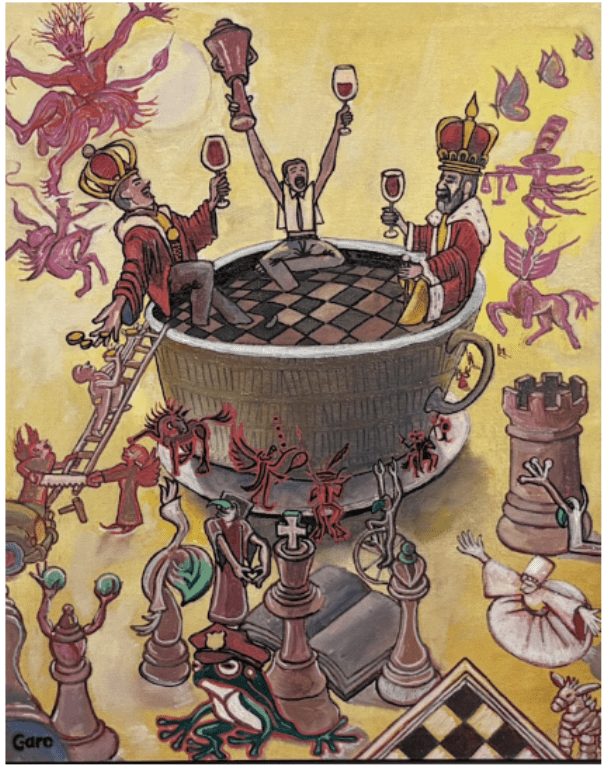
The Game in Which We All Have a Role: “The Game” In “The Game,” chess is no longer merely a game. Kings, pieces, stairways, human and strange figures, symbols of victory and power — all are part of one system. Some are players. Some are pieces. Some perhaps do not even know that they themselves are being played. Here Garo is more ironic, at times raising social and philosophical questions, yet once again he refuses to give us a ready-made answer. Who writes the rules? Who is the real player? And is the one still standing at the end of the game always the winner?
According to Garo, his habit of questioning ready-made answers goes back to childhood. At the age of ten or eleven, in one of his Bible classes, he heard two contradictory ideas: God created both evil and good, yet everything created by God is good. That contradiction stayed with him for years, and from that very time taught him to ask questions about religion, science, and philosophy. Perhaps it is precisely from there that the questioning nature of his art arises. There are many symbols in Ourfalian’s paintings, but there is no explanatory dictionary for them. He does not instruct the viewer how to understand the canvas. The artist completes the painting, but not its meaning. That is continued by the viewer.
Garo himself formulates the purpose of this exhibition with a simple yet unsettling question: “I want the viewer to ask himself: what is true in me when entropy hits? What is real in our life when we go through shocks?”
One person will see himself in “Loneliness,” another will see someone long lost. For one viewer, the cage in “Time” will be the past; for another, everyday life. The painting “You Are Not Defeated, You Are an Angel” may speak to one person of pain, and to another of salvation.
This is precisely where the miracle of art lies: the same painting hangs on the same wall, yet each person takes home their own painting.
For Garo, “Before the Entropy” is not merely the title of an exhibition. It is a space for reflection — on the human being, time, memory, and salvation.
His figures often have no eyes, sometimes no face, sometimes not even a complete body. Yet, strangely enough, it is precisely these people who compel us to look more attentively at the human being. And perhaps at ourselves as well.
Ourfalian’s “Before the Entropy” exhibition recently closed its doors, but the most important life of a good exhibition often begins precisely afterward-in memory, in conversations, in the first still-invisible line of the next painting.
Garo’s art cannot be exhausted in a single glance. One has to stand before his paintings, because a second look may reveal what the first failed to notice.
And we would like to believe that “Before the Entropy” is not the high point of his creative journey, but rather a platform for a new ascent.
For an artist like Garo, we would like to wish what is perhaps the most precious gift for a painter: inexhaustible inspiration, creative courage, and the restless need to create new works. May his paintings move beyond the boundaries of already familiar exhibition spaces and find their place in prestigious galleries around the world. Because the path of true art does not end at a wall.
The wall is simply the place where a painting pauses for a moment before its next journey.
May the doctor’s precise and confident hand continue for many years to restore health to people, while the artist’s hand, knowing no boundaries, continues to open the immeasurable spaces of the soul — spaces that no unit of measurement can measure.