How Armenia’s Church and government conflict challenges secularism
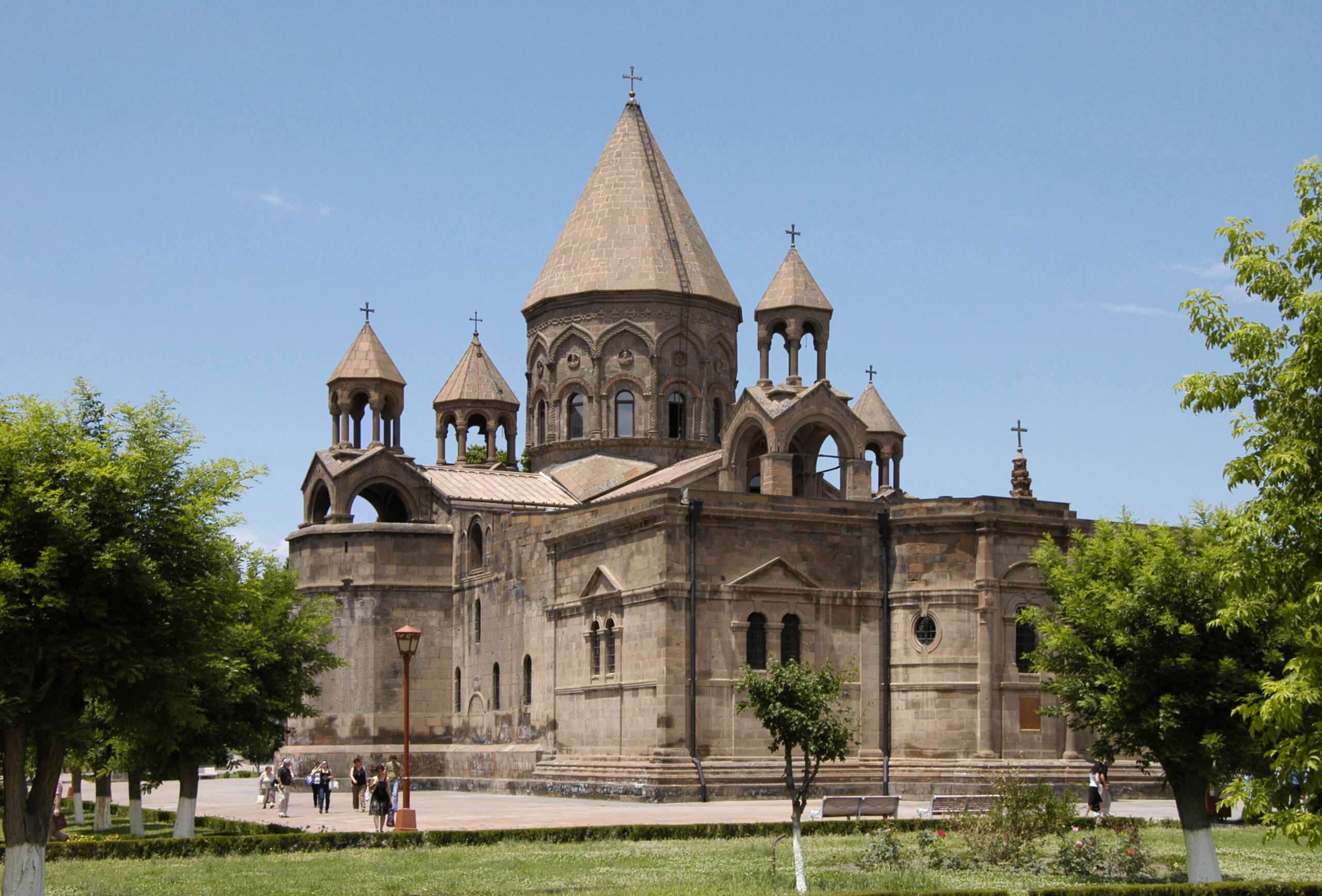
From May onward, Pashinyan has repeatedly urged the Catholicos to step down, framing his demands as part of what he described as the “cleansing of the church.” In December, the prime minister went further, unveiling what he called a roadmap for the “restoration” of the Armenian Church after the removal of Karekin II. The proposal envisioned the creation of a provisional governance structure within the Church, the adoption of a Church Code of Regulations, and the election of a new patriarch.
The conflict has sparked widespread debate in Armenia, with frequent references to the constitutional principle of separation between church and state.
Church and the Constitution
The separation of church and state is part of the broader concept of secularism that emerged after the late-18th-century American and French revolutions, shaped by opposition to the English episcopal system and the authority of the English crown.
The First Amendment to the U.S. Constitution explicitly states that Congress shall make no law respecting an establishment of religion. This contrasts with the United Kingdom, where the monarch is the head of the Anglican Church.
The Armenian Constitution guarantees the freedom of activity of religious organisations and formally separates them from the state (Article 17), while at the same time recognising the Armenian Apostolic Church’s exclusive mission as a national church in the spiritual life of the Armenian people, as well as in the development of national culture and the preservation of national identity, with relations between the state and the Church regulated by law (Article 18).
Beyond its own Constitution, Armenia is bound by obligations stemming from its membership in the Council of Europe, including compliance with the European Convention on Human Rights and relevant case law. Council of Europe standards explicitly protect the autonomy of religious organisations, treating them as beneficiaries of freedom of assembly.
“The right of believers to freedom of religion encompasses the expectation that the community will be allowed to function peacefully, free from arbitrary State intervention,” one such guide says.
Response from Armenia’s civil society
The standoff between church and government leaders has prompted a strong reaction from civil society. Last month, a dozen NGOs, along with numerous Armenian intellectuals and civil society figures, issued a joint statement condemning the government’s actions, citing “a gross breach of the autonomy of the Armenian Apostolic Church.”
“The authorities’ unlawful and unacceptable attempts to influence the formation of ecclesiastical governance bodies and internal decision-making processes are deeply concerning. Equally unacceptable are attempts to arbitrarily edit or alter the Church’s centuries-old traditions, rites, sacraments, canonical order, and other domains of ecclesial life,” the appeal said.
Days before the joint civil society statement, ten regional archbishops and bishops effectively sided with the government by signing a joint address to Catholicos Karekin II, asking him to step down. Although the address came from the clergy itself and was written in a far less harsh language than Prime Minister Nikol Pashinyan’s public rhetoric, many observers still found it problematic.
The line between ethics and legality
Isabella Sargsyan, an international expert on freedom of belief, says that according to international legal practice and Council of Europe guidelines, the state cannot interfere with religious affairs and must not give preference to one group over another within any religious organization.
Speaking to CivilNet, Sargsyan added that “whenever a national security service meddles with religious life, when certain priests are being pressured, when details of private life of priests are being leaked online, it is against international law.”
Since last year, Prime Minister Nikol Pashinyan has begun attending Sunday liturgies across Armenia, something he had not done before and which many see as a way of backing clergy aligned with him in his clash with the Catholicos. In Sargsyan’s view, this creates an ethical rather than a legal problem.
“As long as Armenia is a secular state, it is somewhat strange when the head of the state gets deeply involved in religious affairs. It is not illegal, though. So, when we see the head of the state attending liturgies every Sunday, siding with one particular religious organization, it is questionable in terms of state impartiality and non-discrimination to other religions,” she said.
Sargsyan also noted that while the government has become more deeply involved in religious ceremonies, it is at the same time moving to cut certain Church privileges, such as tax exemptions.
What the Church is allowed and not allowed to do
The principle of secularism not only limits government interference in church affairs but also restricts the Church from intervening in secular domains such as education, public morals, and social policy. Its purpose is to prevent religious organisations from imposing their preferences on the state and shaping citizens’ daily lives through religious norms, as seen in some countries governed by Sharia law. It is, however, not the case in the ongoing conflict between the government and the church, and it does not mean clerics have no right to be involved in political affairs altogether.
“They cannot perform state functions such as deciding on state policies, for example, with abortion laws or religion-based education – that’s what the law says. But at the same time, every clergyman has equal rights and opportunities as any other citizen, such as running for office, voting, and expressing political views,” Isabella Sargsyan explained.
According to her, there is no constitutional or legal prohibition preventing members of the clergy from participating in politics. Religious organisations can freely express opinions on political, social, ethical and other issues using the rights to freedom of speech and expression, as long as those are in line with Armenia’s Constitution.
Clerics have no immunity
Several members of the clergy were arrested and, in some cases, convicted last year. Archbishop Bagrat Galstanyan, who led nationwide protests and called for the removal of Prime Minister Nikol Pashinyan’s cabinet in 2024, was charged in June with plotting an armed coup and preparing a terrorist attack.
Bishop Mkrtich Proshyan, a nephew of Catholicos Karekin II, was accused of coercing subordinate clergy to attend anti-government demonstrations in 2021, an offence under Armenian law. Another senior cleric, Archbishop Mikael Ajapahyan, was sentenced to two years in prison in October, found guilty of calls for a violent change of government. All three deny the accusations and consider them politically motivated.
Isabella Sargsyan stressed that Armenia’s law enforcement and courts operate under criminal law and that all individuals are equal before it.
“For sure, the clergy has no immunity.” As long as criminal charges are evidence-based and are in line with the principles of the rule of law, they equally apply to all citizens, including clergy of any religious organization.
At the same time, many human rights lawyers have raised concerns about the prosecutions, pointing to alleged breaches of the presumption of innocence, selective enforcement, and disproportionate punishment. In Ajapahyan’s case, critics note that similar convictions in other instances have typically not resulted in prison sentences.
As the rift continues, it remains detrimental to Armenia’s public discourse and contributes to further polarisation within society. In a carefully balanced statement last month that avoided siding with either party, the Armenian General Benevolent Union, one of the diaspora’s largest organizations, argued that easing tensions would benefit both the authorities in Yerevan and Armenians worldwide. It also stressed the importance of clearly defined boundaries between state and church governance.