
How did Pashinyan cause Armenia to fall under Azerbaijani-Turkish domination?
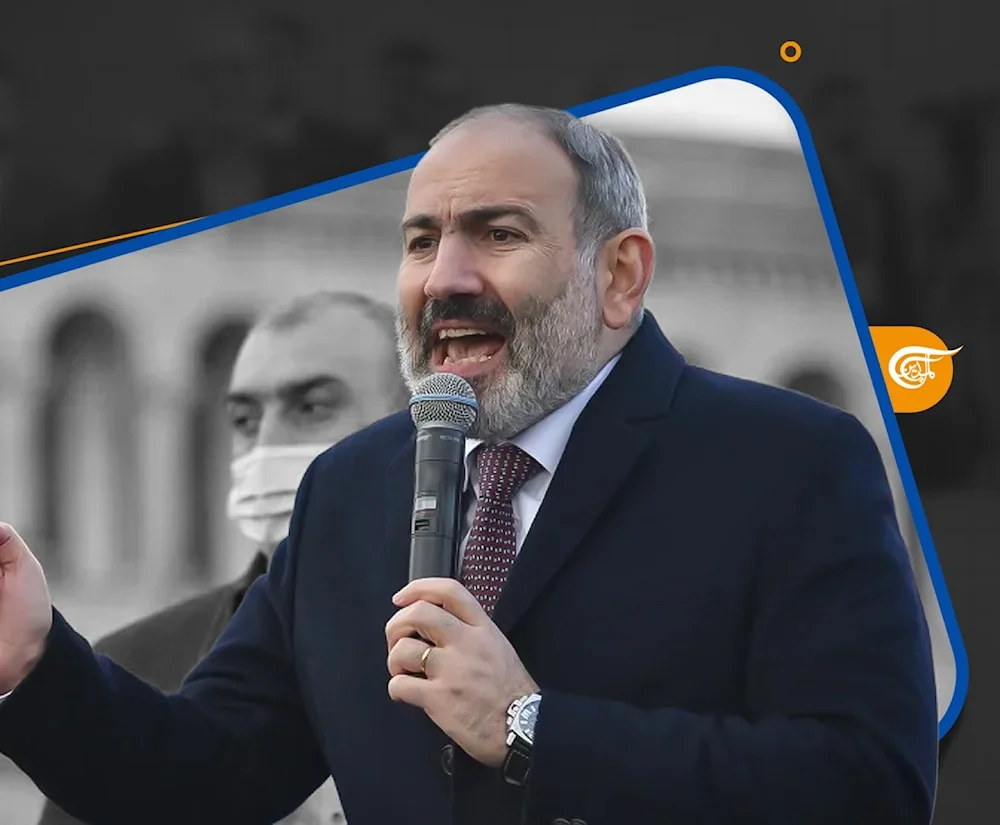
By Jamal WakimProfessor of International Relations History at the Lebanese UniversityAl Mayadeen
Turkey is preparing to launch its project to play a dominant role in the Central Asia region, after its ambitions to play this role in the Arab region failed, despite winning a share of influence in Syria, Libya, Sudan and Somalia.
As a result of its interests clashing with those of a large number of Arab states, Washington decided to withdraw its leading role in the Arab region and entrust it to Israel, and to compensate Ankara by granting it a dominant role in the South Caucasus and Central Asia region in a way that achieves American goals of penetrating through Turkey into the backyard of Russia and China and striking at the “Belt and Road” initiative, a major line of which passes through the Central Asia region.
Pashinyan: The West’s tool in the South Caucasus
It is worth mentioning that preparations for this role had begun years earlier by sponsoring Nikol Pashinyan’s rise to power in Armenia after a US-sponsored color revolution. The aim of this was to move Armenia from the position of a strategic ally of Moscow to the position of an adversary in order to encircle it from the south, while at the same time sponsoring a “neo-Nazi” regime in Ukraine in order to use it as a tool to strike deep into Russia.
Pashinyan, who was groomed by American circles in the same institutions that contributed to the production of Zelensky in Ukraine, Guaido and then Machado in Venezuela and Saakashvili in Georgia, was ready to play this role, even though it came at the expense of Armenian national security, which Russia had been the main guarantor of since Moscow’s protection of Eastern Armenia from the danger of Turkish invasion and genocide that the inhabitants of Western Armenia were subjected to, through the time of the Soviet Union, up to 2018 when Pashinyan’s rise to power constituted a violation of this legacy.
The first thing Pashinyan did was to distance himself from his natural ally, Russia, in addition to distancing himself from his second ally, Iran, and opening up to good relations with Ankara based on American dictates.
As a result, Armenia’s position became weak in the face of its enemies, which represent an existential threat to it, namely Turkey and Azerbaijan, which considered Armenia to be a geographical obstacle in the way of their geographical connection in order to open the land route from Turkey to Azerbaijan and from there towards the eastern bank of the Caspian Sea towards the Republic of Turkmenistan as a prelude to the penetration of Turkish influence in the Central Asian republics as a prelude to the penetration of American influence in this region in order to harm Russian national security and Iranian national security.
How did Baku exploit the Armenian transformations?
While Pashinyan was doing that, Azerbaijan was preparing for war in order to seize the Nagorno-Karabakh region, which Armenia had liberated in the early 1990s.
In 2020, under Pashinyan’s policy of weakening the Armenian army as the Armenian institution supporting a close policy with Moscow, Azerbaijan launched a war against Armenia, through which it was able to seize large parts of the Nagorno-Karabakh or Artsakh region.
Baku benefited from the neglect suffered by the Armenian army at the hands of Pashinyan, in addition to Turkish support for the Azerbaijani army, especially with regard to the use of drones and modern technology, in order to achieve a clear and decisive victory over the Armenian army.
Moscow tried to contain the Armenian losses as much as possible by intervening to sponsor a ceasefire, but its task was difficult in light of the deep damage inflicted on the structure of power and the Armenian army under Pashinyan.
In an attempt to evade responsibility, Pashinyan sought to blame Russia for not intervening militarily on his side, knowing that he had previously distanced himself from Moscow and adopted policies that led the Russian leadership to doubt his intentions. Moreover, the Collective Security Treaty Organization, which includes Armenia and Russia, had no right to intervene in the conflict, given that the Artsakh region was legally considered a rebellious Azerbaijani territory according to the United Nations.
As a result of Pashinyan’s negative stance towards Moscow, Azerbaijan felt that Armenia was distancing itself from its most important ally, which strengthened its position and led it to launch a new war against Armenia in May 2021 with the explicit support of Turkey and the implicit support of the United States, which led to Azerbaijan’s occupation of large parts of Armenian territory.
Ironically, Pashinyan decided not to confront the Azerbaijani invasion with military force and instead resorted to mediation by the United States, which led many in Armenia to accuse him of colluding to cede Armenian lands in order to allow Armenia to open a land route through Armenian territory towards Turkey to secure land communication between Türkiye and Azerbaijan.
What reinforced these accusations was Pashinyan’s later signing of an agreement with Azerbaijan and Turkey, sponsored by US President Donald Trump at the beginning of his second term, with the aim of establishing the Zangezur route from eastern Turkey through Armenian territory towards Azerbaijan, which would lead to the establishment of a bridge linking Turkey and Turkmenistan, and allow Washington to extend its influence across the South Caucasus towards Central Asia.
Strengthening ties with the West at the expense of Armenian sovereignty
In parallel, Pashinyan was reorienting his policies to strengthen ties with the West. Yerevan intensified its contacts with the United States and the European Union, even participating in military exercises with the United States at a time when it was reducing its security cooperation with Moscow, albeit at the expense of Armenian national security.
At this time, Baku was intensifying its efforts to dominate Armenia in coordination with Turkey, aiming to strengthen their geographical connection at the expense of Armenian territory. Azerbaijani President Ilham Aliyev went so far as to openly declare his intentions when, at a European summit attended by both Azerbaijan and Armenia, he announced his plans to establish regional corridors and solidify geopolitical arrangements with Turkey through Armenian lands. This sparked widespread concern among Armenians, prompting them to voice their opposition to Pashinyan, who was present when Aliyev delivered his speech. Pashinyan’s silence was interpreted as tacit acceptance of sacrificing Armenian sovereignty and even part of Armenian territory in exchange for Western political and economic support. This led many Armenian allies to declare that Armenia had become a Turkish colony.
In September 2023, Azerbaijan carried out a swift military operation that effectively ended the existence of the Armenian separatist entity in Nagorno-Karabakh, leading to a mass exodus of tens of thousands of Armenians from the region to Armenia.
This development came as a major shock to Armenian society, as many felt that the government had failed to protect the Armenian population in Karabakh or to secure international guarantees that would prevent the collapse of the humanitarian and political situation there.
The opposition also accused Pashinyan of practically paving the way for abandoning the region through his repeated recognition of Azerbaijan’s territorial integrity within the former Soviet borders.
As a result, opposition to Pashinyan’s government intensified within Armenia, prompting him to respond with repression. In this context, Pashinyan abandoned the slogans of democracy and freedom of expression that formed the basis of the political discourse that brought him to power in 2018 through a Western-backed color revolution. He sought to manipulate the judiciary and security apparatus to launch a campaign of arrests against opposition figures, in addition to attempting to restrict freedom of the press and expression, especially since criticism also extended to the rampant corruption within his inner circle.
Local and international reports indicate a worsening of administrative and economic corruption within Armenian state institutions since Pashinyan took power in 2018, in addition to bribery, nepotism, political manipulation of the judiciary, and a decline in transparency. Pashinyan has tried to cover all of this up by adopting a populist, anti-Moscow rhetoric that blames Moscow for everything Armenia is suffering from, including the loss of territory to Azerbaijan.
Transformations that reflect an existential crisis?!
This Armenian shift reflects a deep crisis related to Armenia’s position in the new international order, which is undergoing a transition from a unipolar system to a multipolar system, witnessing the rise of Russia and China in the face of American hegemony.
In the midst of this pivotal moment, Pashinyan’s choices come as a surprise, as instead of taking advantage of the rising role of Russia, which has been the primary refuge for Armenians for a century and a half, he has chosen to align himself with a power whose influence in the world is waning, namely the United States and the West, even if this means sacrificing structural and vital interests for Armenia.
In this context, we find that Pashinyan is participating in a summit between the European Union and Armenia, making statements attacking Moscow, and signing a joint declaration with Brussels that includes a clause claiming “respect for the rules-based international order,” which observers consider to be part of the West’s soft rhetoric to justify geopolitical interventions.
These observers believe that Pashinyan’s actions are increasing Armenia’s dependence on the West instead of adopting a balanced policy that could safeguard the vital interests of Yerevan and the Armenian people. A segment of the Armenian elite fears that Pashinyan’s policies will strain relations with Russia, potentially leading to Armenia losing its most important military and strategic ally.
Russia maintains a military base in the Armenian city of Gyumri and is a major economic partner and a key source of energy and remittances for Armenia. Therefore, any complete break with Moscow could have serious economic and security repercussions for the Armenian state.
A summaryExperience shows that the policies adopted by Nikol Pashinyan since he came to power in Armenia until today have led to a serious erosion of the elements of Armenian national security, the loss of Artsakh being one of its most important manifestations.
The loss of the region, and subsequently the loss of additional Armenian territory, revealed profound strategic shifts in the South Caucasus. Armenia’s ability to impose the old power dynamics diminished, while Azerbaijan strengthened its regional position, benefiting from Turkish support and its growing importance as an energy supplier to Europe.
At the same time, Russian influence in the region is facing unprecedented challenges, while the West seeks to expand its political and economic presence in the Caucasus. The current debate within Armenia concerns not only Pashinyan’s responsibility for the loss of Artsakh but also the future of Armenian national identity and strategic alliances.