How the fantasy ‘Fustuk’ blends food, Armenian heritage and Japanese manga
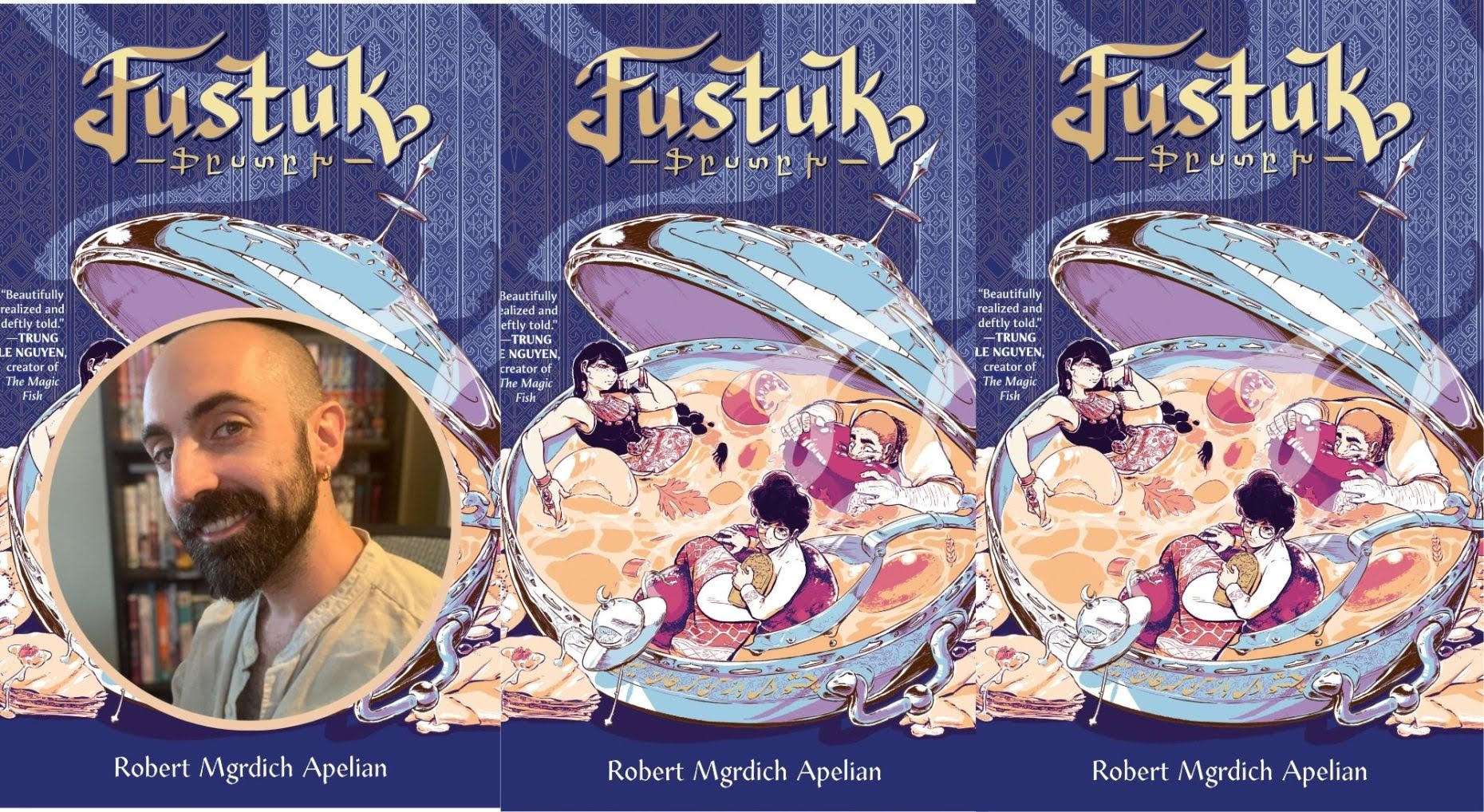
Robert Mgrdich Apelian’s fantasy graphic novel is inspired by the Persian Empire of the 1400s and 1500s.
Drawing pictures of food is its own form of art, and it’s one that Robert Mgrdich Apelian mastered while working on his first graphic novel, “Fustuk.”
“It’s very difficult to draw appealing-looking food,” says Apelian on a recent video call. “I did a lot of practice to make sure that I could draw something that looked tasty, especially with the monochromatic palettes that I use in ‘Fustuk.’”
A fantasy about a family of cooks tasked with using their culinary skills to impress a spirit, or div, who might save their mother’s life, “Fustuk” is a tale in which the stews are action-packed and the desserts ooze drama.
In preparation to create the book, Apelian studied cooking manga, a genre of Japanese comics that incorporates food into the plot. He embarked upon a monthlong drawing challenge that focused solely on food. All of this was essential to telling the story, not simply because Apelian himself loves to cook, but because food is a “product of the experience” that helped shape “Fustuk.”
Of Armenian heritage, Apelian drew upon family recipes for some of the book’s pan-Middle Eastern menu.
“My grandma would make [knafeh] in a big casserole dish, and it would be hot and crispy with a ton of cheese, this big melty thing,” Apelian recalls. “So that’s how I drew it.”
The author’s relationship with his cultural identity plays into “Fustuk” as well.
“Growing up, I had a lot of internal debate about my tie to Armenian culture, I think, because my family was pretty assimilated,” says Apelian, who grew up in New Jersey and Maryland and is now based in Massachusetts.
The setting of “Fustuk” is the Pars Empire, which is modeled roughly on the Persian Empire of the 1400s and 1500s. The book’s protagonist, Katah Fustukian, whose first name is a reference to a type of cookie known as gata or kata, struggles to maintain his heritage while living in another culture. (“Fustuk,” by the way, means pistachio.)
In this fantasy world, the Fustukian family is Hye, a minority ethnic group. In our real world, Hye is, literally, the Armenian word for an Armenian person. Apelian wanted to tell a story where he could “talk about Armenians as a minority in a kingdom and not make it a story completely about oppression.”
He notes that Armenians in the Persian Empire had “a bit of a friendly relationship” during this time in history.
“Granted, it’s a fantasy setting, but it’s pretty historical, so it felt easier to write about that,” he says. Plus, the two cultures have overlapping ancient mythologies that could be incorporated into the story’s fantasy elements. Apelian describes his basic premise for world-building this way: “We take the real historical world, but what if these ancient mythological stories were true.”
SEE ALSO: “Saga” creator Brian K. Vaughan looks back at 10 years of the graphic novel
While “Fustuk” is rooted in Middle Eastern cultures, its narrative and artistic style are heavily influenced by manga. Like many who grew up at the dawn of the millennium, Apelian has read a lot of it.
“I grew up reading almost exclusively manga, and I still read a boatload and try to collect where I can,” he says.
“One Piece,” the Japanese comic series that has been running since the late 1990s and is now a global sensation, has been a favorite ever since Apelian was introduced to it through a Scholastic Book Fair. “My sister and I would read these together to keep up to date,” he says. “I’ve been up to date, reading every week when the chapters come out, for, I think, 20 years now.”
“Witch Hat Atelier,” a decade-old series that has won prestigious Harvey and Eisner awards, is another. “I think that has my favorite art in all of comics,” he says, noting that he took inspiration from the manga’s nods to art nouveau and melded it with Armenian and Persian design elements in his own art.
Moreover, a number of fantasy manga series, like “Inuyasha,” have successfully merged history and mythology, and their popularity in the U.S. has helped introduce American young people to culture and traditions they might not otherwise learn.
“I now have a pretty good understanding of some Japanese mythology just from reading manga and playing video games,” says Apelian. “I think it helps build empathy.”
And that’s something Apelian would like to see happen for Armenian and other Middle Eastern cultures.
“I think that we’re so accustomed to a European fantasy in the same time period,” he says, “so I like the idea of establishing this world. I intend to keep using it to keep making more books, sticking in the same world and time period. There’s so much interesting history to portray there.”