INTERMEZZO AT 1 PM: Celebrating Alexander Arutiunian
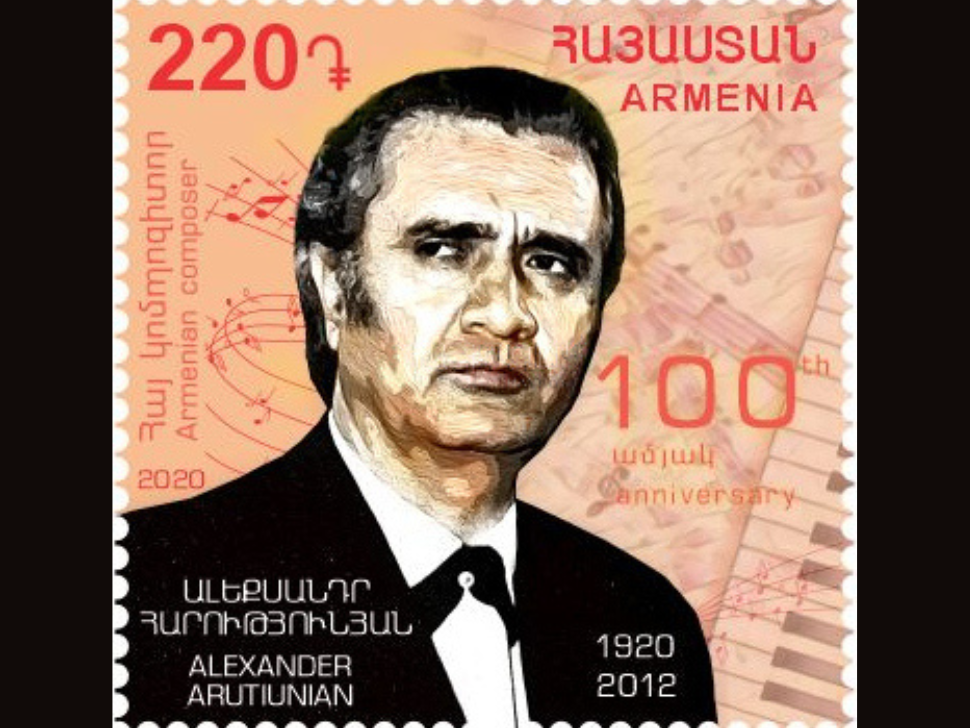
All this week, from Monday, September 21 through Friday, September 25, the 1 p.m. hour on Classic 107 will feature the music of Armenian composer Alexander Arutiunian, culminating on Wednesday with a celebration of his birthday.
Born in Yerevan on September 23, 1920, Arutiunian became one of the most important Armenian composers of the 20th century. He studied piano and composition at the Yerevan Conservatory before continuing his studies in Moscow with composer Genrikh Litinsky from 1946 to 1948. After returning to Armenia, he became an important figure in the country’s musical life, working as a composer, teacher and artistic director.
Arutiunian’s music combines elements of Armenian musical traditions with the techniques of 20th-century classical composition. Armenian melodies, dance rhythms, modal harmonies and the expressive character of folk music are woven into works that also draw on classical and neo-classical forms. His music can move from energetic rhythmic writing to long, lyrical melodies, often with a strong sense of colour and instrumental character.
Over his long career, Arutiunian wrote concertos for numerous instruments, orchestral works, chamber music, vocal works and the opera Sayat-Nova. He was also particularly interested in brass instruments and wrote concertos for trumpet, horn, trombone and tuba. His 1950 Trumpet Concerto became his best-known composition and has become part of the international trumpet repertoire.
Throughout the week, we will hear five works that demonstrate the variety of Arutiunian’s musical language.
Monday, September 21
Suite for Clarinet, Violin and Piano
Performed by the Amici Ensemble
The week begins with Arutiunian’s Suite for Clarinet, Violin and Piano, a chamber work commissioned by the Verdehr Trio and premiered in 1992.
The Suite is written in four movements, each offering a distinctly different mood. The opening Introduction is dark and sentimental, establishing an expressive atmosphere before the music moves into the more playful Scherzo.
The third movement, Dialog, is more sombre and melancholic, with the clarinet and violin placed in conversation with one another. The movement leads directly into the Finale, which introduces an energetic rhythmic pattern built around a distinctive 3+3+2 grouping.
The Finale’s rhythmic drive is interrupted by a lyrical melody before the energetic material returns for the conclusion. Throughout the work, Arutiunian’s musical language remains rooted in Armenian melodic character.
The Suite demonstrates Arutiunian’s ability to bring his Armenian musical identity into an intimate chamber setting, while giving each of the three instruments an important role in the musical conversation.
Tuesday, September 22
Violin Concerto “Armenia-88”
Performed by Ilya Grubert, violin
Tuesday’s selection is Arutiunian’s Violin Concerto, known as “Armenia-88.” The work is dedicated to violinist Ruben Agaronyan, who was the first performer of the concerto in Armenia and Europe.
The concerto was written following the devastating Spitak earthquake in Armenia. Rather than attempting to portray the disaster directly through musical effects, Arutiunian responds to the event through the emotional character of the music. The work is marked by what the supplied research describes as a noble sense of grief, combined with elements of neo-baroque and neo-romantic writing.
The concerto is divided into four movements. The opening movement combines classical harmonic thinking with colourful modal writing and chords built on fourths. The second movement, an Allegretto, takes the form of a toccata, with pulsating quavers throughout the orchestra and rhythmic characteristics inspired by Armenian men’s dances.
The third movement, Adagio recitativo, serves as the lyrical centre of the concerto. The solo violin takes on a monologue-like character, functioning almost like an aria without a traditional cadenza.
The final Allegro molto becomes a perpetuum mobile, with the principal theme moving between the soloist and other instruments. The concerto ultimately brings together neo-classical and neo-romantic elements with Armenian musical influences.
Wednesday, September 23
Sinfonietta for String Orchestra
Performed by the Moscow Chamber Orchestra, conducted by Constantin Orbelian
Wednesday is Arutiunian’s birthday, and we mark the occasion with his Sinfonietta for String Orchestra.
Written in 1966, while Arutiunian was also working on his opera Sayat-Nova, the Sinfonietta takes a very different musical direction from the opera. The work can be described as an example of Armenian neo-classical music of the 1960s, while also reflecting Arutiunian’s individual compositional style.
The Sinfonietta is arranged in four movements: Prelude, Arioso, Intermezzo pizzicato and Finale. The overall structure has connections with the early classical suite.
The opening Prelude establishes the neo-classical character of the work. The second and third movements create contrasting sides of the same musical image. The Arioso has the character of a nocturne, while the Intermezzo pizzicato takes the form of a scherzo.
Armenian melodies and syncopated rhythms contribute to the national character of these movements. The Finale is the largest movement of the work, driven by motor rhythms and making full use of the string orchestra.
The Sinfonietta offers a particularly interesting example of Arutiunian combining Armenian musical characteristics with the formal language of neo-classicism.
Thursday, September 24
Piano Concerto
Performed by Narine Arutiunian, piano, with the Moscow Chamber Orchestra, conducted by Constantin Orbelian
Thursday’s selection is Arutiunian’s Piano Concerto, performed by pianist Narine Arutiunian with the Moscow Chamber Orchestra under Constantin Orbelian.
The supplied research describes Arutiunian’s concerto writing as an important part of his overall musical language. His approach to the concerto form emphasizes the interaction between solo instrument and ensemble, while allowing him to explore the melodic, rhythmic and harmonic characteristics that became central to his style.
Arutiunian’s music from the 1940s and 1950s drew on Armenian musical traditions, incorporating thematic, tonal, harmonic and textural elements associated with Armenian music. Dance rhythms derived from Armenian folk music could be used to generate energy and contrast, while classical forms provided an underlying structural framework.
His writing also frequently moves between contrasting moods. Energetic rhythmic passages can be followed by more lyrical, romantic episodes, allowing the music to shift between movement and reflection.
The Piano Concerto therefore provides another opportunity to hear the combination of concerto writing, Armenian musical influence and Arutiunian’s interest in contrasting textures and expressive character.
Friday, September 25
Trumpet Concerto
Performed by Reinhold Friedrich, trumpet, with the Göttinger Sinfonieorchester, conducted by Christoph-Mathias Mueller
We close the week with the work that became Arutiunian’s most celebrated composition: his Trumpet Concerto.
Written in 1950, the concerto has become one of Arutiunian’s best-known works and an important part of the trumpet repertoire. Unlike the chamber music heard earlier in the week, the concerto places a single solo instrument against the larger sound of the orchestra, giving the trumpet opportunities for both lyrical expression and brilliant virtuosity.
The work also reflects Arutiunian’s interest in Armenian musical traditions. Melodic and rhythmic characteristics associated with Armenian music are incorporated into a concerto that combines expressive passages with energetic and technically demanding writing.
The Trumpet Concerto is particularly effective at demonstrating the composer’s ability to combine instrumental virtuosity with a strong sense of melodic identity. The solo trumpet can move from singing, lyrical lines to passages of considerable technical brilliance, while the orchestra provides colour, rhythmic energy and contrast.
It is a fitting way to conclude a week devoted to Arutiunian: five works that reveal different sides of a composer whose musical language remained deeply connected to Armenian tradition while engaging with the broader classical traditions of the 20th century.
So join us at 1 p.m. all this week, September 21 through 25, as we celebrate the music of Alexander Arutiunian — a composer whose music brings together Armenian musical traditions, classical forms, vivid orchestral colour and some unforgettable melodies.