Israel finally named the Armenian genocide. That was the easy part
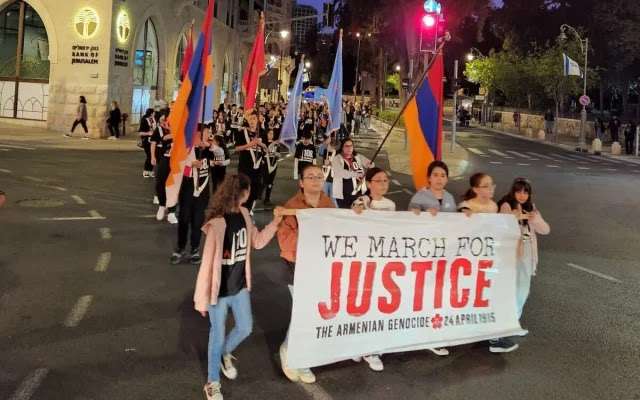
Sa’ar has said the resolution will now go to the Knesset plenum for ratification, though no date has been set. If it passes — as it almost certainly will — Israel joins some three dozen states that have made recognition official policy; its own foreign ministry counted 32 countries that had done so before it.
Let me say plainly what I believe: this is right, it is overdue, and I am glad it has happened. But recognition is the easy part. The harder questions — why now, at what cost, and to what end — are where an honest reader has to sit uncomfortably for a while.
Why now, and why not before?
The uncomfortable truth is that timing is everything here, and the timing is not innocent. Israel spent decades avoiding the word “genocide” for the Armenians not because the evidence was thin, but because Turkey was watching. For years Ankara was one of the few Muslim-majority capitals that treated Israel as a partner, and successive Israeli governments concluded that historical truth was a price worth paying for that relationship. Later, Azerbaijan entered the calculation, and the ledger only grew heavier.
That constraint has now collapsed. Relations with Turkey did not merely cool after October 7 — they cratered. Recep Tayyip Erdoğan has embraced Hamas as a “liberation movement,” compared Israel to Nazi Germany, halted all trade, and pushed to join South Africa’s genocide case against Israel at the International Court of Justice. When the state that spent years pressuring you into silence starts accusing you of genocide, the diplomatic cost of naming its own historical crime drops to almost nothing.
So yes, the skeptics have a point. These people, the skeptics, say that Israel found its moral clarity precisely when it became cheap. But I think it is lazy to stop there. Israeli politicians, historians and public intellectuals — from genocide scholars like Israel Charny and Yair Auron to lawmakers across the spectrum — argued for recognition for decades, long before it was convenient. The Knesset Education Committee acknowledged the genocide back in 2016. Netanyahu himself used the word personally in 2025. What changed in June was not the argument but the arithmetic: Turkey’s hostility finally removed the veto that had always sat over the debate. Reduced leverage created the opening; it did not manufacture the case.
There is also a subtler motive worth naming. Turkey has spent two years hurling the word “genocide” at Israel as a rhetorical weapon. Sa’ar was careful to frame the Armenian decision as recognition of documented history rather than an act of revenge — and I read that framing as a deliberate insistence that “genocide” is a category bound to evidence and memory, not a slogan to be deployed against the Jewish state at will. For a country that carries the Holocaust in its founding DNA, refusing to let the word be cheapened is itself a moral stake.
The case was always robust
None of this should obscure how solid the underlying history is. The United States Holocaust Memorial Museum describes the Armenian Genocide as the physical destruction of the Ottoman Empire’s Armenian Christian population, with estimates ranging from at least 664,000 to as many as 1.2 million dead through massacre, death march, starvation and exposure. It is frequently called the first genocide of the twentieth century, and the scholarly consensus among genocide historians is not seriously in dispute.
For a Jewish reader, there is a detail that ought to land hard. Raphael Lemkin — the Polish-Jewish jurist who coined the very word genocide — was shaped by the destruction of the Armenians as much as by the persecution of Jews and, later, the Holocaust. The Armenian catastrophe is not external to Jewish moral history. It sits inside the intellectual genealogy of the word we use to name our own. Recognizing it is, in that sense, a homecoming rather than a favor.
I will add a personal note. As someone of Greek and Cypriot background who writes about the Eastern Mediterranean, the unravelling of the late Ottoman world is not an abstraction to me. The Armenian catastrophe belongs to a wider Anatolian trauma whose echoes still shape Greece, Cyprus and the region’s politics today. Naming it honestly is something the whole Eastern Mediterranean has an interest in.
The triangle Israel will not escape
Here is where enthusiasm has to meet reality. Recognition changes the moral record. It does not change the map — and the map runs through Baku.
Israel’s relationship with Azerbaijan is the strongest of the three sides of the Armenia–Israel–Azerbaijan triangle, and it is not sentimental. Azerbaijani crude accounted for well over 40 percent of Israel’s oil imports in 2025. SIPRI data show Israel supplying the overwhelming majority of Azerbaijan’s major arms imports in recent years. Add intelligence cooperation and a shared strategic concern regarding Iran, and you have a partnership built on interests that recognition does nothing to soften.
That is precisely why so many Armenians will greet this moment with a raised eyebrow rather than gratitude. For them, the grievance against Israel is not really about the Ottomans; it is about the present. They watched Israeli weapons help Azerbaijan retake Nagorno-Karabakh, and they watched more than 100,000 people flee the enclave in 2023 in what Armenia’s prime minister called ethnic cleansing. If Israel continues arming Baku while lighting a candle for 1915, many Armenians will conclude that the recognition was morally welcome and materially hollow — a gesture timed for the moment Turkey had already become an enemy.
I don’t think that skepticism can simply be waved away. It is the honest cost of a recognition that arrives without any change in strategic alignment. Israel is not going to trade Azerbaijan for Armenia; the interests are too deep. So we should be clear-eyed: this is recognition without reconciliation, at least for now.
Armenian anger, and its limits
There is one line I want to draw firmly, because it will be tempting for some to cross it. Armenian anger at Israel can be politically intelligible — but it is not a license for antisemitism, and the two must not be confused in either direction.
The evidence does not support the ugly generalization that “Armenia is antisemitic.” The head of Armenia’s small Jewish community has said everyday antisemitism is not a feature of Armenian life, and Armenian officials have publicly said it has no place in the country. At the same time, it would be dishonest to pretend nothing has happened. Yerevan’s only synagogue was vandalized and then subjected to attempted arson in late 2023, and survey data show unusually high reluctance in Armenia to accept Jews as neighbors or citizens (Pew found 32 percent would not accept Jews as fellow citizens, and the ADL index scored Armenia at 58 percent), while antisemitic incidents and online discourse rose during the fighting with Azerbaijan and the use of Israeli-made weapons.
The honest reading is that this is anger born of war and trauma, not theology — and that most of it targets Israeli arms policy, which is a legitimate thing to criticize. But when criticism collapses “Israel,” “Zionists” and “Jews” into a single conspiratorial target, it stops being political and becomes antisemitism, and no amount of Armenian grief excuses it. We can hold both truths at once: the grievance is real, and the bigotry is unacceptable.
Overdue, legible, unfinished
So where does that leave us? With something less satisfying than a triumph and more meaningful than a stunt.
Recognition is morally overdue, because historical truth matters — and it matters most from the state that made “never again” its watchword. It is geopolitically legible, because Israel no longer owes Ankara its silence and is now willing to absorb Turkish fury. And it is diplomatically unfinished, because a resolution does not repair the wound of Israel’s alignment with Azerbaijan, nor does it dissolve the anti-Zionist and sometimes antisemitic currents in parts of Armenian discourse.
Survey data shows unusually high reluctance in Armenia to accept Jews as neighbours or fellow citizens. Pew found that 32 percent would not accept Jews as fellow citizens, while the ADL Global 100 Index scored Armenia at 58 percent. Meanwhile, antisemitic incidents and online discourse rose during the fighting.
Prime Minister Pashinyan’s cool response — his refusal to “weaponize” the issue — tells us that Yerevan understands this perfectly. Armenia does not want to become a prop in an Israel–Turkey quarrel, and it knows that recognition alone will not redeem the relationship.
The right posture, then, is neither self-congratulation nor apology. Israel has finally said something true and important, and it deserves credit for it. But the test of whether this was conscience or convenience will come later — in whether Israel is willing to let this opening lead somewhere with Armenia, or whether it remains a single honest sentence spoken into a region that measures sincerity in arms shipments. Naming the genocide was the easy part. Meaning it will be harder.