
Israel’s enemies say it is anti-Christian. Jewish extremists are helping them make the case
Ongoing attacks on civilians are creating a national security problem for Israel and a propaganda tool for those who want to destroy the Jewish state
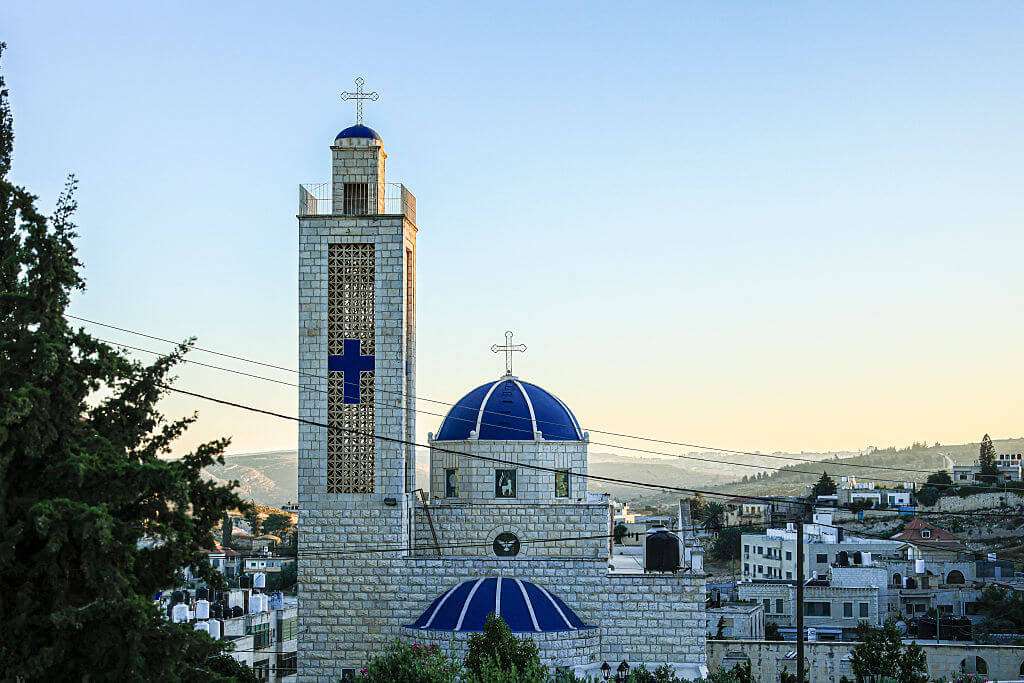
A church in the predominately Palestinian Christian village of Taybeh. Photo by Mohammad Nazal / Middle East Images / AFP via Getty Images
Dan PerryForward
One of the more damaging charges against Israel now circulating in the United States portrays the Jewish state as increasingly hostile to Christianity and Christians. The accusation has acquired considerable prominence in American media, where stories about attacks on clergy, harassment of worshippers, restrictions around Christian holy sites and violence against Christian communities have accumulated into a broader portrait of a country becoming inhospitable to one of the faiths born in the Holy Land.
The Washington Post recently devoted a major article to attacks on Christians in Israel and the government’s lackluster response, while other reporting has focused on Jews spitting at Christian clergy and pilgrims in Jerusalem, vandalism of Christian property and the April assault on a Roman Catholic nun near the Old City.
The nun’s case was particularly appalling: according to the subsequent indictment, a Jewish Israeli man chased the 48-year-old French Catholic sister, pushed her to the ground and kicked her after identifying her as a Christian nun. Israeli police arrested the suspect and prosecutors charged him with an assault motivated by religious hostility.
The Armenian Christians of Jerusalem have become another symbol of the phenomenon. Their community predates almost every modern political dispute over the city, with a continuous presence stretching back some 1,700 years. Yet Armenian clergy and residents have described repeated episodes of spitting, intimidation and abuse.
Israeli media in recent weeks described Israeli teenagers arriving at the headquarters of the Armenian Apostolic Church in the Old City and asking whether Christians were inside because they wanted to spit at them.
Scenes like these travel instantly around the world and provide ready-made material for anyone seeking to portray Israel as a place where Christians are despised. In fact, Israel’s Jewish extremists have no particular beef with Christians – but rather a conflict with, and often a hatred for, Arabs in general, of any religion.
Overall, the incidents are not representative of Christian life inside Israel. About 200,000 Christian citizens lived in the country at the end of 2025, most of them Arab Christians, and the community has continued to grow. Arab Christians have exceptionally high educational attainment and are disproportionately represented in Israeli higher education. Christians serve as judges, diplomats, doctors, academics and public officials, and their churches and institutions form a recognized part of Israeli public life. Moreover, the assault on the Catholic nun produced an arrest and indictment rather than tacit approval, and Israeli authorities regularly proclaim their commitment to Christian worship and the protection of Christian holy places.
Yet a radical Jewish fringe appears determined to furnish Israel’s enemies with the pictures, anecdotes and headlines required to transform an inflammatory accusation into a plausible story. The latest damaging example comes from Taybeh, the last predominantly Christian Palestinian village in the West Bank (and home to its only beer brewery).
Taybeh has endured months of tension and violence. In June, Israeli settlers obstructed Palestinians attempting to extinguish a large fire near the village, according to Palestinian firefighters and a local priest. Residents have complained of arson, vandalism, incursions onto private property and intimidation.
“The settlers can do whatever enters their heads,” said the Rev. Jack Abed of Taybeh’s Greek Orthodox community. “And every now and then we have rioting from settler youth who come into the village. They bring sheep with them to graze in our fields.”
This week the Israeli military responded by closing the village to Israelis, saying the measure followed violent attacks by Israelis in the area and was intended to protect local residents and maintain order.
The order illustrates two realities at once. The Israeli army is using military power to protect a Palestinian Christian community from Israeli Jewish extremists. This tells a very different story from the sweeping claim that the Israeli state has embarked upon a campaign against Christians. At the same time, the necessity of such a measure shows the extent of the problem Israel has permitted to develop.
Indeed, Israel Radio this week reported that there have been 660 cases of “nationalistic crime” by Jews in the West Bank in the first six months of 2026 – a 50 percent increase over the same period last year. The report, citing military sources, said six Palestinians were killed and 140 injured in these attacks. There are rarely long-term arrests and no settlers have been convicted in the deaths.
I recently wrote in these pages about Jewish terrorists in the West Bank after extremists torched two mosques, burned cars and fields and attacked Palestinian motorists. One mosque in Qusra was burned and covered with revenge graffiti; another in Kur was set ablaze.
The violence belongs to a larger pattern of attacks on civilians, destruction of property and vigilante incursions into Palestinian communities. I described this as both a moral failure and a national-security disaster because every such episode creates another security problem for the Israeli soldiers and police who must contain the consequences, while simultaneously providing Hamas, Iran and Israel’s other enemies with propaganda more effective than much of what they could manufacture themselves.
The Christian dimension makes the strategic stupidity even more breathtaking. Israel depends upon deep reservoirs of sympathy among Christians around the world, especially in the United States, where tens of millions of evangelical Christians have provided some of the most consistent political support for the Jewish state. Christian attachment to Israel also extends far beyond evangelical politics to people who regard the survival of ancient Christian communities and access to the holy places of Jerusalem, Bethlehem and the Galilee as matters of profound spiritual importance.
Every video of an extremist spitting at a priest, every report of an Armenian Christian being harassed and every attack on a Christian Palestinian village chips away at that reservoir of goodwill. These extremists are weakening Israel’s security, staining Judaism and turning potential friends of Israel into skeptics and existing skeptics into enemies.
The military’s action in Taybeh is therefore welcome, and it is also woefully insufficient. Israel’s Oct. 27 election offers the possibility of a different approach. Should Netanyahu be defenestrated and a new government take office, a comprehensive crackdown on Jewish terrorism in the West Bank should rank among its first priorities. The task requires arrests, prosecutions and enforcement rather than declarations of concern after each fresh outrage.