
“Do Mice Drink Wine” by Jerry Tutunjian
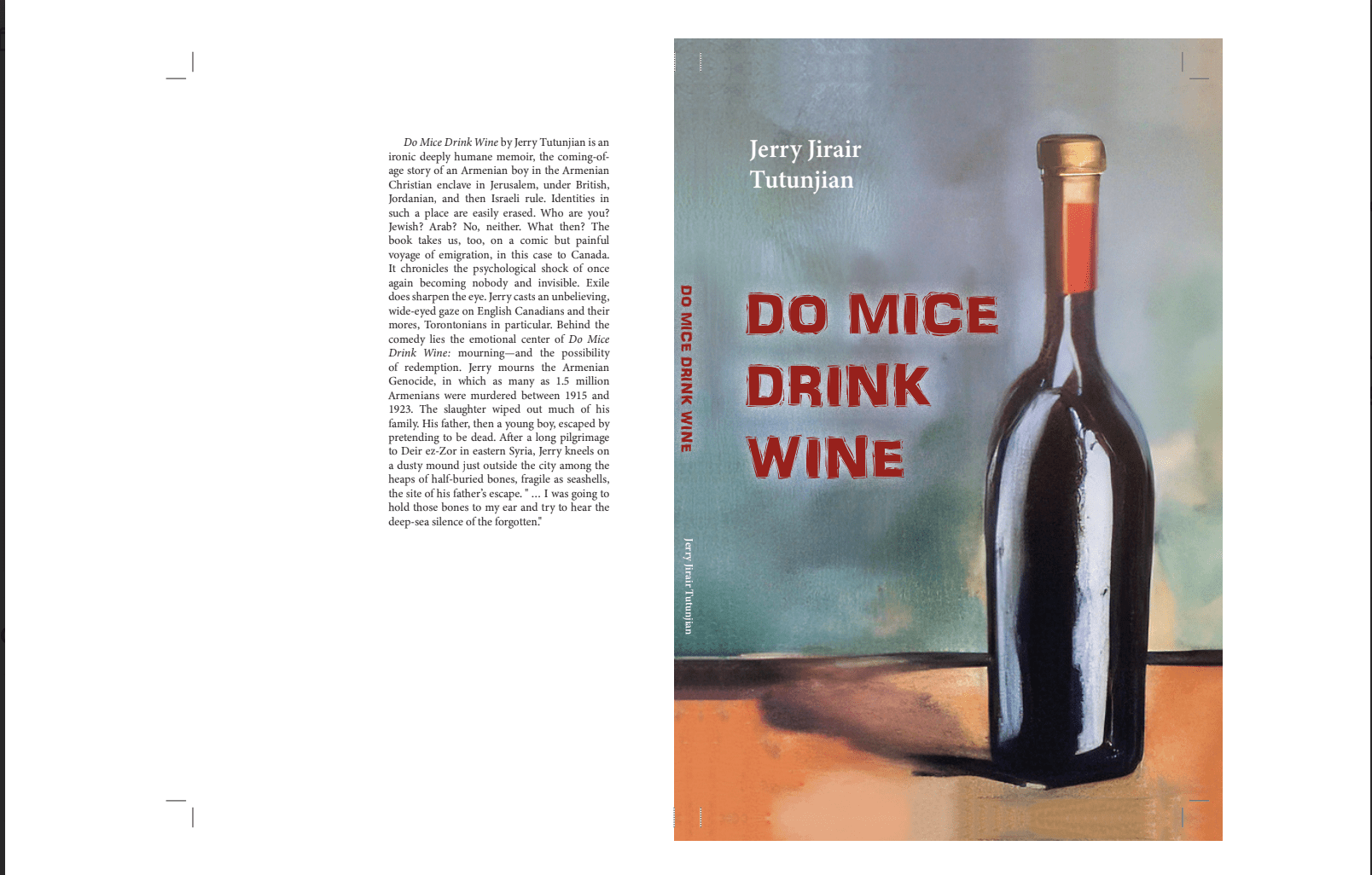
“Do Mice Drink Wine” by Jerry Tutunjian is an
ironic deeply humane memoir, the coming of age story of an Armenian boy in the Armenian
Christian enclave in Jerusalem, under British,
Jordanian, and then Israeli rule. Identities in
such a place are easily erased. Who are you?
Jewish? Arab? No, neither. What then? The
book takes us, too, on a comic but painful
voyage of emigration, in this case to Canada.
It chronicles the psychological shock of once
again becoming nobody and invisible. Exile
does sharpen the eye. Jerry casts an unbelieving, wide-eyed gaze on English Canadians and their mores, Torontonians in particular. Behind the comedy lies the emotional center of “Do Mice
Drink Wine: mourning—and the possibility
of redemption.” Jerry mourns the Armenian
Genocide, in which as many as 1.5 million
Armenians were murdered between 1915 and
1923. The slaughter wiped out much of his
family. His father, then a young boy, escaped by pretending to be dead. After a long pilgrimage
to Deir ez-Zor in eastern Syria, Jerry kneels on
a dusty mound just outside the city among the
heaps of half-buried bones, fragile as seashells, the site of his father’s escape. ” … I was going to hold those bones to my ear and try to hear the deep-sea silence of the forgotten.”
Canadian Armenian author-editor Jirair Tutunjian’s sixth book (“Do Mice Drink Wine”) is an autobiography told through forty-eight short stories. The book is divided into three parts. The first is about growing up in Jerusalem’s Armenian community. Thus, by talking about his life in the Holy City, Tutunjian talks about the historic Armenian community which punched above its weight. As is well known, the Armenian Quarter covers one-sixth of the Old City’s area. Most Armenians lived in the Quarter which was a city within the city. Quarter included four churches, a printing press, three social-sport club, three Boy Scout teams, a co-ed high school, a massive library, two playing fields, and the second-largest collection of Armenian manuscripts. Tutunjian grew up in this miniature Armenia. Tutunjian’s dream of becoming a journalist was born in this effusive community. The book includes chapters about the author’s several failed attempts to emigrate. In retrospect, these come across as humorous.The second part of the book is about the challenges of making a home in a vast, strange, and cold country. Tutunjian narrates his adventures and misadventures in his new home with a light touch, avoiding the cliches of the “stranger in the strange land.” Most of the stories in the section are about building a career—in this case as journalist. He eventually became the youngest—at age 24—the youngest Canadian journalist to edit a major magazine. The record stands. Just before “retiring,” the magazine he edited was nominated by Canadian magazine editors as one of the ten “all-time most influential” magazines. Soon after he retired, he became the English language editor of “Keghart” and as such wrote most of the editorials.Part three of the book is about Tutunjian’s visit to Deir el Zorr where in Markadeh he picked up Armenian bones. Some of the bones are on display at the St.Mary’s Armenian Church in Toronto.The book can be purchased from Amazon.