My Armenian family fled terror, death. Haitians shouldn’t be sent into similar storm.
I am here because my grandparents were welcomed. I am here because they could stay.
The Columbus Dispatch
- A retired pastor draws parallels between the potential deportation of Haitian immigrants and her own family’s history.
- The author’s grandmother immigrated to the U.S. from Armenia as a child, escaping what would become a genocide.
Karen Chakoian is a retired pastor who has served churches in Granville and Des Moines, Iowa.
I thought of my own family and their immigration story — the stories I heard from my grandmother when I was a child — when I heard what might be in store for our Haitian neighbors.
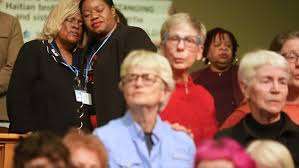
I joined over 1,000 people at St. John Missionary Baptist Church in Springfield on Feb. 2 in a show of solidarity with a community facing the very real possibility of mass deportations.
One of the speakers, Viles Dorsainvil, described the devastation facing families if these refugees are forced back to Haiti with the ending of the temporary protective status that brought them here legally.
The potential violence, hunger and lack of medical care and basic services would be deadly. In preparation for this horrific possibility, parents are creating emergency plans for care for their children if they are swept up in ICE raids.
All of this brought memories bubbling up, and tears with the memories.
My grandma’s stories
Esther Kirishian came to the United States when she was just 7 years old. She left Armenia with her mother, Margaret, and brother Benjamin, just a baby.
Born in Sivas, Armenia, to the Minassian family, her grandparents were leaders in their community, one of two prominent families. Her grandmother led a school, and their store, the Tas Han, provided beautiful products to their city.
As Grandma described it, they lived on a family enclave on a city block in the center of town, including a pool and storehouse.
Influential leaders, the Minassians built the first Protestant church in the city, welcoming the Presbyterian missionaries who came to the community (Armenians were among the first to embrace Christianity in ancient days).
My grandmother’s parents married because her two grandmothers, close friends, arranged the marriage when they were children.
Her father and older brothers came to the United States after conflicts began to arise in Armenia, to seek their fortunes at a time when immigrants were more welcome.
Soon after, Esther and her mother followed.
I remember Grandma describing what it was like as a little girl to land on Ellis Island and be processed. She told of the coin that was pressed into her hand as welcome. She was welcome.
What if she hadn’t been?
The horror my family escaped and couldn’t
Life had become very grim for those who remained in Armenia. For centuries, Christian Armenians and Muslim Turks had lived side by side as neighbors and friends, sharing life together, each with their own language, religion and traditions. Until the tides turned — and the genocide began.
The stories I heard as a child were horrifying.
My grandmother’s grandmother dying enroute as they were forced from their home and sent to march out of their country. Her cousin being abducted to be taken as a slave. Her uncle Vahan, who stayed behind in Sivas to protect their home, their business, their belongings, was arrested, and executed with other leaders from Sivas.
These are the stories I heard as a child.
My grandmother’s love and gratitude for this country.
And the terrifying stories of those who endured brutality in their home country.
What if the Armenians here had been forced to return “home”? Back to a “home” that no longer existed?
What if her parents had been sent back, and she and her brothers were left here alone?
Do you know what Armenian immigrants did to protect their lives, and their kin? In 1909, they petitioned the federal court in Massachusetts to declare that Armenians were legally White so that they could become U.S. citizens, with the right to vote, own property and be fully protected by U.S. law. The petition was granted.
Can you imagine?
I am here because my grandparents were welcomed.
I am here because they could stay.