
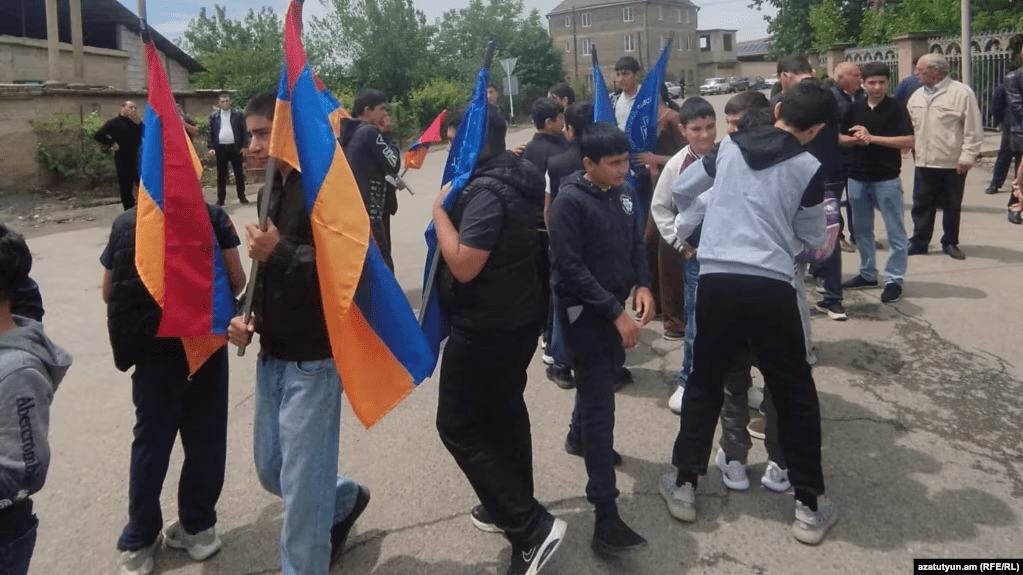
RFE/RL correspondents and other local journalists routinely witnessed their presence at such rallies held in small towns and villages in the run-up to the June 7 parliamentary elections. A community in the central Aragatsotn province was a case in point. Classes in several local schools were cut short when Pashinian visited the area on May 13.
Akanates (Eyewitness), an independent election-monitoring group, said that their students and teachers were illegally forced by school principals and local government officials to go to his rallies. Responding to a resulting uproar, Pashinian said the next day he told four principals to tender their resignations and wait for the findings of an “internal inquiry.”
The practice continued unabated, however. Pashinian denied afterwards forcing school administrations to bring their staffs and students to his rallies held in rural areas.
The rallies were also marked by the presence of large numbers of local government officials. Armenian law bans them from attending such events during work hours.
“We couldn’t fail to come here to greet our prime minister,” a female schoolteacher told RFE/RL’s Armenian Service later in May. “That’s why we cut short classes.”
Many schoolchildren likewise admitted being taken to Pashinian’s rallies. They included a group of teenage students in Chambarak, a small town in the eastern Gegharkunik province, who played national instruments to greet the premier under the watchful eye of their principal.
In written comments to RFE/RL’s Armenian Service, Deputy Education Minister Araksya Svajian said on Wednesday that the Aragatsotn school heads involved in Pashinian’s May 13 rally have only been “strictly reprimanded” for breaking the law. Svajian did not say why their resignation letters were ignored by her ministry.
One of the principals, Sasun Ashughian, said that he stepped down “a few days ago.” He insisted that he did so “of my own will” and was not pressured by the government.
Two other local school chiefs revealed, meanwhile, that they were questioned by Armenia’s Anti-Corruption Committee (ACC) earlier this month. They refused to give details of the interrogations. The ACC did not comment either. Armenian law makes it a crime to pay or force citizens to participate in political gatherings.
Pashinian’s Civil Contract party was accused by opposition groups and media of abusing its administrative resources even before the official start of campaigning for the disputed elections. One of the opposition leaders, Arman Tatoyan, publicized in May purported audios of a college lecturer affiliated with the ruling party ordering her students to attend a Pashinian rally in the town of Armavir. She was not indicted or fired as a result.
Nor have any other Civil Contract members or supporters been prosecuted on election-related charges. Law-enforcement authorities have arrested instead hundreds of opposition activists and supporters on charges of buying votes or paying people to attend opposition rallies.